UK's swarming drone rollout stymied by ‘competing resource priorities'


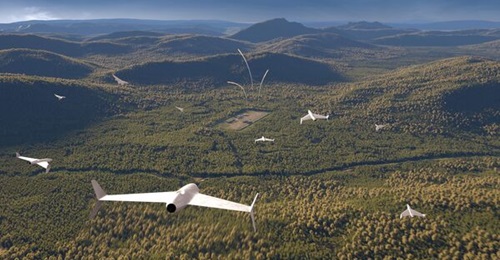
An artist's conceptualisation of a swarming drone capability being developed by 216 Squadron. However, since being formed in 2020, the unit, which is tasked with testing future drone swarm technology, has completed no tests or trials either in-house or with industry, the government has disclosed. (Leonardo)
The United Kingdom's effort to develop and field an unmanned ‘swarming drone' capability is being stymied by “competing resource priorities”, the government disclosed on 4 March.
Answering questions in the House of Commons, Minister of State for Defence Procurement at the Ministry of Defence (MoD) James Cartlidge said the Royal Air Force's (RAF's) 216 Squadron had performed no ‘swarming drone' tests or trials as resources had been diverted elsewhere.
“Since the formation of 216 Squadron in 2020, there have been no completed tests or trials conducted either in-house or with industry. 216 Squadron personnel have participated in several technical demonstrations as military advisers and subject-matter experts in partnership with the Defence Science and Technology Laboratory (Dstl),” the minister said. “A trial was planned for June 2023 using the Callen-Lenz Koios air vehicle and the Blue Bear Systems Research Centurion ground control station, but this activity was cancelled due to competing resource priorities.”
Cartlidge added that no unmanned aerial vehicles (UAVs) have been recommended by 216 Sqn for acquisition into service.
Go beyond the headlines - with direct links to interconnected entities
Get full access to validated equipment, military capabilities, and market insights.