India's MKU develops Anti-Drone Net
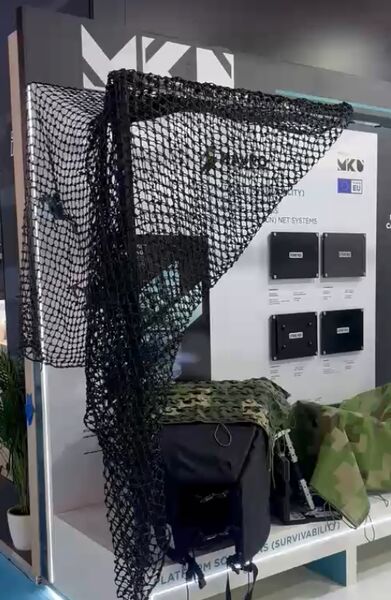

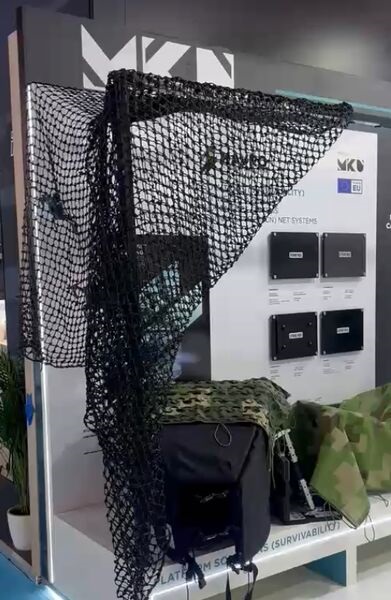
MKU's Anti-Drone Net is intended to neutralise aerial threats by entangling the propellers, airframe, and control surfaces of UAVs. (MKU Limited)
Indian defence firm MKU has developed Anti-Drone Net, a system designed to neutralise aerial threats through physical entanglement.
Anti-Drone Net is intended to intercept an unmanned aerial vehicle (UAV) by entangling its propellers, airframe, and control surfaces. Once captured, the drone loses lift and manoeuvrability, causing it to descend or become immobilised.
According to Karan Gupta, vice-president of international sales at MKU, Anti-Drone Net is primarily intended to counter commercial off-the-shelf (COTS) quadcopters and multirotor UAVs; FPV (first-person-view) attack UAVs; small and medium tactical UAVs; and intelligence, surveillance, and reconnaissance (ISR) UAVs.
He told Janes on 20 July that the system can also be employed against certain loitering munitions, depending on target characteristics and engagement conditions. The net is available in multiple mesh configurations intended for different categories of UAVs.
Gupta said recent conflicts, including the war in Ukraine, have underscored the growing impact of low-cost UAVs and FPV attack systems. He added that these developments influenced the design philosophy behind Anti-Drone Net, with emphasis on affordability, rapid deployment, and ease of use.
The system is intended to provide a non-kinetic means of countering UAV threats, including autonomous and electronically hardened platforms, while reducing the risk of collateral damage and supporting the protection of military positions and critical infrastructure
Capability
According to Gupta, Anti-Drone Net is intended to counter UAV threats at both high and low altitudes and is available in 25×25 mm and 40×40 mm mesh configurations.
Go beyond the headlines - with direct links to interconnected entities
Get full access to validated equipment, military capabilities, and market insights.