New UAVs operated by the M23 indicate improving capability and likely increased threat to DRC stability
Event
On 28 September, videos posted on X showed a large quadcopter unmanned aerial vehicle (UAV), with a caption claiming it had been shot down by a pro-DRC government Wazalendo (Swahili: Patriots) militia near Minembwe, Sud-Kivu province, and that it belonged to the Rwandan Defence Force (RDF), which supports the M23.
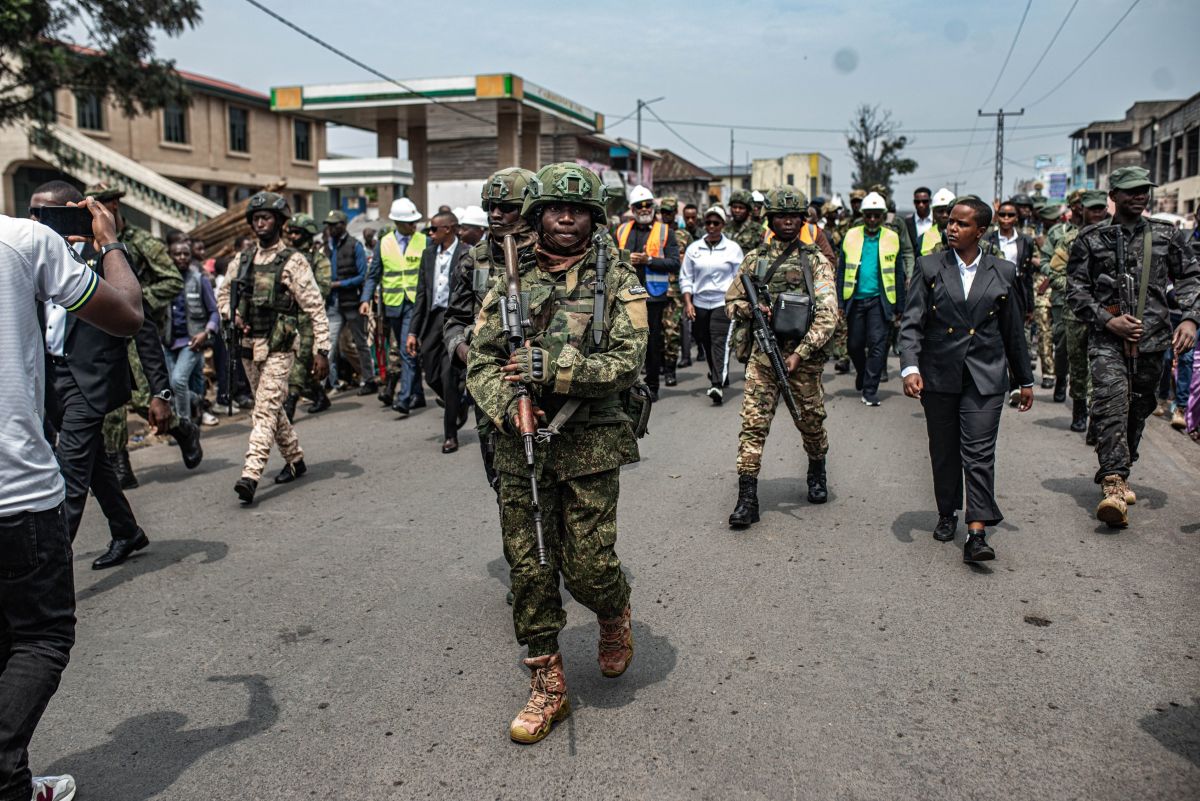 Soldiers walk down the street as M23 North Kivu provincial leadership marked one year of M23's control of Goma with a review of ongoing construction work and a visit to the Stade de l'Unite on 6 February 2026 in Goma, Democratic Republic of the Congo. Image credit: Daniel Buuma/Getty Images
The UAV shown in the video has a rotor arm span of roughly 2.5 m equipped with a mounting plate underneath the UAV’s central hub. The plate features three holders and electrically actuated mechanism for holding and dropping munitions.
An X account with the username @michombero, under the display name Daniel Michombero /Batubenga, published the video. Michombero is a freelance journalist based in Goma who has published reliable information in the past. The context around the video is probably true, as it aligns with previous information and there is no evidence it has been altered.
The video followed images and video posted over August and September showing two other UAV types that had not previously been identified in use by the M23. Images of a delta wing UAV were published by Umuseke, a Rwanda-based news website, on 21 August, which the outlet claimed had been downed by the Armed Forces of the Democratic Republic of the Congo (Forces armées de la république démocratique du Congo: FARDC) near Minwmbwe, Sud-Kivu province, on 20 August. Based on the video, this UAV has an approximate wingspan of 2 m and approximate length of 2.5 m from nose to tail. Its profile resembled a scaled down Shahed-136 and was powered by a jet turbine. The nose was missing from the delta wing UAV, which means there is no evidence of its payload, but it would likely have contained an explosive warhead, as the UAV’s small size and archetype indicate it is likely a loitering munition.
Images of another UAV type were published by DRC-based news outlet TazamaRDC to its X account @TazamaRDC on 3 September, which claimed in an accompanying post that a Wazalendo militia had shot down a UAV used by the M23 near Masisi, Nord-Kivu province, on 29 August. The images showed a large hexacopter type UAV, with a rotor arm span of roughly 2.5 m, with three points for holding and dropping mortar bombs, from which two 60 mm mortar bombs were protruding.
Both Umuseke and TazamaRDC have published reliable information in the past, whilst the context provided with the images and videos is probably true, and there is no evidence any of the content has been altered.
Janes was not able to positively identify any of the three UAVs revealed over August and September. The delta wing, large quadcopter, and large hexacopter archetypes are commercially available to the non-military customers. The variety of commercial-off-the-shelf UAVs that have similar features means that it is often not possible to positively identify them.
Significance
The quadcopter UAV seen on 28 September is the fourth new UAV type observed by Janes in the M23's use since January 2026, indicating the threat posed by the group to the stability of the DRC has increased. New information revealing the use of new equipment or the acquisition of new capabilities by the M23 is an important observable indicator of whether the threat the M23 poses to the DRC government has increased. Janes has monitored the M23’s introduction of other UAVs to its attacks in 2026, with the group first using the Baykar Sivresinek loitering munition in January.
For more see: DRC armed forces’ downing of M23’s YIHA-III loitering munition indicates their future use is very likely
The reveal of new UAV types has aligned with an increase in the number of attacks by M23 using UAVs over 2026; Janes recorded 13 attacks using UAVs over July–September, which accounted for 50% of the total attacks using UAVs since January. This amounted to attacks by UAVs constituting 10% of all M23 attacks between July and September, compared with 5% over first half of the year. This alignment with the proliferation of different types of UAVs likely reflects the number of UAVs available for the M23 to use is increasing and a greater variety of tactical and operational scenarios in which the group can employ them.
The proliferation of UAVs in different areas of operation, such as the Minembwe, Masisi, and Pinga areas, suggests that their use is widespread among different units of the M23. This is supported by geospatial analysis of attacks that occurred over 2026, which shows that the M23 employed UAVs across all areas in which it has fought with pro-DRC government forces.
The M23 poses a high threat to the stability of the DRC, as the group has repeatedly demonstrated the ability to defeat the FARDC in ground combat because of the group’s high level of capability. This high capability is mitigated by divisions among leadership figures over the M23’s intent which have existed since the group’s resurgence in 2022, whilst its capability has increased greatly over the same timeframe.
Outlook
In the short term (one to six months), the threat posed by the M23 to the stability of the DRC is likely to continue to increase, primarily driven by the increased use of new equipment like the UAVs over August and September 2026.
The increase of the threat from the M23 is likely to continue a long-term trend observed since 2022, in which the group has introduced new sophisticated capabilities with increasing frequency. According to United Nations Group of Experts on the DRC publications in 2023–26, the M23 has acquired GPS jamming, self-propelled surface-to-air missiles, and GPS-guided munitions.
Risk positive indicator
- A significant reduction in the amount of territory controlled by the M23 either through deliberate withdrawal or through territorial loss. This would indicate either reduced capability or reinforce the group’s change in intent towards pursuing local grievances instead of national ones.
- Statements of intent focused on pursuing local grievances instead of national ones. This would indicate the M23's intent has solidified towards local aims, meaning a reduced threat.
- Security forces capture or killing of key M23 personnel. This would indicate a reduction in the group's command and control capability.
Risk negative indicator
- A significant increase in the M23’s territorial control would indicate either increased capability or signal a change in intent towards national grievances.
- New equipment and capabilities. This would indicate an increased combat capability for the M23.
- Statements of intent focused on pursuing national grievances instead of local ones. This would indicate the M23's intent has solidified towards national aims.
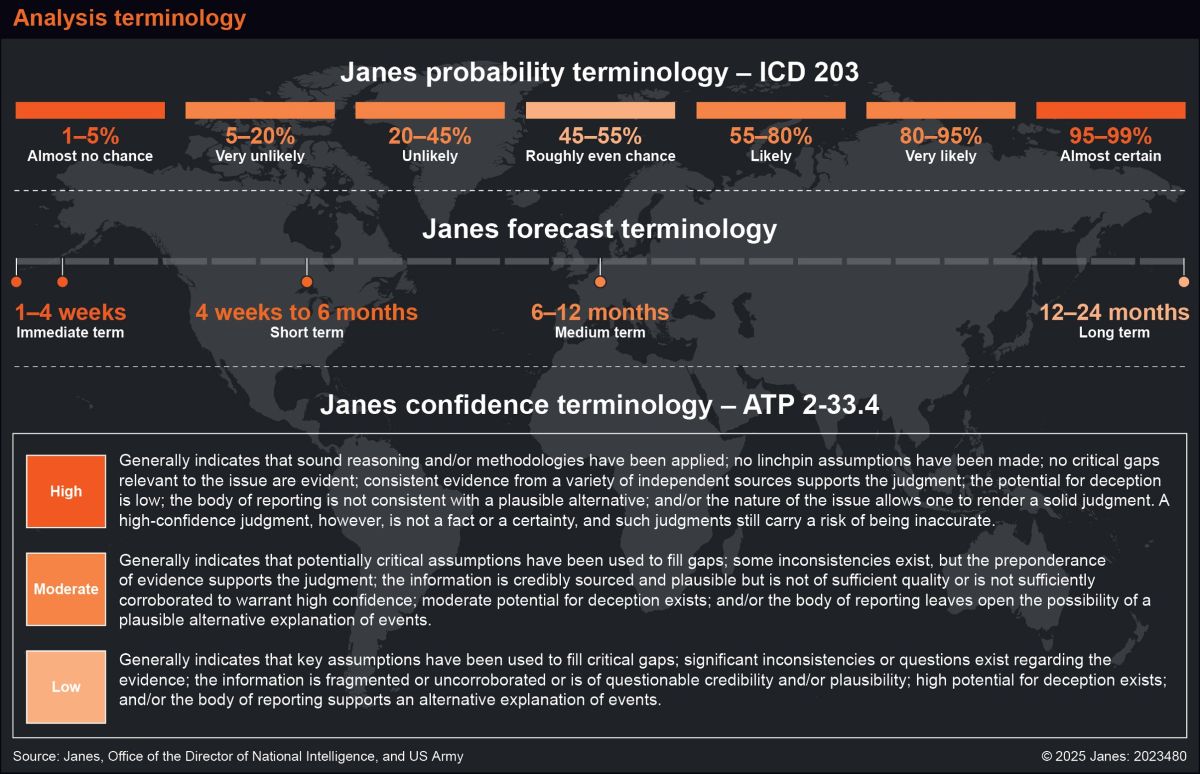 Analysis terminology. Image credit: Janes