US-Russia diesel agreement calculated to increase pressure on Ukraine, but meaningful supply unlikely given refinery production constraints
Event
On 9 October 2026 the Russian President Vladimir Putin and United States President Donald Trump held a phone call, after which the Kremlin published Putin’s statement that the country is ready “to supply oil and petroleum products to the American and global markets”. On same day Trump stated Russia will “immediately supply 300,000 tons of diesel to American and global markets, another 500,000 tons in November, and 1,000,000 tons thereafter”.
The US Treasury issued General License 135, authorising Russian diesel transactions including imports into the US up to 7 April 2027.
On 10 October Trump announced that “there is an energy ceasefire in the War between Russia and Ukraine.”
Significance
Political aspects
Janes assesses that Russia very likely intends to increase political pressure on Zelensky’s government, by keeping the agreement strictly bilateral between Moscow and Washington, excluding other stakeholders. This was emphasised on the same day, 9 October, when US Envoys Steve Witkoff and Jared Kushner held talks in Miami, with officials from Ukraine, France, Germany, United Kingdom, European Commission, and NATO. Janes assesses that this Russian and US bilateral deal very likely destabilises and weakens Zelensky government’s political standing with the US administration and reduces Ukraine’s confidence in Washington's impartial mediation, in the short term (one to six months). Janes assesses the deal likely widens fractures between the US and European partners in their support for Ukraine.
German Chancellor Friedrich Merz on 12 October commented that the US-Russia diesel export agreement is “out of the question” for Germany and Europe.
Following the US-Russia diesel announcement, Ukrainian President Volodymyr Zelensky on 9 October stated that “easing of sanctions ... without a clear and lasting de-escalation agreement is obvious weakness”. Between 9-11 October Zelensky intensified diplomatic efforts and spoke with European Commission President and NATO Secretary General as well as with heads of state of UK, Norway, France, Finland, Poland, and Canada.
Russia presented the diesel agreement as part of the Kremlin’s broader ability to be a responsible international actor, with Putin stating he is “confident this will have a positive impact on the global economy”.
Trump on 10 October stated: “I think it’s time for Ukraine to get a new president”. Russian Senator Aleksey Kondratyev on 11 October commented on Zelensky and the diesel agreement on Russian national television – saying that “Zelensky ... will be forced either to leave his post or call elections”.
Janes assesses that during the Trump-Putin call on 9 October, the Russian president refused to agree to an energy ceasefire, as implied subsequently, on 10 October, by Trump. This is indicated by the Kremlin’s call notes, which stated that Putin “clearly conveyed that our (Russia’s) position on goals of the special military operation remains unchanged” and that Russia is ready for diplomacy to reach a long term peace.
Putin also hardened his stance on restarting trilateral Russia-Ukraine-US talks, revoking the Kremlin’s current readiness for the talks, claiming that Russia’s position changed due to Ukraine’s air strikes on Moscow and other Russian cities on elections day on 20 September.
Janes assesses that Russia very likely wants to present itself as an intermediary both on energy and on Iran; as indicated by the Kremlin’s 9 October call notes that “possibilities for diplomacy on Iran are far from exhausted”.
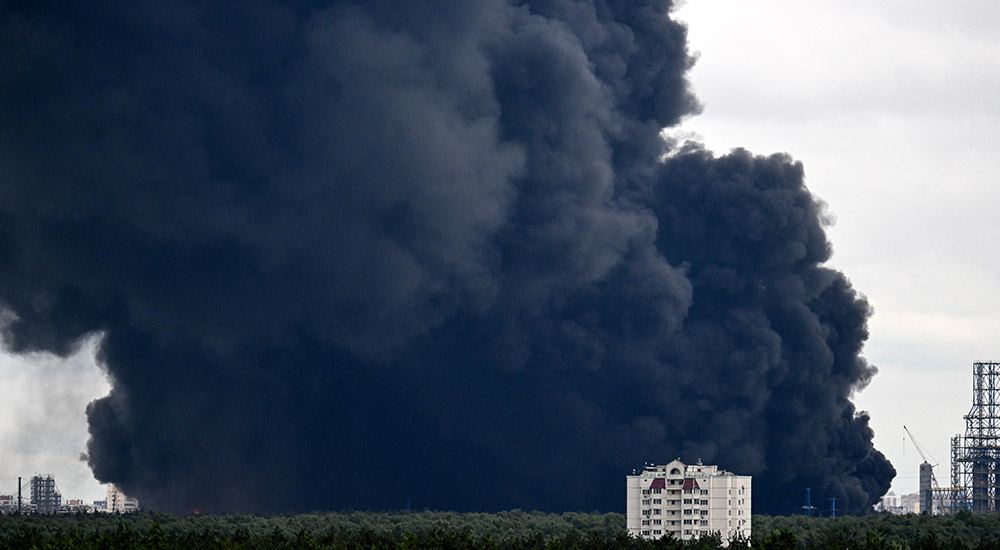 Gazprom Neft's oil refinery, south-east of Moscow, after a Ukrainian attack, 18 June 2026. Image credit: AFP via Getty Images
Economics aspects
Output capacity
An immediate constraint on Russia’s agreement to release diesel onto global markets is the reduction in Russian refinery output caused by Ukrainian attacks, together with existing demand from the domestic market and primarily Central Asian states exempted from Moscow’s wider prohibition on refined-petroleum exports.
The state-owned Russian news agency TASS reported on 10 October 2026 that the Russian government authorised the initial release of 500,000 tons of diesel to the global market. Russian deputy prime minister Aleksandr Novak clarified in the same report that the government was ready to supply 300,000 tons in October, 500,000 tonnes in November and 1 million tons in December.
Janes assesses the October objective is likely to be achievable given remaining refinery output after domestic and ringfenced demand. The November objective is plausible but would absorb almost all theoretically available discretionary output, while the December objective will almost certainly depend on the restoration of refining capacity taken offline by hostilities, inventory draw-downs or the diversion of supplies from existing customers.
The International Energy Agency (IEA) estimated in September 2026 that Russian refinery output had fallen by around 30% year on year. Russian diesel production in 2023 - before the intensification of Ukrainian strikes against refinery infrastructure - totalled 88 million tons, according to TASS. Domestic consumption accounted for 51 million tons, leaving a theoretical exportable surplus of 37 million tons.
Applying a 30% reduction to the 2023 production level implies annual diesel output of approximately 61.6 million tons. Assuming domestic consumption remained at around 51 million tonnes, this would leave a theoretical exportable surplus of approximately 10.6 million tons annually, or around 880,000 tons per month. Industry reporting indicates that approximately 350,000–370,000 tons was supplied in August 2026 to countries covered by intergovernmental agreements, leaving theoretical discretionary availability of around half a million tonnes per month.
Outlook
Political outlook
Russia will very likely attempt to use the diesel agreement to weaken Zelensky’s presidency, in the short term (one to six months). This is indicated by the agreement’s bilateral nature, the Russian domestic elite’s views that “Zelensky needs to leave”, and by Ukrainian president Zelensky’s own strengthened diplomatic engagements with European allies over 9-11 October. Janes assesses Russia will very likely refuse any energy ceasefire in the short term. This is indicated by Putin’s hardened stance, voiced on 9 October, on freezing trilateral negotiations, and by Russian Presidential spokesman Dmitry Peskov’s statement on 12 October that Russia “wants, not a ceasefire, but rather wants a long-term peace”.
Fiscal outlook
The limited release onto the global market and – in the event of more elevated releases of diesel from November onwards - the likely need to redirect output from existing customers (notably states covered by intergovernmental agreements) mean that the increase in export receipts from Russia’s perspective is likely to be limited, potentially to hundreds of millions of dollars. The associated fiscal take will likely be correspondingly modest and very unlikely to materially improve Russia’s present fiscal position.
The more significant effect is likely to be the reopening of a previously sanctioned market channel, which would provide Russia with an additional means of monetising refined-product output should production capacity recover.
A durable ‘energy ceasefire’ underpinned by the agreement between Russia and the US would be more consequential by preventing further damage and allowing repairs to proceed. The benefits would very likely accrue gradually rather than immediately and could protect or restore state revenue in the low billions of dollars over the six-month period covered by the US licence, based on prior Janes’ modelling of the fiscal impact of reduced refined petroleum output in 2026 (see: Higher crude prices likely to offset short-term Russian revenue losses from refined petroleum export pause)
Risk positive indicator
- Russian refinery throughput and diesel export availability increase, enabling larger volumes to be directed through the market channel reopened by General Licence 135.
- Global diesel supply tightens and prices or refining margins rise, increasing Russia’s potential export receipts and associated fiscal revenue.
- General Licence 135 is extended or expanded, or the energy ceasefire remains durable, allowing refinery repairs and exports to continue.
Risk negative indicator
- Russian refinery throughput and export availability remain constrained by renewed attacks, slow repairs, domestic demand or commitments to states covered by intergovernmental agreements.
- Global diesel supply increases and prices or refining margins fall, potentially reducing the export receipts and fiscal gains available to Russia.
- General Licence 135 is narrowed or revoked, or payment or logistical constraints limit Russia’s ability to use the reopened market channel.
 Analysis terminology. Image credit: Janes