Ethiopian military advances in Tigray indicate high risk of inter-state conflict with Eritrea
Event
On 6 October, a BBC Monitoring article citing a 5 October report by Ethiopian pro-government Lualawi Media outlet stated that the Ethiopian National Defense Force (ENDF) and the pro-government Tigray Peace Force (TPF) were advancing towards the town of Adigrat in Tigray region approximately 25km from the border with Eritrea.
Janes rates Lualawi Media as C3 fairly reliable and its 5 October report as possibly true due to the source’s close links to the Ethiopian military meaning it is a biased source. Given the challenging information environment in Ethiopia and Eritrea in terms of access and biases, reliable sourcing is rare or incomplete meaning assessments are also based on assumptions.
Significance
ENDF and TPF advancements north towards Eritrea suggest the ENDF is intent on further consolidating its control of northern Tigray following the capture of Mekelle from the Tigray People’s Liberation Front (TPLF) on 3 October. Capturing Adigrat would likely enable the ENDF to pursue control of the major road to Eritrea to the north, the B20 Adigrat-Zela Ambessa, and the A2 road to the west that connects Adigrat with Axum airport, which the TPLF seized on 23 September 2026, to enable future operations to secure the transport hub.
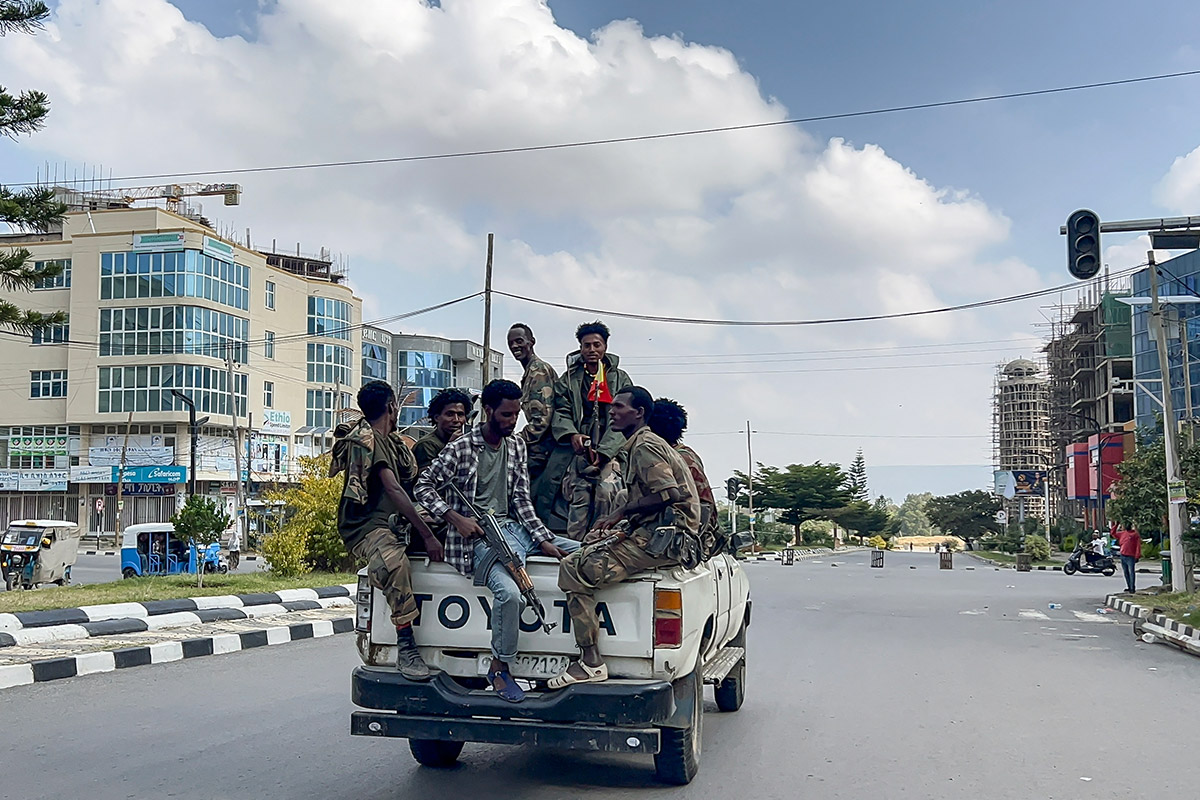 Members of the Ethiopian pro-government Tigray Peace Force (TPF) patrol the streets of Mekelle in Tigray region on 4 October 2026. Image credit: AFP via Getty Images
Several reports on social media including by journalist Martin Plaut and by the Ethiopian think tank Horn Review on 4 October stated that Eritrean forces were present in Adigrat, Tigray region. Previously, the United States Africa Command’s Africa Defense Forum magazine had reported on 3 March 2026, citing unnamed Ethiopian military sources, that Eritrean forces were present in Adigrat. Janes was unable to corroborate the reports due to a lack of credible information.
Ethiopia and Eritrea broke diplomatic ties on 1 October after the Ethiopian Ministry of Foreign Affairs announced the closure of its embassy in Asmara and expelled 10 Eritrean diplomats, claiming they had been involved in “activities that pose a direct threat to Ethiopia’s national security”. This removed a key bilateral deconfliction channel, increasing the risk of direct military conflict. The break in ties represents an escalation in tensions between the two countries over alleged Eritrean support for non-state armed groups in Ethiopia – claims Eritrea denies.
Former president of the Tigray Interim Administration and current Ethiopian Nuclear Energy Commission commissioner Abraham Belay told the Ethiopian News Agency on 4 October that the Eritrean army “has taken part in the current fighting [in Tigray]” and that Ethiopia’s “response will be double”.
Since August 2025, Ethiopia has regularly referenced its intent to secure Red Sea access and its claim to Eritrea’s port of Assab. For example, an Ethiopian Ministry of Foreign Affairs statement on 5 October highlighted Ethiopia’s “legitimate interests and its enduring connection to the Red Sea”. According to a BBC Monitoring report on 5 October, commander of the Ethiopian Navy, Vice-Admiral Kindu Gezu, told ETV News that the navy was “capable of fighting and accomplishing its mission of securing our occupied national interest”, referencing sea access.
Ethiopia is landlocked and relies on a road and rail corridor from the Port of Djibouti through Afar region to Addis Ababa for 97.61% of its imports and exports, according to a statement by Ethiopia's Minister of Transport and Logistics published via his official X account on 21 August. This vulnerability is very likely a key driver of Ethiopia’s pursuit of Assab to diversify sea access.
Outlook
Eritrea is very likely to deploy forces to its southern border in the Guna Guna area – where satellite imagery shows what Janes assesses to be a military staging area – to counter what it perceives as a territorial threat due to the proximity of the ENDF. Direct clashes between the ENDF and Eritrean military are likely in areas where they operate in close proximity. This would indicate escalation to inter-state conflict is very likely in the short-to-medium term (one to 12 months), particularly without any mediation between the two sides.
Monitored troop movements around the contested border area of Bure, Afar region, would indicate Ethiopian intent to secure the port of Assab approximately 65km to the northeast of Bure. This would lead to a high risk of conflict spreading to eastern Ethiopia.
The Ethiopian government will very likely present an ENDF incursion into Eritrea as an act of self-defence to restore its territorial integrity based on the repeated allegations of the presence of Eritrean military personnel on Ethiopian territory. Eritrea is very likely to perceive Ethiopian movement towards its border as a threat, particularly after the TPLF’s withdrawal from Mekelle removed a de facto buffer zone between Eritrean forces and the ENDF.
Risk positive indicators
- International mediation efforts involving Ethiopia and Eritrea enable agreements on key drivers of bilateral tensions, such as Ethiopia's sea access
- Eritrea publicly commits to withdrawing any forces present on Ethiopian territory and ending support for NSAGs operating in Ethiopia
Risk negative indicators
- Eritrea provides TPLF forces withdrawing from northern Tigray with sanctuary on Eritrean territory, giving the ENDF pretext to directly attack Eritrea
- Eritrean troops move to the border with Ethiopia's Afar region. This would be perceived as a potential threat to Ethiopia’s trade route with Djibouti, increasing the likelihood of military confrontation.
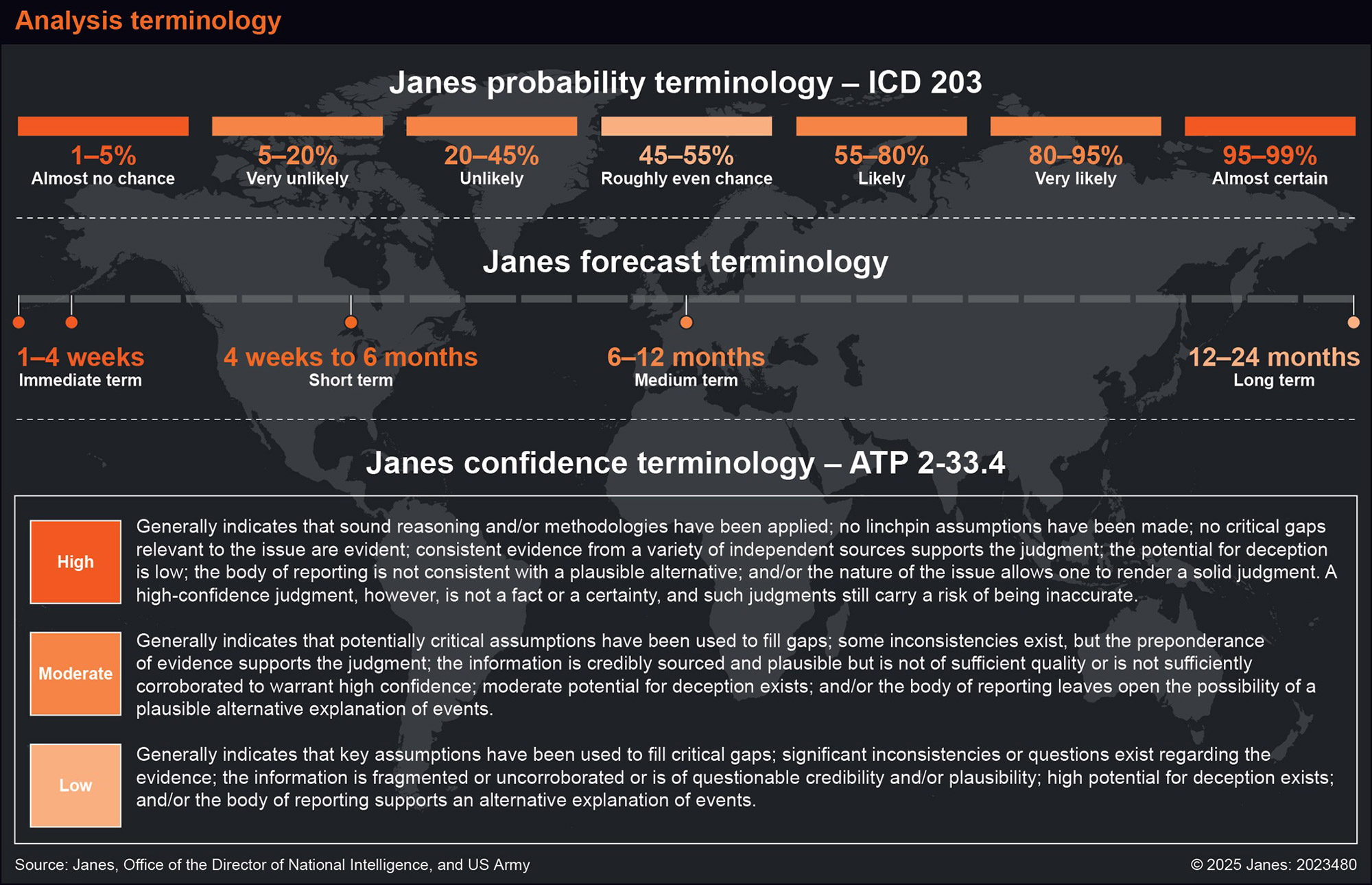 Analysis terminology. Image credit: Janes