MENA Energy Activity Tracker: US blockade on Iranian oil exports likely to drive socioeconomic instability in Iran, encourage more attacks on shipping
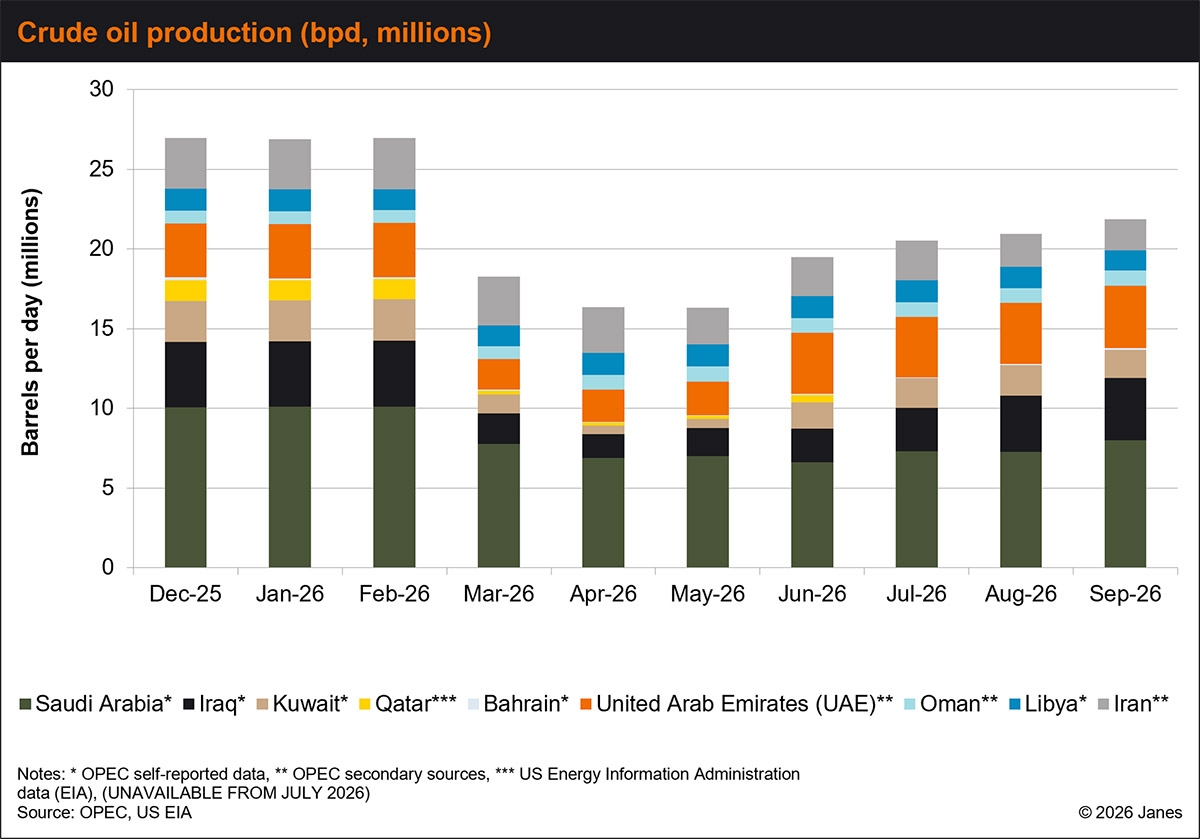 MENA oil production, Dec 2025 - September 2026. Iranian production is depicted in grey. Image credit: Janes
Strait of Hormuz (SoH)
- 14-29 September: The United Kingdom Maritime Trade Operations (UKMTO) Centre reported that at least seven vessels had been attacked in the SoH.
- 1-13 October: UKMTO reported that at least 23 vessels had been attacked in the SoH.
Red Sea
- UKMTO has not reported any attacks on shipping in the Red Sea and Gulf of Aden since 24 August 2026.
Organisation of the Petroleum Exporting Countries (OPEC)
- October: OPEC+ agrees to keep November oil output targets steady[i].
Iran
- 16 October: Reuters, citing maritime intelligence company SynMax and US advocacy group United Against Nuclear Iran (UANI), reported that Iran had successfully exported Liquefied Petroleum Gas (LPG) and jet fuel cargoes by concealing them among ship-to-ship (STS) transfers off Oman[ii].
Syria
- 25 September: Reuters, citing a Syrian oil official, reported that gasoline shipped to Syria had begun moving by road to Iraq[iii].
- 12 October: Reuters reported that Syria had issued its first letter of credit in 14 years to facilitate a petroleum products supply deal between the Syrian Petroleum Company and Saudi Aramco[iv].
Saudi Arabia
- 18 September: Bloomberg News reported that Saudi Aramco had informed at least two European refiners that they would not receive crude oil in October, following an attack on the Kingdom's East-West pipeline[v].
- 22 September: Reuters reported that Saudi Arabia had restarted operations at its East-West pipeline[vi].
- 24 September: Le Monde reported that French President Emmanuel Macron had stated that France would send "military assets, meaning soldiers, radars, and defense systems" to help protect the Saudi port of Yanbu from attacks by Ansar Allah (Yemen)[vii].
- 29 September: Reuters reported that Saudi Arabia had resumed Yanbu loadings after restarting operations on the East-West pipeline[viii].
- 4 October: Reuters reported that Saudi Arabia had cut its November oil prices to Asia to six-year lows in order to compensate for higher freight rates, while raising prices for oil directed to northwest Europe and the Mediterranean[ix].
- 6 October: Saudi Arabian Minister of Energy Prince Abdulaziz bin Salman stated that oil pumped via the East-West pipeline to Yanbu had reached 5.8 million barrels per day (bpd)[x].
- 12 October: Energy Minister Prince Abdulaziz bin Salman announced that the Kingdom is looking to expand its pipeline crude export capacity to as much as 10 million bpd. Prince Salman stated that repurposing a domestic gas pipeline could provide an additional 1.2 million bpd within seven to eight weeks, and investing in the East-West network could add 3 million bpd - no timeline for this was provided[xi].
- 13 October: The Saudi Gazette reported that Saudi Aramco plans to bring six-to-seven gas and liquefied gas facilities into operation between 2025-27 in a push to increase gas sales by 80% by 2030. Abdulkarim Al-Ghamdi, Aramco's executive vice president of gas, highlighted the push as aimed at strengthening 'the Kingdom's ability to respond to disruptions and unexpected developments.'[xii]
- 14 October: The Saudi Press Agency (SPA) reported that Saudi Arabia had signed Memoranda of Understandings (MoUs) with Kuwait, Qatar, and Egypt to explore cooperation on electricity, renewable energy, and oil, gas, and petrochemicals[xiii].
- 15 October: Reuters reported that Saudi Arabia has increased crude oil shipments available to European customers for October and November[xiv].
- 19 October: The Financial Times reported that Saudi Arabia has postponed its '2026 Future Investment Initiative' following continued attacks on the Kingdom's airports by Ansar Allah (Yemen)[xv].
Kuwait
- 5 October: Reuters reported that Kuwait Petroleum Corporation CEO Shaikh Nawaf Al-Sabah had estimated that around 6 million bpd of refined products were missing on the global market[xvi].
United Arab Emirates (UAE)
- 5 October: Nikkei reported that a framework for Saudi Arabia and the UAE to cooperate with Asian countries on oil stockpiling is set to be launched[xvii].
- 5 October: The UAE's Abu Dhabi National Oil Company (ADNOC) signed a multi-year agreement to supply up to 2 million metric tonnes of LNG to Thailand's Gulf Group, starting in 2027. Thailand is southeast Asia's biggest LNG importer and has been diversifying its supply away from Qatari shipments, which have been repeatedly under force majeure[xviii].
- 6 October: ZAWYA, an LSEG trade publication focused on the Middle East, reported that the UAE's ADNOC had invested USD324 million to acquire three very large gas carriers (VLGCs). Delivery is scheduled for the second half of 2029[xix].
Qatar
- 28 September: Reuters reported that QatarEnergy had extended force majeure notices on its LNG cargoes to Italian utility Edison and some undisclosed Asian clients until at least December 2026[xx].
- 7 October: Reuters, citing two people aware of the company's plans, reported that QatarEnergy's North Field East expansion project would be ready to start operation in November 2026, with LNG production starting in Q1 2027[xxi].
Libya
- 14-29 September: Libya's National Oil Corporation (NOC) reported that a valve on the Sharara-Zawiya pipeline had been closed by members of the Petroleum Facilities Guard (PFG) - a militia - leading to a 200,000 bpd fall in production[xxii]. Please see the Libya Country Politics Profile for more information on the militias in the country.
- 26 September: Reuters reported that Libya's NOC had reopened the Sharara-Zawiya pipeline and resumed operations[xxiii].
Context
Transits via the SoH increase throughout September and early October
The previous US-Iran ceasefire, dubbed the ‘Islamabad Memorandum of Understanding’ collapsed on 7 July. Between 16 September and 19 October 2026, no agreement was made to introduce a new ceasefire or a durable arrangement for unimpeded transits via the SoH.
In a 2 October report, the UKMTO, a UK government-affiliated maritime security coordination and reporting centre, stated that, since the collapse of the ceasefire, “no diplomatic resolution has been achieved and the regional threat environment remains elevated” and highlighted that “commercial vessels continue to be targeted on the southern route, with ongoing military activity sustaining increased risk to maritime operations”[xxiv].
Despite this, transits via the SoH steadily increased throughout the reporting period. On 18 September 2026, UKMTO estimated that traffic through the SoH remained at 10% of its pre-conflict level[xxv]. By 9 October, this had increased to approximately 25%, and by 16 October, had reached 30% of pre-war levels[xxvi]. These figures only include vessels which transited the Strait with their Automatic Identification System (AIS) trackers active, which primarily use the Iranian-approved route.
Vessels travelling via the southern route, which hugs the Omani coast and is protected by US naval escorts, typically travel with their AIS systems disabled[xxvii]. Exact figures for the transits undertaken via this route are not available. However, in a 17 October interview with Fox News, US CENTCOM spokesman Captain Tim Hawkins claimed that, thanks to US-coordinated protection, “about 97% of the ships that have sought to transit the Strait of Hormuz have done so successfully without being hit by an Iranian projectile.”[xxviii]
The increase in traffic is reflected in a broad recovery in Middle Eastern oil exports throughout September. According to data from trade intelligence firm and ship tracker Kpler, published in reports by The Guardian and Reuters, at least 16.5 million bpd had exited the region in September – approximately 81% of the pre-war total[xxix].
The US blockade tightens on Iranian exports
The ongoing US naval blockade in the Arabian Gulf has prevented Iran from benefiting from this recovery. According to a 13 October report by Reuters, Iranian seaborne crude exports fell to zero in the second week of September, down from a 14-day average of 230,000 bpd at the start of the month[xxx]. Citing data from Vortexa, an energy intelligence platform, Reuters also reported that Iranian outflows remained at zero as of 5 October[xxxi].
Since the collapse of the US-Iranian ceasefire and the reimposition of the US blockade in July, Iran has relied on oil revenues from tankers that were already on the water beyond the cordon in mid-July.
However, this supply has been depleted. Kpler estimates that approximately 8 million barrels of Iranian crude oil remains on the water outside the US blockade, down from 90 million in mid-July[xxxii]. In a 10 October interview with Iran International, a London-based Persian-language news provider, Kpler’s head of crude oil analysis, Homayoun Falakshahi, stated that when this supply runs out, Iran’s “revenues from crude and condensate will drop to zero for the first time ever”[xxxiii].
Iran intensifies strikes on shipping following US rejection of talks
Reporting from the United Nations (UN) General Assembly on 25 September 2026, CNBC reported that Iranian Minister of Foreign Affairs Abbas Araghchi had proposed reopening the SoH and resuming nuclear talks with the US within seven days, dependent on “certain conditions” – “nothing more than what was already in the Islamabad MoU” - being met[xxxiv].
On 26 September, the BBC reported that US President Donald Trump had rejected the Iranian proposal[xxxv].
From late September, Iran intensified its attacks on tankers transiting the SoH. UKMTO recorded at least three strikes on tankers between 28-29 September, 11 strikes between 1-7 October, and at least 12 further strikes on tankers and container ships between 8-15 October[xxxvi]. As of 16 October, the number of impacted vessels is likely substantially higher, with the UKMTO advising that it was “struggling to accurately report [the] true number of attacks with [the] majority of vessels attacked refusing to report to UKMTO.”[xxxvii]
Oil prices remain elevated
Oil prices remained elevated throughout the period. According to the Financial Times, on 20 October 2026 Brent crude was priced at approximately USD111 per barrel on global markets – 59% higher than the pre-war price of around USD70 per barrel[xxxviii].
Analysis – Iran
Iranian oil and natural gas reserves
According to OPEC and US Energy Information Administration (EIA) figures, Iran holds approximately 12% of global crude oil reserves, at 208 billion barrels as of 2023[xxxix].
Iran’s primary oil deposits are split between onshore and offshore basins. Onshore basins provide approximately 80-85% of crude output and are concentrated in the southwest: the Ahvaz, Marun, Aghajari, and West Karoun cluster fields are located in Khuzestan province, bordering Iraq; and the Gachsaran field is located in Gachsaran province, southeast of Khuzestan[xl].
Offshore basins provide approximately 15-20% of output; the largest deposits are the Soroush and Doroud fields.
Iran also holds the second largest global reserves of natural gas, at 1,200 trillion cubic feet (Tcf) – 17% of the global total[xli]. 70-75% of processed and marketed Iranian gas is produced by offshore deposits, primarily from the South Pars fields[xlii]. 10-15% is provided from the onshore Fars, Bushehr, and Hormozgan fields and northeastern fields[xliii]. 12-18% is associated gas produced as a byproduct of operations at Iranian oil fields.
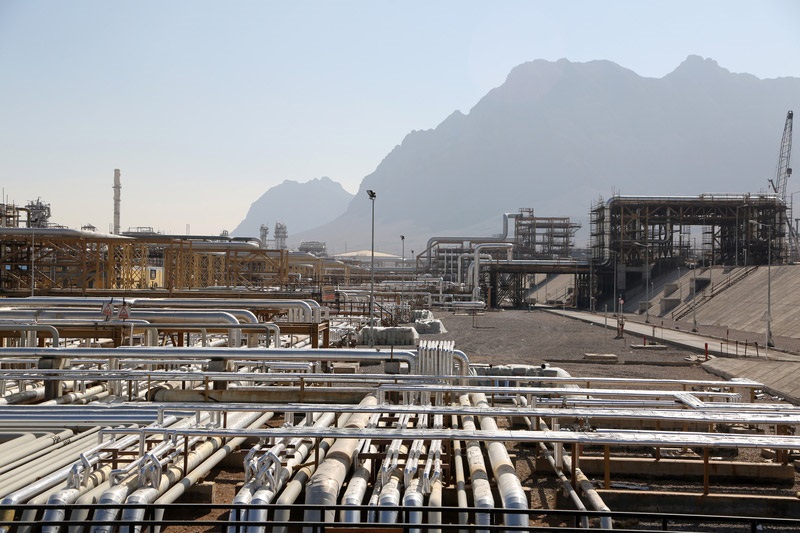
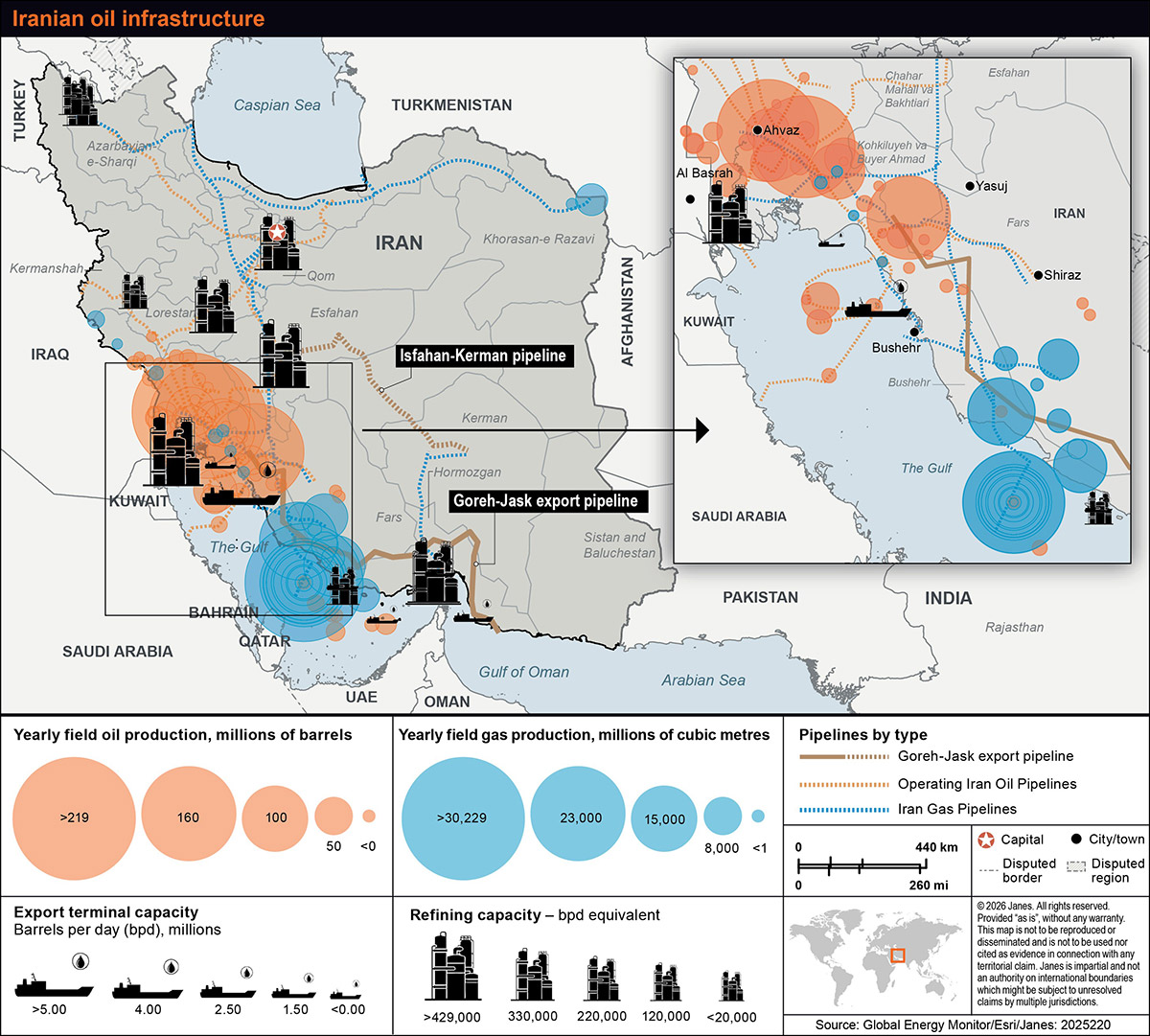 Iranian oil infrastructure. Image credit: Global Energy Monitor/Esri/Janes
Iran’s oil and gas sector
Janes notes that the following overview assesses Iran’s production, export, and domestic demand relationships before the outbreak of the US-Israel-Iran conflict on 28 February 2026. The implications of the conflict are explored in the ‘Outlook for Iran’ section, found below.
Crude oil production
According to an October 2024 assessment by the EIA, Iran has a sustainable crude production capacity of 3.8 million bpd and produced an average of 4.0 million bpd of petroleum products – of which 2.9 million was crude oil - in 2023[xliv]. According to an October 2026 OPEC report, by 2025 this had increased to 3.26 million bpd of crude produced[xlv].
For more information, please check out MENA Energy Activity Tracker: US blockade on Iranian oil exports likely to drive socioeconomic instability in Iran, encourage more attacks on shipping