Special Report: Indo-Pacific SOF leaders push autonomy and AI adoption
Special operations forces (SOF) leaders from across the Indo-Pacific gathered in Honolulu, Hawaii, from 18 to 20 August to discuss upgrading military capabilities to deter and counter regional near-peer adversaries.
At the Global SOF Foundation’s Indo-Pacific Irregular Warfare Symposium, military leaders from the United States, Canada, New Zealand, Australia, the Philippines, Japan, South Korea, Singapore, Thailand, and elsewhere called for greater use of technological advances to support SOF operators.
Autonomous warfare
In his keynote address, Admiral Frank M Bradley, commander of US Special Operations Command (USSOCOM), said SOF must “look to partner with those leaders of market technology to ensure that our people have decisive advantage and the best equipment for that future”.
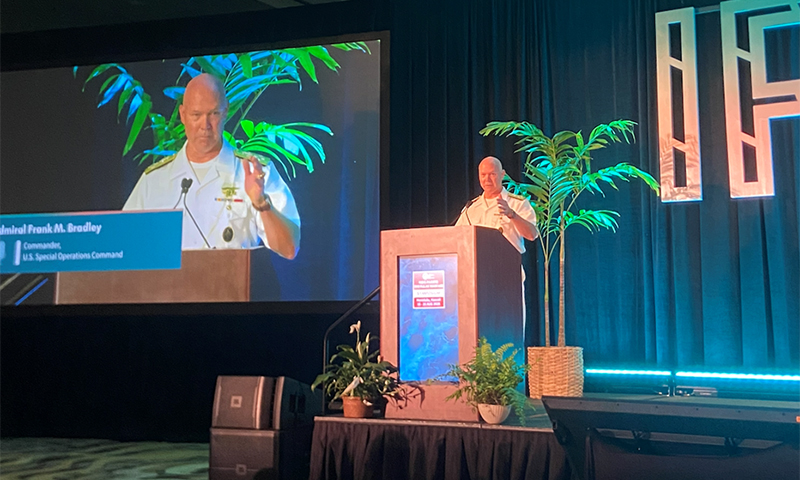
Admiral Frank M Bradley, commander of US Special Operations Command, delivers his keynote address at the Indo-Pacific Irregular Warfare Symposium in Honolulu, Hawaii, in August 2026. Image credit: Andrew White
“We need both modern hardware and software to equip those humans, and so we must include our industry partners in this ‘team of teams’ to operate, evolve, and experiment alongside each other,” he said. Adm Bradley added that the future operating environment would include the “mass application of autonomous systems”.
He highlighted the proliferation of uncrewed systems and the emergence of machine learning and artificial intelligence (AI), both in the Indo-Pacific and globally.
“If we want to manifest true joint effects, true integrated interagency effects, we must anticipate and be in the lead for artificial intelligence-enabled man-machine teaming, mass and attritable autonomy,” Adm Bradley said.
“We must design for them deliberately, but we must also design them to be able to be adapted on the battlefield at the edge. That means working with those industry partners, building these systems, bringing engineers, operators, and our acquisition professionals together in that team of teams to work on these capabilities before crisis forces the issue.
“When crisis comes, you will have what you have in your inventory, and you must learn to adapt it. But you should get ahead of that.”
Adm Bradley also called for SOF units across the theatre to be equipped with “edge-based, cloud-hosted data centres” and the capacity to make non-geographic data available across the force.
“On-edge laboratories will allow us to adapt these systems at the pace that the modern battlefield will require. The adage ‘build a little, test a little and learn a lot’ has got to drive our approach,” he said.
“We need to integrate abundant, attritable, and collaborative autonomous systems ... in the surface and subsurface maritime domains, as well as in the air. Our operational concepts have got to be integrated and employed and driven by an open, interoperable architecture, data architecture.
“We must leverage these low-cost systems to flood the battlespace and create multiple simultaneous dilemmas across all of those domains,” he added.
Discussing the proliferation of attritable uncrewed systems, Adm Bradley said such platforms could operate collaboratively and at scale to support “our exquisite, apex-predator weapon systems coming from our [conventional] services”.
“We must be able to operate and have humans on the loop to ensure that only the decisions that humans can make are being made at the right time and at an increased pace with increased visibility of the information environment.
“In short, we turn our enemy's rigid mass against them. We create the fatal knot that their inelastic, specialised command structures cannot untangle in order to achieve that decisive asymmetric advantage that ensures the deterrence of denial will succeed,” he said.
Adm Bradley also called for human-machine teaming to be adopted wherever possible, encouraging Indo-Pacific SOF leaders to “bring your industry partners into the ideation of the concepts that you are looking to develop”.
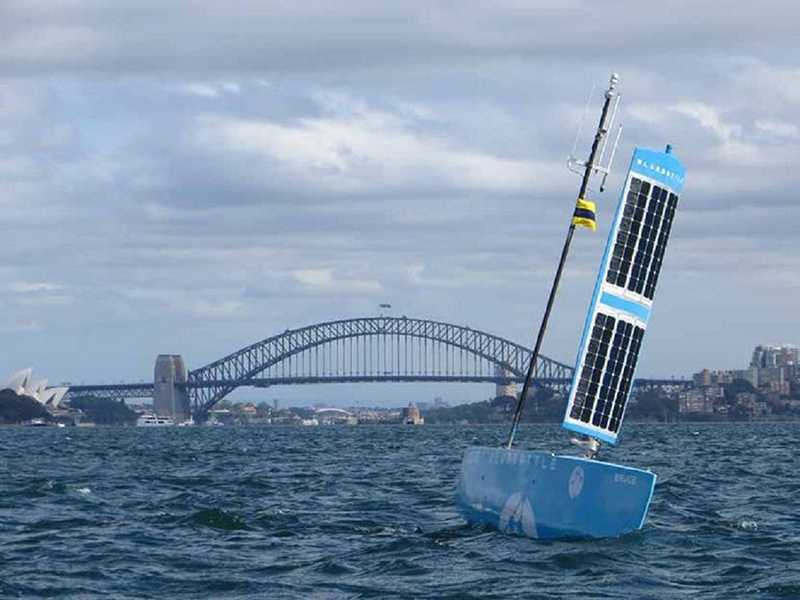
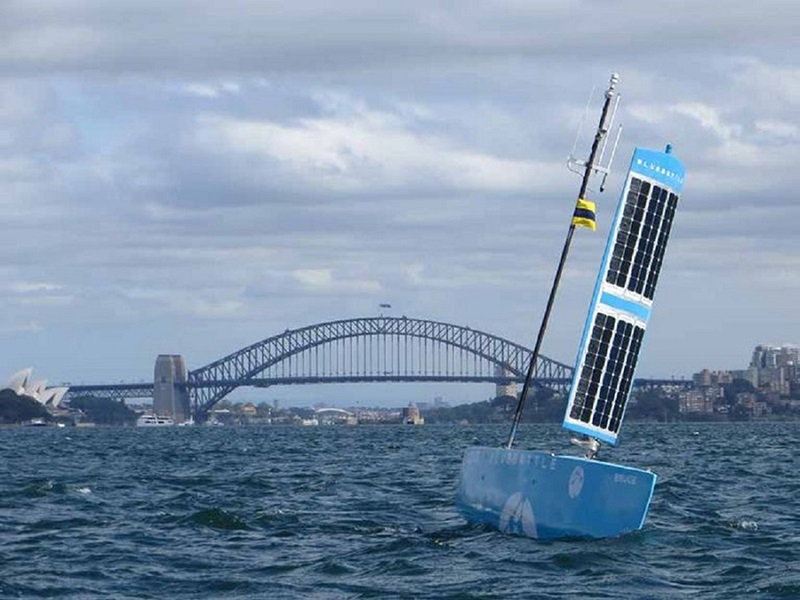
An Ocius Bluebottle uncrewed surface vessel. Platforms of this type could support persistent maritime surveillance and sensing across the Indo-Pacific. Image credit: Ocius
For more, please see Special Report: Indo-Pacific SOF leaders push autonomy and AI adoption