NATO details DIANA technology programme
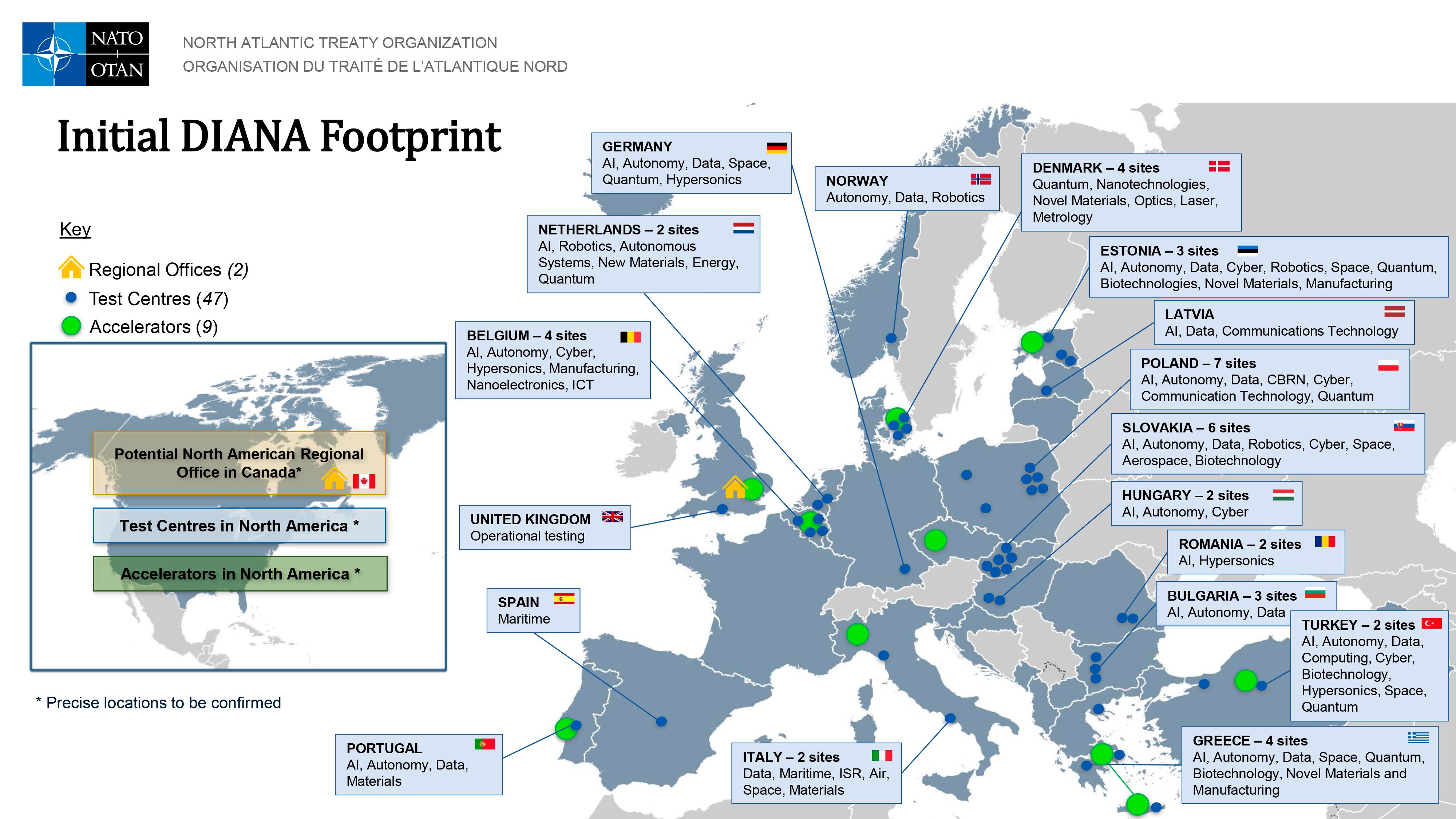

DIANA‘s initial footprint. (NATO)
NATO has revealed more details on the Defence Innovation Accelerator for the North Atlantic (DIANA) technology programme, whose charter was approved by allied foreign ministers who met in Brussels on 6–7 April. The alliance has also announced additions to the technology list DIANA will focus on.
In a 7 April press conference following the foreign ministers' meeting, NATO Secretary General Jens Stoltenberg noted that the concept would blend emerging civilian technology and military requirements to support trans-Atlantic security using an initial network of 60 innovation sites in North America and Europe.
On 5 April, during a press conference prior to the foreign ministers' meeting, Stoltenberg said, “We expect DIANA will continue to expand in the future.”
Approved by NATO's June 2021 Brussels summit, DIANA is designed to harness new academic, commercial, and entrepreneurial start-up technology, test and develop it as potential defence capability, and connect it more quickly to military end-user operational requirements. NATO plans to have DIANA's functional mechanisms established by the June 2022 Madrid Summit, and for DIANA to reach initial operating capability (IOC) in 2023 and full operating capability (FOC) by 2025.
In an online media briefing on 5 April, NATO Assistant Secretary General for Emerging Security Challenges David van Weel provided a detailed update on DIANA's technology and process development.
Go beyond the headlines - with direct links to interconnected entities
Get full access to validated equipment, military capabilities, and market insights.