USAF issues RFI for directed energy C-UAS technologies

The US Air Force (USAF) is requesting information from industry about directed energy (DE) capabilities for counter-unmanned aerial system (C-UAS) technologies.
The Air Force Life Cycle Management Center, Architecture and Integration Directorate (AFLCMC/XA) seeks to better characterise the technological, manufacturing, and performance capabilities of the industrial base to develop and produce upgrades to DE prototypes and related C-UAS subsystems. The directorate will use this information to inform its trade space analysis of solutions for engagement and mission level modelling and simulation (M&S), as well as programme cost estimates for potential future technical maturation of DE C-UAS systems.
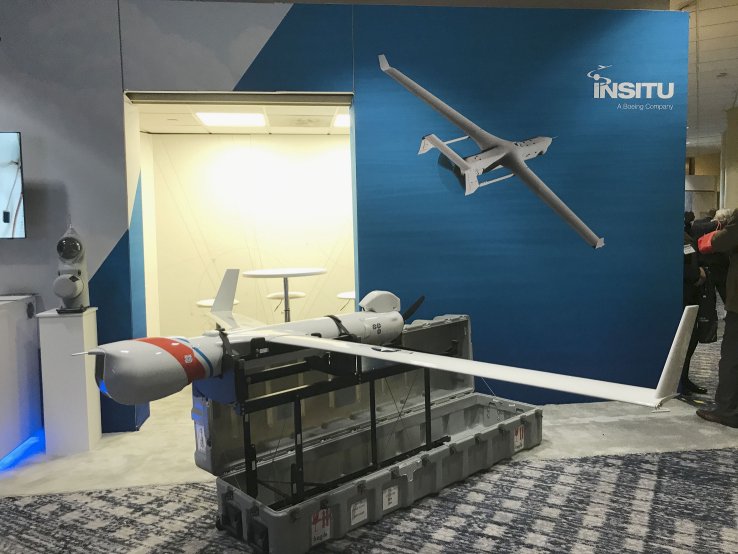
Insitu’s ScanEagle endurance mini-UAS on display at the Surface Navy trade show on 14 January. The USAF seeks information from industry about DE C-UAS technologies to defend against Group 2 UASs, such as the ScanEagle, and smaller. (Janes/Pat Host)
The USAF wants to research the industrial base for C-UAS capabilities related to fixed-site Air Base Air Defense (ABAD) against potential Group 1 and 2 UAS threats, which weigh 25 kg or less. These threats may have characteristics such as small size; low radar cross sections; low infrared (IR) or radio frequency (RF) signatures, or no RF signatures at all; the ability to hover; and low-altitude flight capabilities, which may render them difficult to detect and defeat.
Additionally, these UASs are typically either controlled remotely from a ground control station (GCS) or can fly pre-programmed routes. Recent and pending procurements of DE C-UAS weapons require even further development and improvement, including connected and related, but not limited to, subsystems such as command-and-control (C2) suites, radar, and electronic warfare (EW).
Go beyond the headlines - with direct links to interconnected entities
Get full access to validated equipment, military capabilities, and market insights.