Australia, Japan, US demonstrate underwater communications link
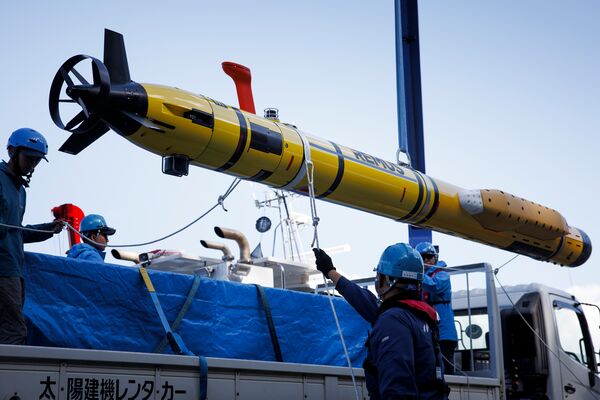

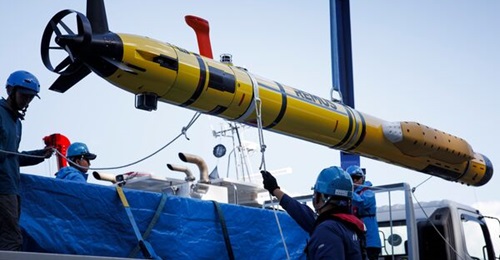
A REMUS 620 unmanned underwater vehicle gets unloaded for deployment during Exercise ‘Keen Sword 27'. (Commonwealth of Australia)
Australia, Japan, and the United States demonstrated underwater connectivity between their assets during Exercise ‘Keen Sword 27', held in Japan in October.
The three countries tested and enhanced their ability to communicate, share information, and operate unmanned maritime systems in realistic operational conditions during an experiment at the exercise, the Australian Department of Defence (DoD) said on 3 November.
The experiment involved a Japanese REMUS 620 unmanned underwater vehicle (UUV), which transmitted positional information to an Australian Rock Lobster underwater communications node, the DoD added.
The DoD said the node relayed the information to a US gateway, which forwarded it to a US ground station. A command signal was subsequently sent back through the network to the REMUS 620, completing the communications chain and demonstrating two-way communication across Australian, Japanese, and US systems, the DoD added.
According to Janes data, Remus 620 can be configured with up to three batteries and deployed from submarines, warships, smaller manned or unmanned boats, and helicopters. It has a length of between 3.1 to 5.4 m depending upon its configuration, an estimated speed of about 4 kt, an operating depth of 600 m, and a maximum endurance of up to 110 hours when operating with three batteries and no payload.
It is unclear when the Japan Maritime Self-Defense Force (JMSDF) procured Remus 620.
Rock Lobster is an underwater acoustic communication relay system developed by L3Harris in collaboration with the Royal Australian Navy (RAN) and the DoD's Defence Science and Technology Group (DSTG).
Go beyond the headlines - with direct links to interconnected entities
Get full access to validated equipment, military capabilities, and market insights.