US Navy seeks jet aircraft for land- and sea-based carrier training

The US Naval Air Systems Command (NAVAIR) has issued a request for information (RFI) for a jet aircraft to perform some aspects of land- and ship-based carrier training in support of the Undergraduate Jet Training System (UJTS) programme.
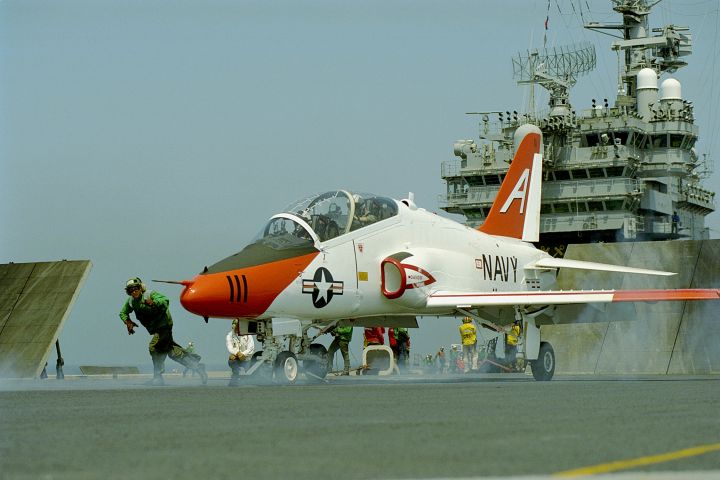
The US Navy currently conducts all elements of carrier-based pilot training using the Boeing T-45C Goshawk (pictured). An RFI for a land-based aircraft to conduct those elements of carrier training that do not include arrested landings or catapult-assisted take-offs has been issued, as it perhaps looks to divide its future carrier training requirements between different aircraft types.
The RFI, issued on 14 May, calls for information on the suitability of an existing twin-seat land-based jet trainer aircraft design to satisfy certain requirements under consideration for the next generation USN undergraduate jet trainer aircraft.
Specifically, the solicitation noted the capability of this non-developmental aircraft to perform land-based Field Carrier Landing Practice (FCLP) events and ship-based carrier touch-and-go events for USN and US Marine Corps (USMC) pilots.
According to the RFI, the aircraft is not required to conduct either arrested landing or catapult-assisted take-offs, although it does need to be able to withstand the very high sink-rates associated with carrier landings.
Performance specifications listed by NAVAIR include a top speed in excess of Mach 0.84, an operational ceiling of 41,000 ft, synthetic radar and other sensors, as well as simulated air-to-air and air-to-surface weapons employment. It should also have two rocket/bomb-capable pylons.
Go beyond the headlines - with direct links to interconnected entities
Get full access to validated equipment, military capabilities, and market insights.