UK opts for efficiency and battlefield commonality over power in AW149 engine selection
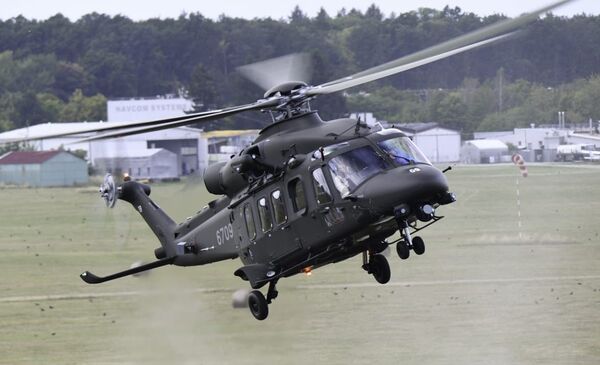

UK AW149 helicopters will be powered by the same General Electric engine as fitted to Poland's helicopters of the same type (pictured), the MoD has told Janes. (Polish Ministry of National Defence)
The United Kingdom has chosen the more efficient General Electric (GE) engine to equip its future fleet of Leonardo AW149 helicopters, selecting a powerplant already in national service on another battlefield helicopter type over a more powerful one offered by Safran.
The UK Ministry of Defence (MoD) told Janes on 25 March that the GE CT7-2E1 turboshaft will equip the 23 AW149 twin-engined rotorcraft it selected in February and signed for on 24 March. The CT7-2E1 (a member of the T700 engine family) is one of two powerplants offered for the AW149, with the other being the Aneto-1K from Safran.
The CT7-2E1 puts out 4,000 shp across both engines per helicopter, while the Aneto-1K puts out 5,000 shp. Either option would have offered more power than the 3,600 shp of the two Turbomeca Makila 1A1 engines that equipped the Airbus Puma HC2 that the AW149 is replacing.
While its power output is less than the Aneto-1K, the CT7-2E1 offers lower fuel consumption. For the UK, the CT7-2E1 also offers commonality with the Boeing AH-64E Apache Guardian, reducing support costs. It also offers commonality with Poland, which selected the CT7-2E1 for its 32 AW149s that are now being delivered.
As previously noted by GE, in excess of 25,000 CT7/T700 engines have been delivered to more than 130 customers in more than 50 countries. In doing so, the model has surpassed more than 100 million flight hours.
UK AW149 deliveries are due to run between 2030 and 2033, with the type entering Royal Air Force (RAF) service in January 2031.
Go beyond the headlines - with direct links to interconnected entities
Get full access to validated equipment, military capabilities, and market insights.