KAI's Adaptable Aerial Platform conducts first MUM-T flight
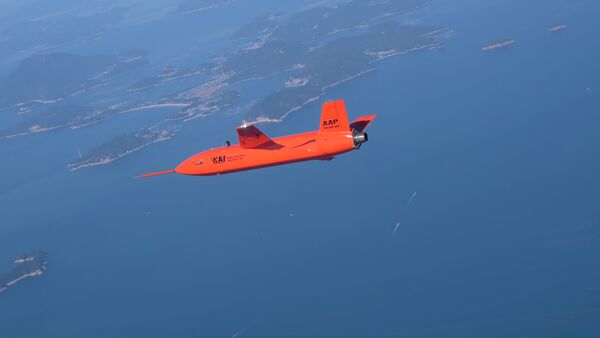

The unmanned Adaptable Aerial Platform (AAP) is being developed to operate alongside larger collaborative combat aircraft (CCAs) and manned fighters. (Korea Aerospace Industries)
Korea Aerospace Industries (KAI) has flown its Adaptable Aerial Platform (AAP) alongside a manned aircraft for the first time, demonstrating manned-unmanned teaming (MUM-T) capabilities.
The 150 kg-class unmanned aerial vehicle (UAV) is being developed to operate alongside larger collaborative combat aircraft (CCAs) and manned fighters.
According to KAI, the AAP and a KAI FA-50 tandem-seat light-attack aircraft flew “in formation for 20 minutes on 8 October, maintaining a separation distance of nine to 30 m at an altitude of about 7,000 ft, south of Goheung Sea”.
“This formation flight… is the first time in South Korea that the feasibility of operating a manned-unmanned integrated system has been confirmed through actual flights involving manned and unmanned aircraft,” KAI CEO Kim Jong-chul said.
According to the company, the “formation flight was conducted at a speed of 360 km/h with the manned aircraft and the AAP flying steadily while maintaining a constant distance”.
“The AAP used in the formation flight is capable of flying at speeds of up to 790 km/h, and plans are in place to gradually increase its flight speed and operational range in the future,” KAI added.
KAI also designates the platform the AAP-150. The company has funded its development through internal investment since 2024. The AAP is designed to conduct diverse missions, including reconnaissance, jamming, deception, and strikes.
Janes has previously reported that the UAV is powered by a single 250 lbf commercial off-the-shelf (COTS) turbojet engine. According to KAI, the AAP is 3.1 m long and has a wingspan of 2.2 m.
Go beyond the headlines - with direct links to interconnected entities
Get full access to validated equipment, military capabilities, and market insights.