Indian firm develops SGV-500 combat UGV
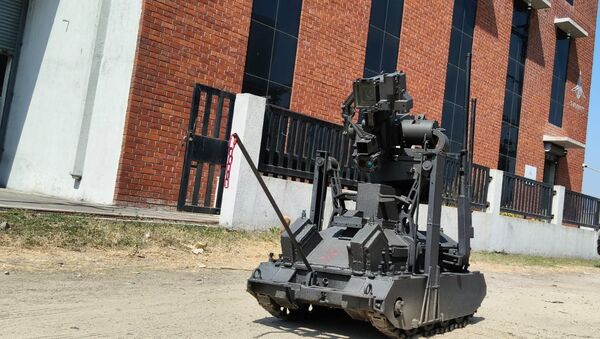

Svaayatt Systems's SGV-500 is pictured at the company's headquarters in Vadodara, Gujarat. (Svaayatt Systems)
Indian firm Svaayatt Systems has developed a semi-autonomous tracked combat unmanned ground vehicle (UGV) called the SGV-500.
A company spokesperson told Janes on 26 March that the UGV is modular multi-role system featuring a scalable architecture that allows the integration of several payload options. He added that the system is designed for “multi-terrain mobility, remote weapon integration, and mission adaptability”.
The spokesperson said the UGV is at a “pre-production demonstrator stage” and is scheduled for live technical demonstrations to the Indian Armed Forces. However, the company did not disclose the demonstration timeline.
“The platform has been engineered with a modular, scalable architecture, allowing rapid transition toward production-standard configurations based on user-specific requirements and feedback from upcoming demonstrations,” the spokesperson said.
According to the spokesperson, the UGV features a “multi-sensor fusion architecture”, which can be configured based on mission requirements. “The architecture supports artificial intelligence (AI)-assisted tracking and classification, enabling improved detection performance in complex environments,” the spokesperson added.
The SGV-500 is capable of integrating hard-kill and soft-kill mechanisms, the spokesperson said. To support hard-kill missions, the UGV could be fitted with a remote weapon station (RWS). The soft-kill capabilities that could be fitted to the system include electronic countermeasures (ECM), jammers, and directed-energy payloads.
The spokesperson said the SGV-500 is also capable of functioning in global positioning system (GPS)-denied or contested environments. “This aligns with emerging battlefield doctrines where UGVs are increasingly expected to operate in electromagnetically contested environments,” the spokesperson added.
According to the spokesperson, the SGV-500 supports semi-autonomous and tele-operated modes. “Navigation and targeting rely on sensor fusion, inertial systems, and onboard processing, reducing dependence on GPS,” the spokesperson said.
Go beyond the headlines - with direct links to interconnected entities
Get full access to validated equipment, military capabilities, and market insights.