Italy, Sweden, and Germany advance maritime intelligence vessels
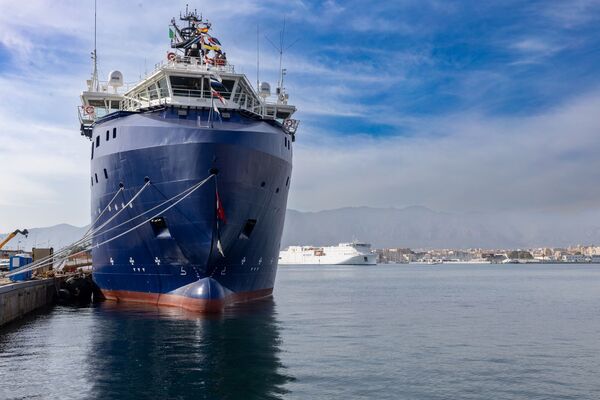

Multi-purpose support vessel Tritone, seen on its delivery to the Italian Navy on 14 April 2026. (Fincantieri)
Italy and Sweden have joined countries looking to add vessels and testing for underwater and seabed warfare activities such as protection of critical undersea infrastructure (CUI). Meanwhile Germany is pressing ahead with a maritime intelligence vessel that can also conduct intelligence gathering below the waterline.
Italy
Fincantieri announced on 14 April 2026 that, through its Underwater Technology Hub, it had delivered what it called the “multi-purpose support vessel” Tritone to the Italian Navy at its Palermo shipyard.
In a press release the same day the Italian Navy called the Tritone a “mothership with submarine [underwater warfare] characteristics” and said its conversion from a civilian vessel conducting underwater services and cable-laying was completed in under a year.
“It was conceived as a coordination hub for seafloor activities,” the navy said, “but it is also a strategic unit dedicated to safeguarding critical infrastructure. Its operational applications include the surveillance and protection of oil and gas pipelines, trunklines, and underwater cables, all crucial assets for Italy and vulnerable to emerging threats.”
The navy added that the Tritone can be used for submarine rescue operations.
Tritone will help define the requirements for, and provide a bridge to, the Italian navy's future seabed warfare capabilities with the arrival of its Multi-purpose Underwater Domain Surveillance Vessels (UPSDS), expected from 2031.
The Tritone was bought up from trade and was likely the offshore supply vessel MV Coco, built by Vard (possibly a Vard 1 08 design) at Vung Tau in Vietnam. It is 81.7 m long with a beam of 18.4 m.
Go beyond the headlines - with direct links to interconnected entities
Get full access to validated equipment, military capabilities, and market insights.