Taiwan seeks to operationalise large numbers of UAVs in 2027
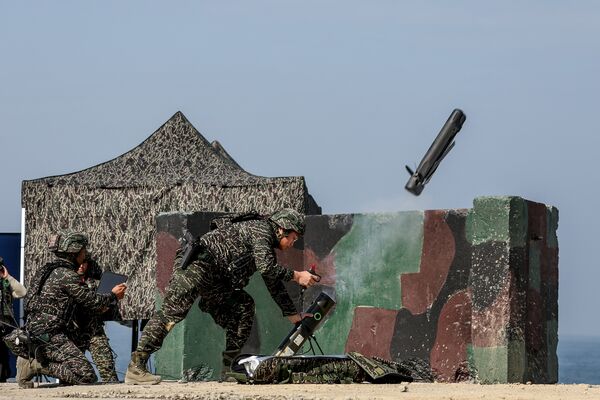

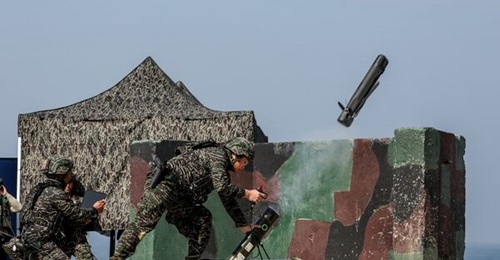
Taiwanese marines launch a Mighty Hornet I loitering munition during the spring military drills at the Tsoying Naval Base in Kaohsiung in January 2026. (AFP via Getty Images)
The Taiwanese Ministry of National Defense (MND) announced a plan to operationalise a large number of unmanned platforms in 2027.
In an announcement on 3 November, Taiwan's Minister of National Defense Wellington Koo outlined the island's Cabinet-approved TWD55.9 billion (USD1.7 billion) acquisition plan to procure three types of unmanned systems requested by the MND.
These include coastal reconnaissance unmanned aerial vehicles (UAVs), coastal attack UAVs, and kamikaze unmanned surface vehicles (USVs).
Under the plan, the MND said that it plans to establish an initial combat capability in 2027 with nearly 700 coastal reconnaissance UAVs, up to 40,000 coastal attack UAVs, and 120 one-way attack USVs.
The acquisition plan is part of a TWD607.6 billion (USD19 billion) government-wide supplementary budget request that the Cabinet approved in September. The unmanned systems allocation combines the MND's 2026 and 2027 requirements. The budget request requires final legislative approval.
According to the MND, combining 2026–27 requirements is intended to avoid delays until 2028.
The acquisition of unmanned platforms is intended to support Taiwan's efforts to conduct asymmetric warfare and support operations similar to the US military's ‘Hellscape' initiative, which proposes employing large numbers of unmanned aerial, surface, and underwater systems to hinder a Chinese invasion of the island.
According to Koo, the military's unmanned systems will establish “mobile, intelligent, and autonomous attack capabilities”. Working in conjunction with anti-ship missile units, they will conduct layered strikes in littoral areas to counter landings by the People's Liberation Army (PLA), he said.
Go beyond the headlines - with direct links to interconnected entities
Get full access to validated equipment, military capabilities, and market insights.