Atomic-6 offers Space Armor to address growing threat of space debris
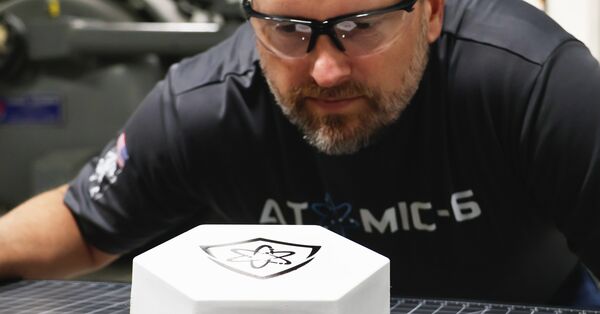

An example of Atomic-6's Space Armor tile, which is designed to protect spacecraft from microdebris in orbit. (Atomic-6)
In early November, a 1 mm crack was found in a window of the Chinese Shenzhou-20 spacecraft, delaying a mission to bring astronauts back to Earth from China's Tiangong space station, according to Chinese media.
The incident illustrates the growing threat of microdebris in orbit, Trevor Smith, founder and CEO of Atomic-6, a composites manufacturer, told Janes on 5 December. “For a reference point, right now, [debris that is] 3 mm and less is basically untrackable,” he said.
“More satellites going up means more debris in space and a higher likelihood of this kind of thing continuing to happen,” Smith added.
This is known as the Kessler syndrome, which describes an increasingly crowded orbital space resulting in collisions producing “thousands of pieces of debris. Then those pieces of debris hit more satellites, which causes a snowballing effect of additional debris”, he explained.
There is both natural and manmade debris, Smith noted, adding “most of the concern around debris is in LEO [low Earth orbit] and certain orbits are more debris filled than others”.
Spacecraft can manoeuvre around larger debris, “but when you get to that 3 mm or less size, there's nothing that's really capable of actively tracking that … and that's the majority of debris up there; it's over 90% of the debris in LEO”, he said.
NASA recently published a cost trade analysis indicating that 3 mm was a good “point of protection because it covers the vast majority of debris” without requiring heavy protection, Smith said.
Go beyond the headlines - with direct links to interconnected entities
Get full access to validated equipment, military capabilities, and market insights.