Australia lays down keel for first Hunter-class frigate
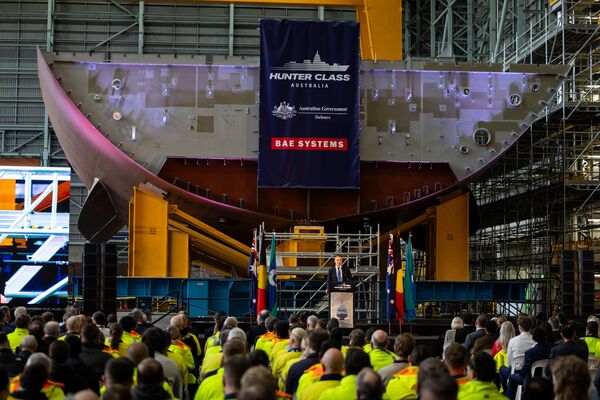

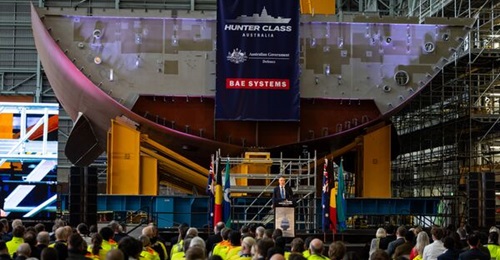
The keel-laying ceremony for the first Hunter-class frigate at Osborne Naval Shipyard on 24 August 2026. (BAE Systems)
Australia has laid the keel of the first Hunter-class frigate, marking the start of full assembly of the Royal Australian Navy's (RAN's) new anti-submarine warfare (ASW) warships.
The ceremony was held at the Osborne Naval Shipyard in South Australia on 24 August. In a joint statement, Australian Defence Minister Richard Marles and Defence Industry Minister Pat Conroy said work was under way on 20 of the first ship's 22 blocks.
BAE Systems Maritime Australia is building the six Hunter-class frigates under Project Sea 5000 Phase 1. The vessels will form a key component of the RAN's future ASW capability.
Based on BAE Systems' Type 26 Global Combat Ship design, the Hunter class measures approximately 151.4 m in length and displaces about 8,200 tonnes.
The frigates will be equipped with the US Navy's Aegis combat management system, an Australian interface developed by Saab Australia, and the Australian-designed CEAFAR2 phased-array radar.
Their armament will include the Mk 41 vertical launch system, SM-2 and Evolved Sea Sparrow missiles, and MU90 torpedoes.
The first three ships in the class will enter service as HMAS Hunter , HMAS Flinders , and HMAS Tasman . The first-of-class is scheduled for delivery to the RAN in the early 2030s.
For more, please see: Chess Dynamics selected to supply electro-optical systems for Hunter class
Go beyond the headlines - with direct links to interconnected entities
Get full access to validated equipment, military capabilities, and market insights.