UK DIP 2026: Government changes Royal Navy, funds sovereign munitions and strike capacity
The Capital Departmental Expenditure Limit (CDEL), which includes equipment spending is:
- GBP26.6 billion (USD35.3 billion) in financial year (FY)26/27
- GBP31.2 billion in FY27/28
- GBP32.7 billion in FY28/29
- GBP34.5 billion in FY29/30
- Totalling GBP125 billion over the four financial years
Combined with a Resource Departmental Expenditure Limit (RDEL) of GBP172.7 billion, used for day-to-day spending on things including training and readiness, the total is an overall Departmental Expenditure Limit (DEL) of GBP297.7 billion, rounded up and announced by new UK Secretary of State for Defence Dan Jarvis as GBP298 billion.
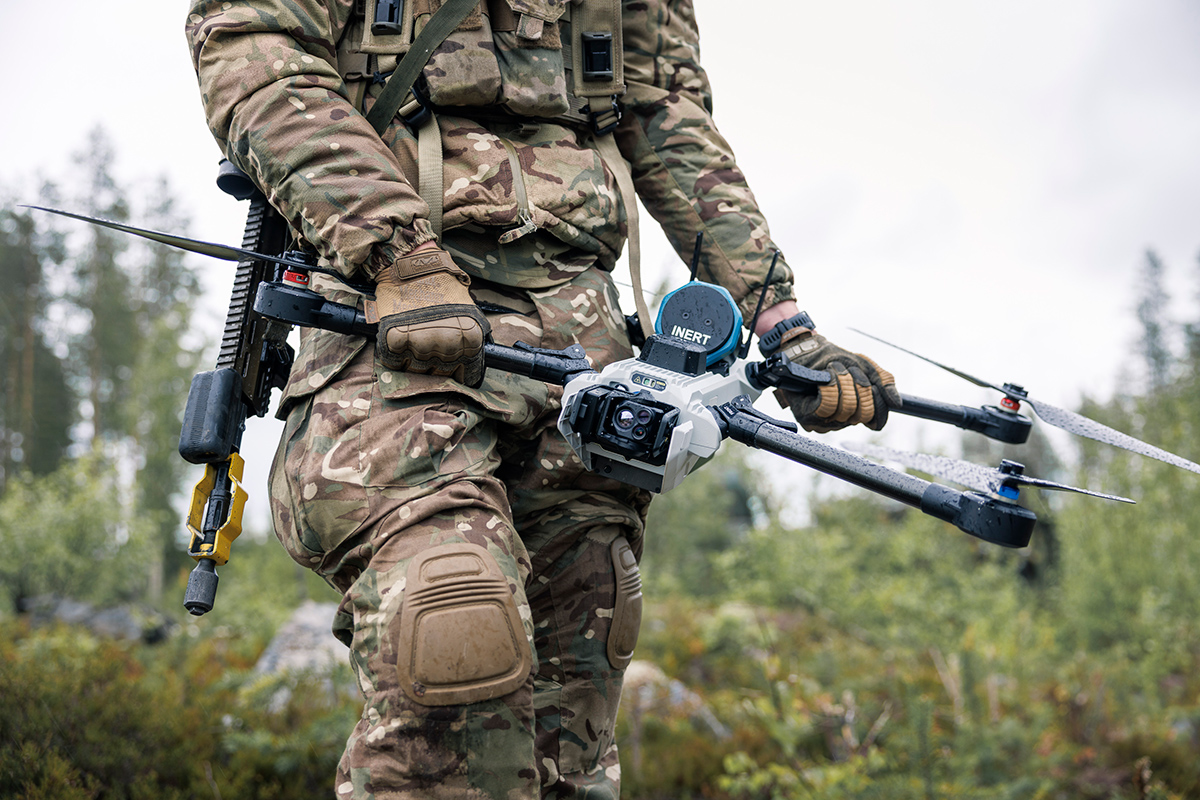 A British soldier holding a one-way effector UAV
Image credit: MoD/Crown Copyright
Spending
Unmanned systems feature heavily in the DIP, which has seen fraught negotiations inside government for months, and Defence Secretary John Healey's resignation over the document.
In his resignation letter on 12 June, then Defence Secretary John Healey said that government work had sought to “set a clear path to meet the new NATO commitment you [Prime Minister Keir Starmer] agreed, to spend 3.5% of GDP in 2035.” While Healey said that “a headmark date for 3% of GDP on defence in 2030 is what Britain must set,” he noted that instead “your DIP financial settlement... falls well short of what is required... The extra support is backloaded [pushed back to later years] when the pressure of operations and imperative to speed up readiness to fight is in the first two years [after 2026] and it rises to just 2.68% of GDP in 2030, when we will reach 2.6% next year [2027] with the investment we are already making.”
An MoD official told Janes during a briefing on 30 June that, "the plan is built on the department having an additional GBP15 billion of spending power against its previous plans agreed in the last spending review. That comprises an additional GBP11.6 billion of new cash from the Exchequer [UK finance ministry, or Treasury] for the department and GBP3.4 billion of increased spending power by transferring risk for spending lines like the burden of Ukraine security guarantees from the MoD to the Exchequer. That produces GBP15 billion in total."
The DIP said that "We [the UK government] continue to spend GBP3 billion on military support for Ukraine every year and will continue securing new industrial partnerships with Ukrainian firms." In addition GBP300 million will be invested to learn lessons and technological developments from Ukraine to develop new lower cost cruise missiles, initially air-launched, but exploring follow on land and maritime options.
Pressure, initiated by the US, continues among NATO member countries to raise defence spending. "In the document [the DIP] there is a very clear commitment that the government is making to increase defence spending to 3% of GDP in the next parliament, with the funding and profile to be agreed in the next spending review. We also confirm... our commitment to meet the 3.5% of GDP NATO target in 2035," an MoD official said.
Starmer said on 30 June that the increased funds would mean defence spending of almost GBP80 billion a year by 2029. Major funded areas include GBP63 billion over the four years to 2029 for the UK's continuous at-sea deterrent (CASD), and for the building of Dreadnought and SSN-AUKUS submarines, a replacement nuclear warhead, and associated work.
While using the broader DEL figure, combining both capital and resource spending, the funding for some of the main capability areas contributing to what the government is terming its future "Integrated Force" from FY26/27 to FY29/30 are:
- Defence Nuclear Enterprise (DNE: excluding workforce but including all investment within the DNE ringfence, including submarines, warheads and infrastructure): GBP63.6 billion
- Air: GBP27.8 billion
- Land: GBP19.2 billion
- Naval: GBP18.0 billion
- Weapons and munitions: GBP11.1 billion
- Digital backbone: GBP5.5 billion
- Science, innovation, and technology GBP4.3 billion
- Space: GBP3.2 billion
- Joint support enablement and defence medical services: GBP2.9 billion
- Cyber and electromagnetic (EM): GBP2.5 billion
- Digital targeting web: GBP1.8 billion
Spending within the DNE includes GBP47 billion for submarines (including maintenance and infrastructure). Among the things this is to cover is the build of the final Astute class submarine, continuing the build in Barrow of the four-boat Dreadnought-class boats that are set to enter service from the early 2030s, and building up to 12 SSN-AUKUS submarines, with steel on the first boat in 2027. These will be the same class of submarines that Australia will also build under AUKUS.
GBP13 billion is also intended to cover maintaining the Mk4A warhead and designing its replacement, Astraea, for the UK's Trident II D5 submarine-launched ballistic missile (SLBM) system. This is supported, the DIP added, by GBP15 billion announced in the 2025 SDR for the nuclear warhead programme between FY25/26 and FY29/30.
GBP1.7 billion has been assigned to establish a nuclear fuels programme to explore options for re-establishing a nuclear fuel cycle for defence reactor fuel. Unspecified DNE funding will also go to expand infrastructure and production including reactor core production and manufacturing capacity.
The DIP also includes:
- GBP26 billion out to 2036 on Project Royal Oak, for upgrade work to HM Naval Base (HMNB) Clyde, HMNB Portsmouth, and HMNB Devonport. This will include acquiring three floating docks and infrastructure at HMNB Clyde for out-of-water engineering for all submarine classes.
- GBP790 million to FY29/30 for integrated air and missile defence (IAMD).
- GBP11 billion on munitions including long-range strike weapons, low-cost cruise missiles and one-way effectors (OWEs), and on at least six new energetics factories and increased our national munitions production capacity by 2030.
- GBP900 million to reform procurement, including GBP500 million for a Transformation Fund for productivity investments in AI and workforce transformation, and an initial GBP400m contribution to setting up the Multilateral Defence Mechanism. The Multilateral Defence Mechanism was proposed by the United Kingdom, Finland, and the Netherlands in March 2026 to combine defence financing with joint procurement.
- GBP100 million ringfenced for a Rapid artificial intelligence (AI) Delivery Taskforce (RAID) for defence uses
Jarvis added that other government departments were required to sacrifice at least 1% of their own budgets to allow for extra spending.
Analysis by Janes defence budgets
The GBP298 billion figure outlined from FY26/27 to FY29/30, culminates in an annual defence budget of just under GBP80 billion in 2029. This means the UK would be spending just under 16% more in nominal terms on its military by the end of the period, or around 9% after the effects of inflation.
Assuming economic expansion accelerates from the currently forecast sub-1% rate in 2026 to just above 1.5% by the end of the decade, the cited figure for 2029 would likely be equivalent to just under 2.3% of GDP by 2029, up from GBP68.9 billion, or 2.2% of GDP, in 2026. The government’s claims that the plan will result in defence spending equal to 2.7% of GDP rely on the inclusion of non-military security and intelligence, amongst other categories which are not transparently reported.
This growth trajectory would not result in a major departure from that produced by recent budgets and would appear to preclude any significant growth spikes such as those seen in 2022 and 2024. In nominal terms average annual expansion of the defence budget is likely to reach around 4.9% under the plan, compared to 8.2% over the previous four years. However, given an expectation of a marked deceleration in price inflation the average real growth of 2.7% suggested by the headline DIP figures is broadly consistent with the 3.1% seen from 2022-25.
Despite the announcement of an additional GBP15 billion in funding across the four-year period, the scale of the proposed “investment” (which is in fact composed mainly of recurrent operational costs) in the DIP remains very similar to that which prompted the resignation of former defence secretary John Healey just over two weeks prior to its publication.
Healey’s departure does not appear to have materially affected funding for the DIP. Even including the extra GBP4 billion – 0.1% of GDP – now planned for allocation to the Ministry of Defence (MoD) in 2029 as part of the additional GBP15 billion announced, UK defence spending is unlikely to significantly exceed the apparent 2.68% of GDP target leaked by the former minister from an earlier version of the plan.
Although the 3% of GDP funding level (by the government’s more inclusive ‘NATO spending’ definition) advocated for by Healey will remain fairly distant under the government’s latest projection, concerns that the impact of the plans would be backloaded appear to have been addressed. According to a forecast released by the MoD 2027 is due to see the fastest budget expansion with a nominal rise of 8.1%, before a notable slowdown to 3.7% in 2028 and 3.4% in 2029.
From the 2029 base provided by the DIP, which plans to raise defence spending by the government’s most generous metric of just 0.1 percentage point of GDP over four years, the path to achieve the further 0.3 percentage point increase required to meet its reiterated goal of 3.0% of GDP by 2032 is becoming increasingly challenging.
Munitions and strike
Within the DIP is a recognition that more 'always on' production lines and greater stockpiles are needed to provide depth to the UK's warfighting capability, an MoD official said. He added that the UK is restarting and sustaining production lines for important munitions. These include: MBDA's Common Anti-Air Modular Missile (CAMM), used by the British Army's Sky Sabre surface-to-air missile system and RN frigates. Over GBP 350 million is being spent to double the number of the Sky Sabre air defence missile systems operated by the Army, said the document.
Other munitions with renewed UK production are the Advanced Short-Range air-to-air Missile (ASRAAM), the Lightweight Multirole Missile (LMM), and the Next Generation Light Anti-tank Weapon (NLAW). The DIP says the MoD will seek to re-start production of the Sting Ray torpedo to support Norway and other export partners, and onshore production of sonobuoys.
The Sting Ray Mod 1 remains the UK's primary lightweight ASW torpedo, fielded by the RN's Merlin HM2 and Wildcat HMA2 helicopters, and some of its Type 23 frigates. In November 2023 the RAF began a programme to integrate Sting Ray Mod 1 onto its P8-A Poseidon maritime patrol aircraft. In September 2024 BAE Systems was awarded a contract until 2028 to design, develop, and construct prototypes of Sting Ray Mod 2, before conducting in-water trials.
In May 2025 German Defence Minister Boris Pistorius and then UK Defence Secretary John Healey signed an agreement on the joint procurement of Sting Ray torpedoes under development for the P-8As of both the Royal Air Force (RAF) and German Navy.
The UK is also working with Germany with a GBP770 million initial investment in the DIP for ongoing work to produce 2000km+ deep strike weapons early in the 2030s. The Deep Precision Strike (DPS) missiles may form part of a family of future stealth cruise and hypersonic weapons, expected to enter service in the 2030s. Initially land-based, sea- and air- launched versions will be explored.
The UK will also join the US and Australia in the Precision Strike Missile (PrSM) programme, with a GBP190 million investment in the short range ballistic missiles.
The DIP outlined GBP6.4 billion of spending on wider munitions. An MoD official added that the UK would start sovereign production on critical energetics and explosives, adding that there would be an early investment in conventional weapons for a better mix of high-end and low-end munitions.
"What we realised in our current plans was that too much of a proportion of our munitions money was being spent on high end, complex munitions - very capable, but low numbers - and so we've redressed that balance. We've also really tried to confront this incoherency that was in our extant plans, because what we don't want is to find aircraft without long-range missiles, ships without ammunition, and army guns without artillery rounds. We begin to address that in this plan. What the plan does is it injects an increase into the lethality of the front line, especially in long-range precision strike, far sooner than we were previously planning to do," an MoD official said.
The MoD official said the UK was "putting proper money" into its collaboration on deep precision strike weapons such as those being developed by Project Brakestop. At least GBP210 million is being invested on low-cost, long-range munitions and one-way attack (OWA) unmanned aerial vehicles (UAVs) for all three branches.
Project Brakestop, which the MoD's Defence Equipment and Support (DE&S) arm announced to industry in September 2024, is the vehicle by which the MoD seeks to develop a sovereign capability for the design, development, and ‘onshore’ manufacture of an affordable long range OWE.
"It's not good enough for us to be sitting on small stocks of exquisite weapons. While bunker busting is important, there is a lot more to operations, so I think Brakestop is a good example of the kind of thing you're going to see across all three domains in the low cost, mass effectors," said the official.
"The rate of sustainment is absolutely key, of course it is, and the 'always on' investment, the starting up of a production line, the sustainment of other production lines, the sovereign energetics capabilities that we know are important and want to start up - and are funded in this parliament - all of those play a part and all of those can be scaled up. You can't scale up something that isn't there," an MoD official said, adding that, "the rate of consumption has been very much on our minds."
For more, please see UK DIP 2026: Government changes Royal Navy, funds sovereign munitions and strike capacity