South Sudan stability report, April–June 2026
Event trends
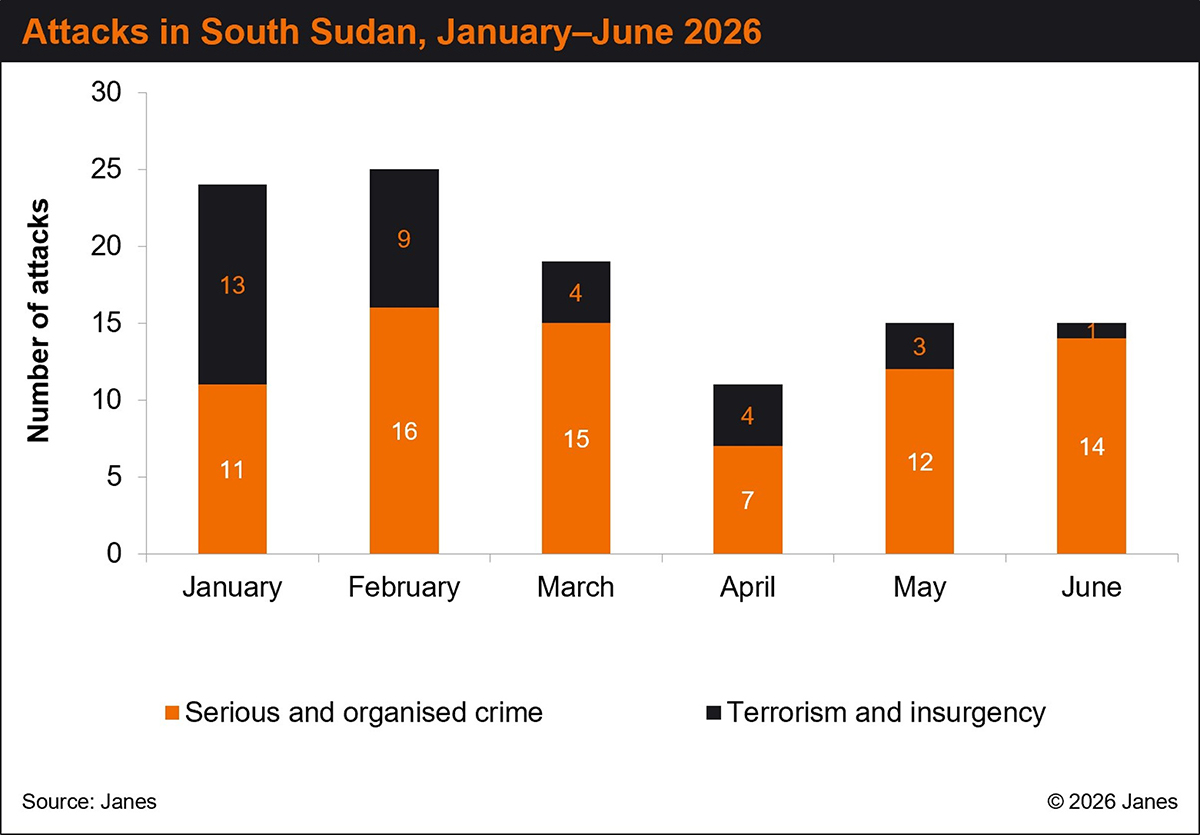 Attacks in South Sudan, January–June 2026
Image credit: Janes
Terrorism and insurgency
Janes recorded eight non-state armed group (NSAG) attacks from April to June, reflecting a 69.2% decrease compared with 26 attacks recorded from January to March. This decrease in attacks likely resulted from fragmented leadership within the SPLM/A-IO and the defection of at least 1,200 SPLM/A-IO members between January and March. Janes recorded a 66.6% decrease in South Sudan People's Defence Forces (SSPDF) counter-terrorism operations from 12 operations between January and March to four operations between April and June.
Janes recorded that all eight attacks between April–June were conducted by the SPLM/A-IO, including two jointly conducted with the ethnocultural White Armies militias. Engagement was the SPLM/A-IO’s most common tactic. The use of engagement was very likely driven by confrontations with the SSPDF, targeted in six attacks (75%) of the eight NSAG attacks. Army bases and barracks were targeted in two (25%) attacks recorded from April to June. Remaining attacks targeted civilians.
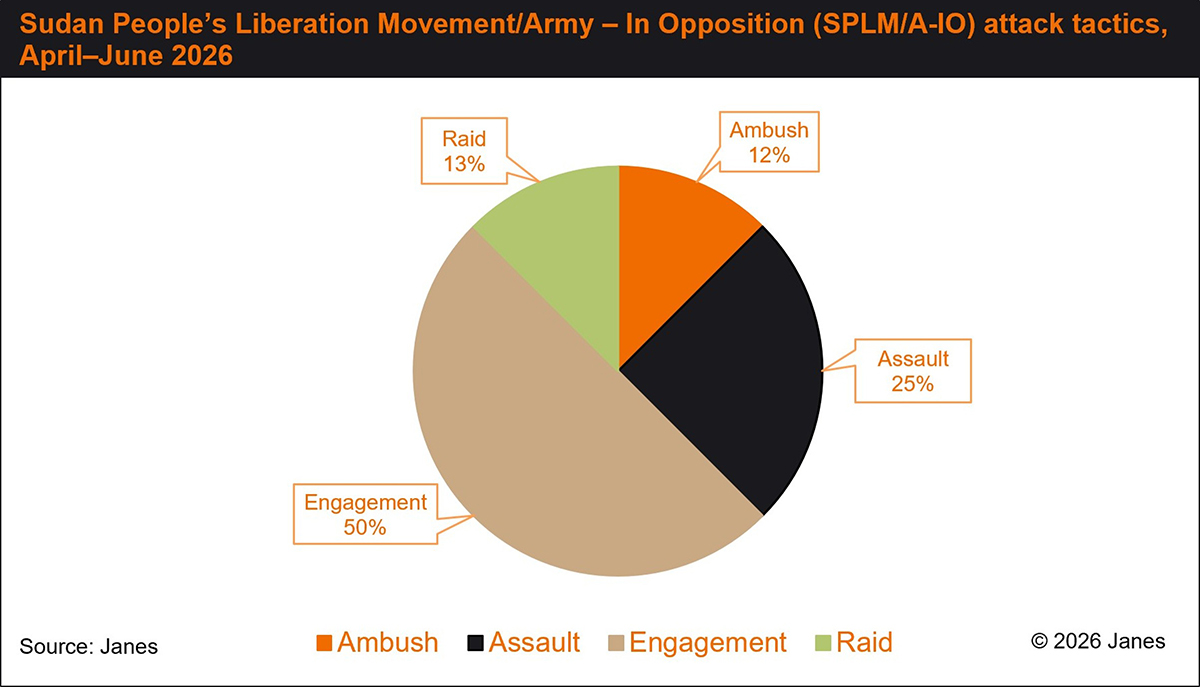 Sudan People's Liberation Movement/Army-In Opposition (SPLM/A-IO) attack tactics, April–June 2026
Image credit: Janes
The highest number of attacks (four) were recorded in Jonglei, followed by Central and Eastern Equatoria states, with two attacks each. The concentration of attacks in Jonglei is consistent with data recorded between January and March.
The decrease in attacks also accounted for a 91% decrease in non-militant casualties, from 291 between January and March to 26 between April and June.
Serious and organised crime
Janes recorded 33 serious and organised crime attacks from April to June, marking a 21.4% decrease compared with 42 attacks from January to March. The highest number of attacks were in Warrap state (nine), followed by Jonglei (six), and Western Bahr el Ghazal (five). Cattle herders and livestock were targeted in 13 of the 33 attacks (39.3%), with cattle raiding remaining a significant driver of criminal activity.
Janes’ January to March 2026 stability report assessed that criminals pose a threat to large aid convoys, and this assessment remains unchanged. On 2 June, unidentified assailants raided a cattle camp and killed at least 14 civilians and wounded 23 others. In another attack, on 29 June, unidentified assailants attacked a humanitarian convoy killing 17 civilians.
Assessment
Political transition
Revitalised Agreement on the Resolution of the Conflict in South Sudan (R-ARCSS)
Janes assesses that state stability deteriorated, and the risk of a return to war in South Sudan increased between April and June because of the Sudan People’s Liberation Movement – In Government’s (SPLM-IG’s) unilateral amendments to the 2018 Revitalised Agreement on the Resolution of the Conflict in South Sudan (R-ARCSS) peace agreement made in April.
Amendments removed the need for a national population census and a permanent constitution before elections are held. According to an 18 April article by independently run Radio Tamazuj, Minister of Information Ateny Wek Ateny said “the cabinet unanimously agreed to the amendment bill to allow the conduct of the elections”. This indicates that the SPLM-IG intends to hold South Sudan’s first national elections on 22 December despite failing to collaborate with other R-ARCSS signatories to fulfil the original provisions of the agreement.
According to the R-ARCSS, amendments must be approved by the other signatories of the agreement. However, amendments were not approved by the largest NSAG signatory - the Sudan People’s Liberation Movement/Army – In Opposition (SPLM/A-IO) - because of a lack of consultation with other R-ARCSS signatories. The Reconstituted Joint Monitoring and Evaluation Committee (RJMEC) responsible for overseeing the full implementation of R-ARCSS also did not approve the amendments. In addition, the South Sudan Opposition Alliance (SSOA) boycotted an 11 May Transitional National Legislative Assembly debate on the amendments showing further opposition to the changes. The unilateral changes very likely increase the risk of signatories pulling out of the agreement. In such a scenario, the risk of a return of full-scale war in South Sudan significantly increases. By removing the need for a census and permanent constitution, the SPLM-IG increased the likelihood of South Sudan’s elections taking place. However, this simultaneously exacerbated political instability and conflict risk. A return to full-scale fighting would almost certainly disrupt the election process.
SPLM-IG provided new funding to the National Election Commission (NEC) between April and June, demonstrating commitment to December elections. On 15 June, Radio Tamazuj reported that the NEC started a nationwide voter education campaign after receiving USD6 million from the government. NEC Chairperson Abednego Akok Kacuol also confirmed on 15 June that the NEC had paid to use the former Aida Hotel in Juba as its new permanent headquarters. These two factors show limited administrative progress in preparing for elections amid very high political instability. On 22 June, reporting by Radio Tamazuj said Kacuol reconfirmed the election date but warned of “legal inconsistencies and financial constraints” which continue to limit preparations.
Security sector reform
Political instability almost certainly prevented security sector reform between April and June based on a lack of open-source information indicating progress had been made. Distrust between South Sudanese political actors, particularly since March 2025, has maintained very high political instability, preventing security sector reform.
For more information on the distrust between South Sudanese political actors, please see Suspension of South Sudanese vice-president very likely to renew NSAG and SSPDF clashes.
However, on 30 June, Chairperson of the Ceasefire and Transitional Security Arrangements Monitoring and Verification Mechanism (CTSAMVM) Major General Teshome Anagawe Ayana (Ret.) acknowledged that there were “8 Battalions of Necessary Unified Forces deployed but it has not been fully established as unified forces”. Failure to establish the battalions as a unified force is another failure by R-ARCSS signatories to fully implement provisions of the agreement.
Ayana added that “The security situation across the country has not changed significantly and remains unpredictable, with prevailing conditions continuing to pose challenges to the full implementation of Chapter II [Permanent Ceasefire and Transitional Security Arrangements] of the Revitalised Peace Agreement”. Therefore, progress on the integration of South Sudan People’s Defence Forces (SSPDF) and former militants into a cohesive national army remains stalled as of 30 June.
Key domestic actors
Sudan People's Liberation Movement/Army-In Opposition (SPLM/A-IO)
Leadership and intent
SPLM/A-IO leadership remained split between two main factions: one loyal to SPLM/A-IO Chairman Riek Machar and an opposing faction led by Minister for Peacebuilding Stephen Par Kuol. Machar’s faction poses a greater risk to state stability because it is unlikely to engage with South Sudan’s elections and therefore conduct further attacks over the short term (one to six months).
Armed elements of the SPLM/A-IO loyal to Machar have continued to conduct attacks following Machar’s arrest in March 2025. This demonstrates the faction’s willingness to return to war against the SPLM-IG if Machar is not released. At least five SPLM/A-IO attacks targeted SSPDF garrison towns between 24 December 2025 and 4 January 2026. However, SPLM/A-IO attacks decreased in frequency between April and June, likely due to a lack capacity to sustain a high frequency of attacks against the SSPDF. Par Kuol’s faction continued engaging with the transitional government and will contest December’s election. This assessment is based on Par Kuol’s registration of his faction as the IO Party with the Political Parties Council (PPC) on 30 June, the deadline for parties to register to participate in the election. SPLM/A-IO Political Bureau member Joseph Malwal Dong (aligned with Machar’s faction) said, “the registration marks the formal political separation of Stephen Par’s faction from Machar’s SPLM/A-IO”, according to a 30 June Radio Tamazuj article. The SPLM/A-IO is not a registered political party and therefore cannot participate in the election.
For more information on SPLM/A-IO attacks in December and January, please see SPLM/A-IO attacks on SSPDF garrisons increase South Sudan's very high civil conflict risk in the immediate term.
Capabilities
Janes assesses that the 1,200 defections which occurred between January and March very likely weakened SPLM/A-IO’s capabilities between April and June resulting in reduced attack frequency, as recorded by Janes since April. In the South Sudan stability report, January–March 2026, Janes assessed that defections “likely indicate weakened military and political support for Machar’s faction, particularly in Unity state”. The report also noted that the SPLM/A-IO “very likely has the capability to conduct successful near simultaneous attacks across different locations”. However, the decreased number of SPLM/A-IO attacks indicates that the group could not sustain its armed campaign with the frequency and intensity recorded at the beginning of 2026. Therefore, Janes assesses that defections likely hinder the SPLM/A-IO's ability to significantly increase the tempo of attacks in the immediate term (one to four weeks).
South Sudan People's Defence Forces (SSPDF)
Leadership and intent
President of South Sudan Salva Kiir reappointed General Santino Deng Wol as Chief of the Defence Forces on 6 May. The reappointment of Gen Deng Wol reflects frequent appointments and reappointments to senior SSPDF leadership roles. Janes assesses that this is very likely intended to limit the political standing and influence of the chief of defence forces and to reduce the risk of coup plotting against Kiir.
Gen Deng Wol had served as chief of the SSPDF between April 2021 and December 2024. Then, General Paul Nang Majok led the SSPDF from December 2024 until July 2025, and General Dau Aturjong Nyuol served a brief period from July 2025 until Majok was reappointed again on 8 October 2025. On 30 June, CTSAMVM Chairperson Maj Gen Anawaye said, “Since the current Chief of Defence Forces [Deng Wol] assumed SSPDF leadership, there is noted reduction in hostilities across the country”. This aligns with Janes data showing a decrease in SSPDF counter-terrorism operations and SPLM/A-IO attacks between April and June.
Capabilities
On 4 May, the United Nations (UN) Panel of Experts on South Sudan published its final report for the 2025–26 period which noted the SSPDF had “received a significant transfer of new weapons, ammunition and military equipment” in 2025 including new Kalashnikov-pattern assault rifles. The panel also obtained images of new unspecified rifles captured from SSPDF soldiers in Upper Nile in 2025, with markings showing the weapons had been manufactured in 2024. The report did not indicate a source for the rifles and their transfer violates a UN imposed arms embargo against South Sudan. Janes monitoring throughout 2025 did not identify large scale shipments of arms to South Sudan.
On 29 May, the UN Security Council renewed its arms embargo against South Sudan until May 2027. This is very likely to lead the SSPDF to seek illicit sources of weapons and ammunition to increase its capabilities ahead of December elections so that the army can provide security throughout the election period.
The UN report also highlighted the surrender of equipment from the Sudanese Armed Forces (SAF) to the SSPDF following the SAF withdrawal from Heglig into South Sudan in December 2025. SAF equipment surrendered to the SSPDF in December was likely subsequently used in SSPDF operations in Jonglei and Upper Nile. The risk of illicit arms flows from Sudan will almost certainly remain high as Sudan’s war continues. The flow of weapons is very likely to exacerbate instability in South Sudan and heighten the frequency of armed violence.
According to the report, SAF soldiers brought a “significant quantity of weapons and ammunition”. This included unspecified numbers of AK-47 rifles, mortars, light machine guns, rocket propelled grenades, towed artillery and vehicle mounted weapons. This included ZY-23-2 anti-aircraft cannon, T-72 tanks, 122 mm field artillery, ZPU-4 anti-aircraft guns, a 122 mm rocket launcher, and several armoured personnel carriers (APCs). This equipment was received by SSPDF Deputy Chief of Defence Forces Johnson Olony who led SSPDF operations in Jonglei and Upper Nile in January and February 2026. Video footage circulated on social media in late January showed Olony telling Agwelek forces aligned to the SSPDF to “spare no lives” ahead of SSPDF counter offensives against the SPLM/A-IO.
Outlook
Short term (one to six months)
- South Sudan’s national election is likely to be held in December because of the SPLM-IG's amendments to R-ARCSS between April and June which indicate their commitment to holding December elections. This is the highest probability assessment Janes has concluded since the first stability report was published in April 2025 and represents an increased likelihood compared with the January–March 2026 report.
- However, Janes maintains its previous assessment, published in April 2026, that elections will almost certainly not be democratic or transparent.
- The exclusion of the SPLM/A-IO from the political transition will very likely lead to armed violence that will disrupt the conduct of the 2026 election. This is demonstrated by the SPLM/A-IO's refusal to register as a political party and to contest the election.
- If the election is held, the inclusion of South Sudanese constituencies in the Abyei border area is very likely to renew Sudan-South Sudan tensions over the status of the territory. This assessment is based on a 13 July 2026 statement published by Sudan’s Ministry of Foreign Affairs which said Sudan rejected the NEC’s decision to include areas of Abyei which it claimed, “violates the Abyei Protocol annexed to the Comprehensive Peace Agreement of 2005, and the Agreement on Temporary Security and Administrative Arrangements for Abyei Area signed between the two countries in 2011”.
For previous iterations of this report series, please see: South Sudan stability report, January–March 2026 and South Sudan stability report, October–December 2025.
Information gap 1: Sources of military equipment received by the SSPDF in 2025 excluding equipment handed over by the SAF in Heglig. Risk negative indicator: SPLM/A-IO withdraws from R-ARCSS and issues public statements urging its members to mobilise for armed action. |
Analysis terminology
Image credit: Janes