Appointment of Mojtaba Khamenei as Supreme Leader of Iran very likely indicates that elite cohesion will remain strong in the immediate-term
Event
On 9 March 2026, Iran's official state news agency announced that Ayatollah Seyyed Mojtaba Hosseini Khamenei, son of the previous Supreme Leader of Iran, Ayatollah Ali Khamenei, had been elected to take the role of the third Supreme Leader of the Islamic Republic of Iran.
Context
Mojtaba Hosseini Khamenei was born in 1968 and is Ayatollah Ali Khamenei's second of four sons, with multiple open sources agreeing that Mojtaba is the most politically influential and active of them.
Mojtaba has kept a low public profile for most of his life but has been an important component in the operation of the Office of the Supreme Leader (Bayt-e Rahbari/Bayt), principally coordinating with the intelligence services and the Islamic Revolution Guard Corps (IRGC), both institutions Mojtaba almost certainly has strong connections with.
Indeed, a February 2026 report by United Against Nuclear Iran (UANI) states that "Mojtaba has shown particular interest in security and military matters and effectively serves as a mini-supreme leader within his father's office."
The UANI report also states that within the Bayt-e Rahbari there are informal security and intelligence groups that have historically helped to marginalise and oppose reformist movements and popular reformist politicians. One such informal network includes what the UANI calls the "Habib Ring" and that "Mojtaba Khamenei commands the Habib Ring, which includes members from his previous IRGC battalion, the Habib Battalion." Indeed, as a March 2026 report from the Washington Institute for Near East Policy states, "Mojtaba’s formative military experiences came during the Iran-Iraq War. As a teenager, he served with the IRGC’s 27th Division, mainly in non-combat roles but sufficient to cultivate close camaraderie with other members of his small “Habib Battalion,” many of whom later filled senior positions in the IRGC, intelligence services, and government.
Another instance of Mojtaba's influence according to the UANI report is when Mojtaba "began meddling in the affairs of the Islamic Propaganda Organisation (IPO), a body under his father's direct authority" and that "in 2002, Mojtaba's behind-the-scenes actions led to the head of the IPO being replaced by one of Mojtaba's close allies, Hojatoleslam Kambooshi, who would go on to lead the IPO for more than 17 years", with another ally of Mojtaba's, Mohammad Qomi being appointed to the IPO in 2019.
Mojtaba's influence and network also extends into the economy. Indeed, in November 2020, the US Department of the Treasury "took action against a key patronage network for the Supreme Leader of Iran, the Islamic Revolution Mostazafan Foundation (Bonyad Mostazafan, or the Foundation), an immense conglomerate of some 160 holdings in key sector's of Iran's economy, including finance, energy, construction, and mining."
Importantly, the US Treasury noted that "while Bonyad Mostazafan is ostensibly a charitable organization charged with providing benefits to the poor and oppressed, its holdings are expropriated from the Iranian people and are used by the Supreme Leader Ali Khamenei to enrich his office, reward his political allies, and persecute the regime’s enemies"
The US Treasury then stated that "the abuse of Bonyad Mostazafan’s assets also benefits the Supreme Leader’s inner circle. Gholam-Ali Haddad-Adel, a Khamenei confidant and the father-in-law of his son Mojtaba Khamenei, occupies Foundation property worth some USD100 million, paying rent far below market rates" and that "Haddad-Adel, was designated pursuant to E.O. 13876 in November 2019" and "Mojtaba Khamenei was simultaneously designated pursuant to E.O. 13876 alongside Haddad-Adel."
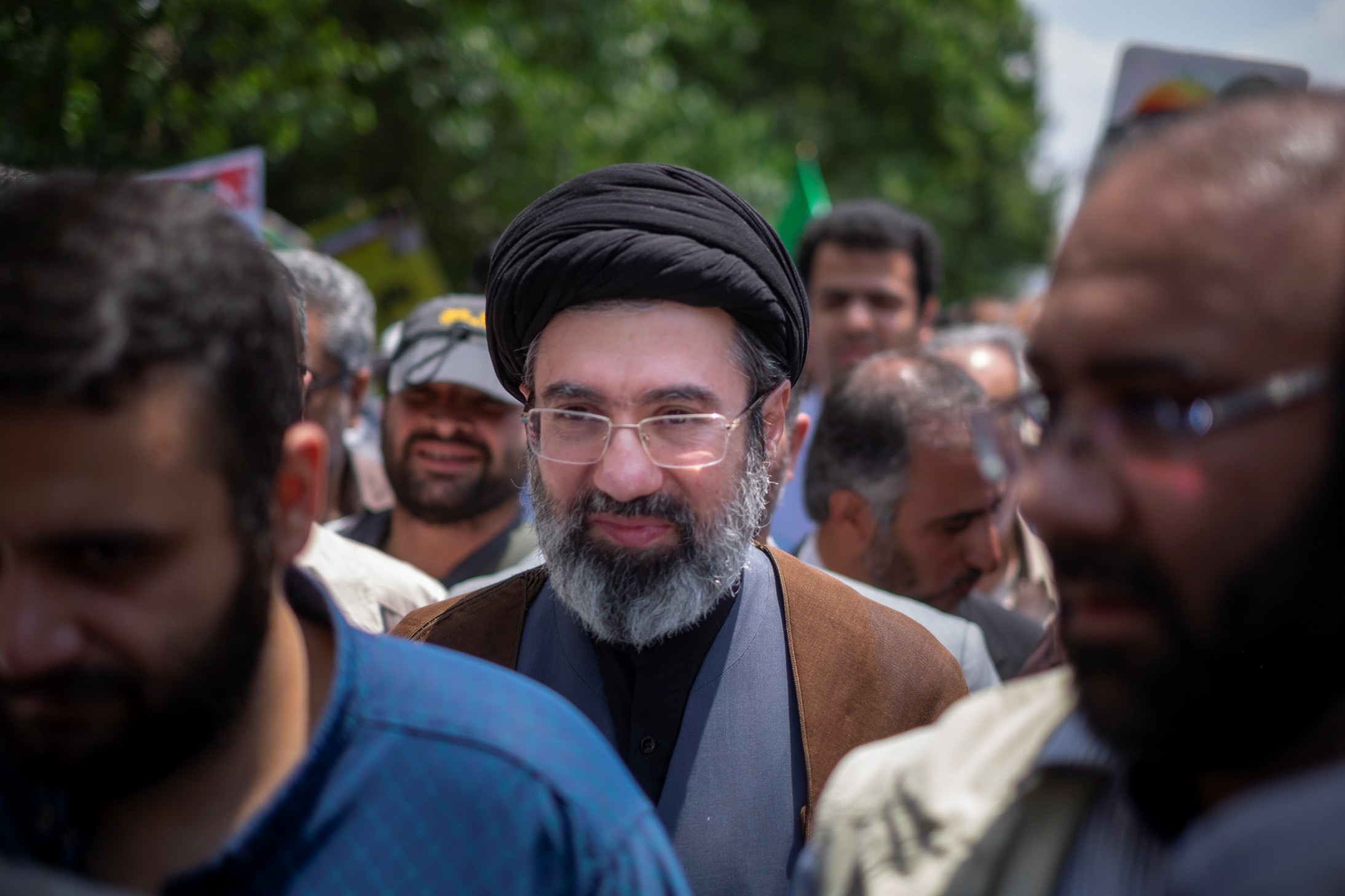
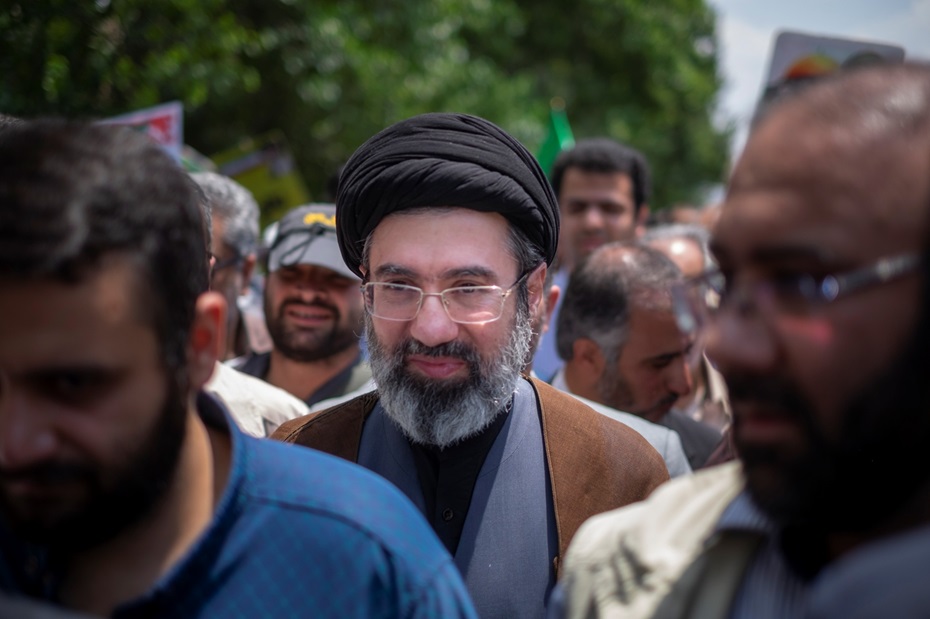
Image caption: Mojtaba Khamenei, Son of Iran's former Supreme Leader Ayatollah Ali Khamenei, attends a demonstration to mark Jerusalem day in Tehran on 31 May 20219. Image credit: Photo by Morteza Nikoubazl/NurPhoto via Getty Images
Green movement
Multiple open sources also agree that Mojtaba played an important role in organising the security crackdown against the 2009 Green Movement protests. Indeed, author and Iran analyst Arash Aiziz told Iran International on 4 March 2026 that this instance "is why he [Mojtaba] has been a bete noire of democratic movements at least since 2009 when he was rumoured to have helped orchestrate the repression."
Supreme Leader credentials
Despite Mojtaba's links to the Supreme Leader's office and his wide network, he lacks the highest level of religious credentials and standing that would normally be required of a Supreme Leader.
Indeed, although he has studied in the seminaries of Qom under prominent conservative scholars, he is not classified as a Mujtahid. A Mujtahid is a senior cleric with the rank of Ayatollah who possesses the religious authority and ability to conduct Ijtihad which is the doctrine of interpreting religious texts and make prescriptions on that interpretation. However, his father Ayatollah Ali Khamenei also did not hold the highest level of religious credentials and the constitution of Iran was amended in order to allow him to be Supreme Leader.
Mujtaba has also never formally held elected public office or an official state administrative office apart from his role within the Bayt-e Rahbari.
Significance
The appointment of Mojtaba Khamenei as Supreme Leader of Iran very likely indicates that elite cohesion remains strong in Iran and that primary actors like the IRGC, clerical, and political leadership of Iran retain a broad level of elite consensus
Mojtaba's historical association within the Bayt-e Rahbari and his strong connections to the IRGC and Iran's intelligence services very likely indicates that the hardliners within Iran's political system retain elite consensus.
Mojtaba is almost certainly a continuity candidate that all the main influential actors across Iran (IRGC, Clerics, and hardline civilian politicians) have quickly agreed to during a time of existential crisis for the government and the Islamic Republic.
The appointment of Mojtaba as Supreme Leader indicates that it is unlikely that there will be any fundamental shifts in government policy towards domestic reform.
As highlighted in this report, Mojtaba has almost certainly been a core part of his father's operations and has been involved in many of the security crackdowns on protest movements in Iran, most especially the 2009 Green Movement.
This indicates that the hardliners and Iranian government apparatus have appointed someone who will very likely be unpopular to segments of the Iranian population who are seeking large-scale domestic political reforms.
Instead, this appointment very likely indicates that hardliners are seeking to project continuity at a domestic level and that the Islamic Republic's revolutionary commitments and ideology are broadly continuing in the same direction set by Ayatollah Ali Khamenei.
The appointment of Mojtaba likely indicates that Iran will not seek to compromise with the United States and Israel in the immediate-term (next four weeks) and will seek to survive the conflict by prolonging the engagement for as long as possible and by widening the war's impacts regionally and globally
Statements by Secretary of the Supreme National Security Council (SNSC) Ali Larijani and other hardline politicians indicating that they are not seeking negotiations with the United States are very likely the product of elite agreement, something Mojtaba has very likely played a role in formulating since 28 February. This indicates that it is very unlikely that Mojtaba will announce any shift in Tehan's approach to the current conflict in the immediate-term.
Outlook
Immediate-term (next four weeks)
The new Supreme Leader will almost certainly be concerned with survival in the immediate-term.
Mojtaba will also very likely try to project a unified message among elite factions to project government strength and unity while shoring up those sections of the population that support the Islamic Republic.
Mojtaba is unlikely to consider any indication of broad reform but there is a roughly even chance he tries to broaden his message to include all Iranians under a more nationalist tone in light of attacks against the country by the United States and Israel, echoing the government's use of such messaging during the June 2025 conflict.
Short-term (one to six months)
The short-term outlook is highly dependent on the course and outcome of the current conflict but Mojtaba's historical profile and association very likely mean that a substantial part of his father's ideology and political agenda are continued. This will almost certainly have implications for broader domestic stability and the risk of protesters seeking domestic reform beginning to stage mass protests again.
Alternative scenario
Mojtaba's appointment opens up a brief window of opportunity for a pivot in both external and internal approaches and for political messaging to be nuanced in light of a new Supreme Leader being appointed after 37 years of Ayatollah Ali Khamenei.
Such a political opportunity could see Mojtaba seek to reframe certain aspects of his father's approach to domestic and external issues, presenting an opportunity to reset dynamics marginally to 1) placate those domestically who are more reform-minded and 2) seek to engage with Israel and the United States and to set out new positions on Iran's nuclear programme and establish a pathway out of the current conflict.
Such an approach could establish a new domestic coalition by bringing back in the moderate politicians and seek to unify the country on a broader base rather than sticking to a hardline continuity narrative.
Such a nuanced and flexible approach is unlikely but would operate alongside the political capability a new incumbent generally has in political office to shape a new narrative in the immediate-to-short-term and which could help the Iranian government to be more flexible towards the US and Israel in any negotiations and to also help mitigate any domestic stability risks if the conflict ends.
Risk positive indicator
Elite consensus continues to remain strong in the short-term (one to six months), shoring up Mojtaba's base of support.
An end to the conflict with the United States and Israel would allow the new Supreme Leader to focus on domestic stability.
Risk negative indicator
Mojtaba is killed in US and/or Israeli strikes and a new successor becomes much more contested between the elite factions in Iran. This could lead to elite fragmentation and the risk of a civil-military crisis.
Mass protests and riots breakout in the immediate-term based around opposition to Mojtaba's appointment, leading to an increase in domestic instability risks.
Image caption: Analysis terminology. Image credit: Janes