Russia begins series production of S-500 air-defence system
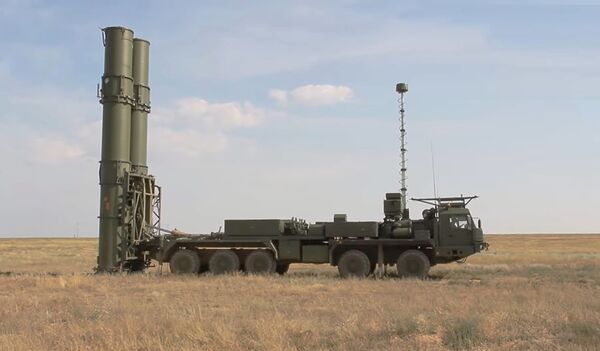

Footage released by the Russian MoD on 20 July 2021 showing the S-500 air defence system conducting a test launch against a ‘high-speed ballistic target' at the Kapustin Yar training ground about 100 km east of Volgograd. (Russian MoD)
The S-500 long-range surface-to-air missile system has entered series production, Almaz-Antey CEO Yan Novikov told the Russian National Defence journal on 25 April in an interview commemorating 20 years of thecorporation.
Novikov also mentioned the S-400 and Tor-M2 air defence systems, in addition to identifyingthe Buk-M3 and S-350 Vityaz as the concern's most promising export prospects, referring to the two medium-range systems as Almaz-Antey's “calling cards”.
The 9K317M Buk-M3 and 50R6 S-350 are in service with the Russian Armed Forces. The Buk-M3 made its combat debut during the Russian invasion of Ukraine. Viking is the name of an export iteration of the Buk-M3.
The exact characteristics of the S-500 Prometey (Prometheus), allocated a UV PVO index code of 55R6M and the research and development effort, which was codenamed ‘Triumfator-M', are the subject of debate, but according to official Russian sources the system can engage targets at a maximum altitude of 100–200 km and at a range of 500–600 km, depending on the speed, size, and radar cross-section of the target. An unnamed US intelligence source told CNBC in May 2018 that the system's missile struck a target 481 km away during a test.
Go beyond the headlines - with direct links to interconnected entities
Get full access to validated equipment, military capabilities, and market insights.