Oshen trials C-Star acoustic picket line at AUKUS exercise
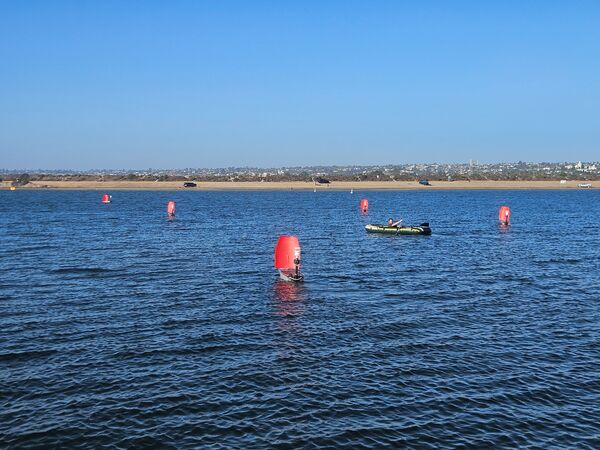

Oshen's C-Star USVs, seen during AUKUS Exercise ‘Maritime Big Play Pacific', held in October 2026. (Oshen)
UK company Oshen deployed eight C-Star unmanned surface vehicles (USVs) to form a passive acoustic picket line off San Diego during Exercise ‘Maritime Big Play Pacific', the company announced on 4 November 2026. Oshen described the trial as the first demonstration of this type of acoustic barrier under AUKUS. It was the company's first AUKUS exercise.
Each 1.2 m long, 50 kg C-Star towed a hydrophone supplied by the UK's Systems Engineering & Assessment (SEA). The boats use wind for propulsion and solar power for their electronics. Onboard software uses artificial intelligence to flag underwater sounds of interest and sends alerts to operators by satellite datalink. During the exercise, a control system shared by Australia, the UK, and the US combined those alerts with data from other manned and unmanned platforms. Oshen said the aim is to direct ships or aircraft to investigate a contact.
Oshen CEO Anahita Laverack said none of the eight USVs required recovery during the trial. The exercise concluded on 25 October. The UK led its anti-submarine warfare element, contributing 13 USVs, four underwater gliders, and two anti-submarine warfare targets from six industry partners, according to the UK Ministry of Defence (MoD).
At Exercise ‘REPMUS 26' off Tróia, Portugal, in September, Oshen tested its picket line against live targets. Three of its six C-Stars towed omnidirectional SEA hydrophones and the other three carried environmental sensors, Laverack said 21 September. She said Oshen's Lighthouse software manages groups of C-Stars and the vessels can transmit data over the Iridium satellite network. SEA announced a follow-on order for its low-power hydrophones on 30 September.
Go beyond the headlines - with direct links to interconnected entities
Get full access to validated equipment, military capabilities, and market insights.