BAE plans trials of updated Herne XLAUV
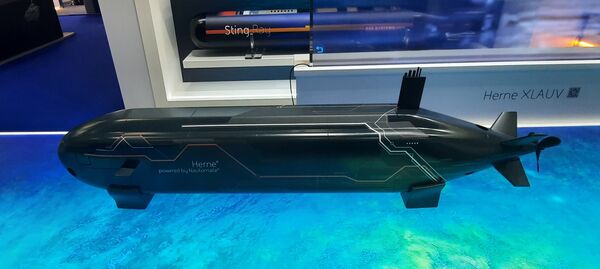

BAE Herne XLAUV model on display at UDT 2026. (Janes/Neil Dee)
BAE Systems is planning trials of a new version of its Herne extra-large autonomous underwater vehicle (XLAUV), with the new version of Herne entering the water in 2026, with trials planned in Canada in 2027.
The new version builds upon the Herne Alpha variant, developed with Canadian company Cellula Robotics, which was tested in 2024. The new version of Herne will be designed by BAE and manufactured by Cellula. In contrast to the spine design of Herne Alpha, the new version will have a bolted aluminium framework allowing for ease of manufacture, Will Doherty, programme lead autonomy, BAE Systems, told Janes during a media briefing at the firm's Broad Oak site in Portsmouth on Tuesday 23 June 2026.
Doherty said that Herne is a 12 m, free flooding XLAUV capable of embarking 5,000 l of payload. The XLAUV consists of six sections for power (aft), sensors (forward), and mission payloads (central), he added, speaking alongside the NATO Industrial Advisory Group (NIAG) plenary meeting in Portsmouth.
Herne is a multi-role platform. Possible integrations include an intelligence, surveillance, and reconnaissance (ISR) mast from Thales, a thin-line array sonar, and BAE's Sting Ray lightweight torpedo. Herne also features BAE's Nautomate autonomous control system.
For more, please see:Feature: XLUUV developments chart a course to hybrid underwater fleetsBAE Systems' Herne XLAUV completes first in-water demonstrations
Go beyond the headlines - with direct links to interconnected entities
Get full access to validated equipment, military capabilities, and market insights.