North Korea fires two apparent SRBMs
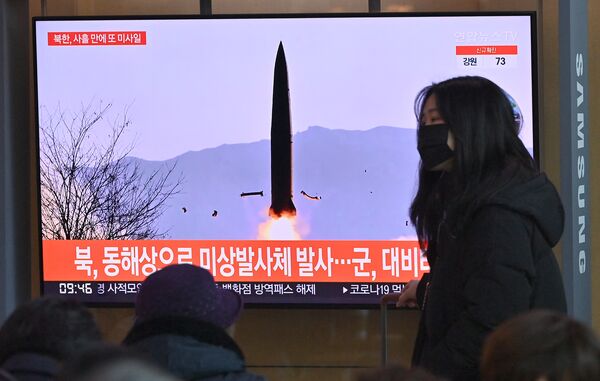

Footage of a North Korean KN-23 short-range ballistic missile launch is shown on a television screen in South Korea. The missiles launched on 20 September exhibited flight characteristics consistent with the KN-23 family. (Photo by Jung Yeon-Je/AFP via Getty Images)
North Korea launched what South Korea's Joint Chiefs of Staff (JCS) assessed to be two short-range ballistic missiles (SRBMs) on 20 September.
The JCS reportedly said the weapons were launched from the Wonsan area on North Korea's east coast towards the East Sea (Sea of Japan). The first missile was launched at approximately 1500 h local time and the second at 1750 h.
Japan's Ministry of Defense (MoD) said the first missile travelled 440 km and reached an altitude of 60 km, while the second travelled 590 km and reached an altitude of 70 km. Both projectiles landed outside Japan's exclusive economic zone.
Janes assesses that the reported flight characteristics suggest that the missiles were likely derivatives of North Korea's KN-23 SRBM family, although neither the MoD nor the JCS has publicly identified the missile type at the time of publication.
Previous KN-23 flight tests have demonstrated ranges of up to 690 km while maintaining low-altitude trajectories of between 37 km and 60 km.
However, the missiles fired on 20 September followed higher trajectories, potentially indicating the development of a modified variant, a different payload configuration, or an alternative flight-test profile. A separate unidentified SRBM fired by North Korea on 12 August, possibly a KN-23 derivative, travelled 690 km and reached an altitude of 90 km, also demonstrating a higher-altitude trajectory.
Go beyond the headlines - with direct links to interconnected entities
Get full access to validated equipment, military capabilities, and market insights.