Aselsan advances UAV and C-UAV strike capabilities
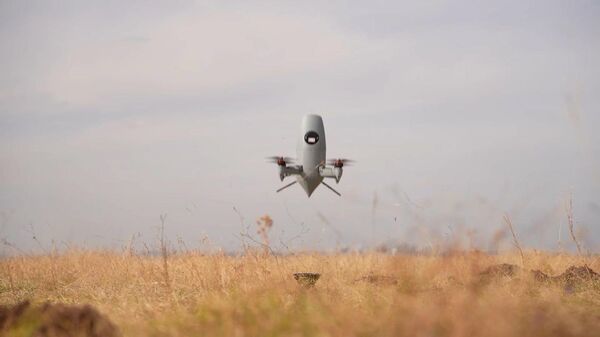

Aselsan's Gökalp E1 interceptor UAV, seen in a photo released on 10 October 2026 after a test of the system. (Aselsan)
Turkish defence companies are developing interceptor UAVs and long-range precision weapons for delivery by unmanned aerial vehicles (UAVs).
On 10 October 2026 Aselsan announced that it had demonstrated its Gökalp interception system against a first-person-view (FPV) UAV, while its Morfoz winged guidance kit was tested on a Mk-82 bomb released from a Bayraktar Akıncı UAV.
Gökalp uses radar and electro-optical sensors to detect hostile UAVs and intercepts them autonomously. It fits on two pick-up-sized vehicles: one carries the radar and controls; the other carries the electro-optical system, interceptor and command equipment.
During a demonstration at Aselsan's Oğulbey Technology Base in Ankara, the company said its Aura 3D surveillance radar detected the target and relayed data through the command-and-control software to the Gökalp E1 interceptor, which destroyed it by direct impact, according to Aselsan.
Aselsan's Dronedef command-and-control software integrates detection and countermeasures against UAVs as part of Türkiye's Steel Dome integrated air defence architecture.
For precision strike, Aselsan's Morfoz KGK 82 kit converts a 500 lb Mk-82 bomb into a guided weapon.
According to Aselsan, Morfoz has deployable wings and operates day and night in different weather conditions. It combines inertial navigation and global navigation satellite system (GNSS) guidance with a controlled reception pattern antenna (CRPA) to improve resistance to GNSS jamming.
Aselsan claims a maximum range of 100 km from a manned aircraft or 60 km from a UCAV, with a circular error probable (CEP) of less than 10 m.
Go beyond the headlines - with direct links to interconnected entities
Get full access to validated equipment, military capabilities, and market insights.