Rauma Marine lays keel for fourth Finnish Pohjanmaa-class corvette
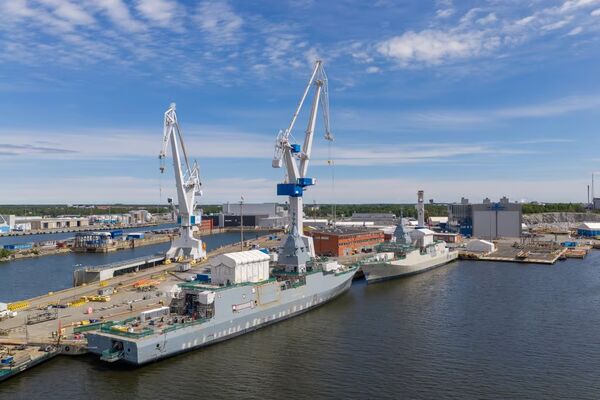

One of four future Pohjanmaa-class corvettes under construction in Finland. (Rauma Marine Constructions)
Finland's Rauma Marine Constructions (RMC) laid the keel for the fourth and final Pohjanmaa-class multirole corvette being built for the Finnish Navy under its Squadron 2020 programme, the company said in a 5 August 2026 press release.
Steel cutting for the fourth corvette took place in January 2026. Construction of all four Pohjanmaa-class vessels is now well advanced. The first and second corvettes were launched in May 2025 and May 2026 respectively and are undergoing outfitting, while the third vessel is in the hull assembly phase following its keel-laying in January 2026, said RMC.
Designed for year-round operations in Baltic Sea conditions, including ice, the vessels will eventually replace the Finnish navy's four ageing Rauma-class fast attack craft, two Hämeenmaa-class minelayers, and one Pohjanmaa-class minelayer (decommissioned in 2013) as part of Squadron 2020. Their capabilities will include laying sea mines, conducting anti-submarine operations, securing sea lines of communication, and achieving sustained presence at sea, said the Finnish Navy in a press release on 4 August.
Each 4,300 tonne Pohjanmaa-class corvette has an overall length of 117 m, a beam of 16.5 m, a draught of 5 m, and a crew complement of 70.
For more, please see: Finland hits corvette construction midpoint milestone
Go beyond the headlines - with direct links to interconnected entities
Get full access to validated equipment, military capabilities, and market insights.