MENA Energy Activity Tracker – 01 July to 11 August 2026
Events: This report considers major energy-related events across the Middle East and North Africa (MENA) region throughout the period 01 July to 11 August 2026. The report provides a case study of Saudi Arabia and its energy sector developments.
Significance: Saudi Arabia's oil and gas revenues have not been materially impacted by the closure of the Strait of Hormuz (SoH), as higher oil prices and a shift from exporting via the SoH to using Red Sea export routes have offset output losses amid the ongoing US-Iran conflict.
However, this resilience has been dependent on Saudi Arabia's unrestricted access to the Red Sea. If use of the waterway is also constrained by attacks on Saudi shipping, Riyadh's export flows through the Suez-Mediterranean (SUMED) pipeline and the Suez Canal are very unlikely to be able to replace those that have been passing through the Bab al-Mandeb since March 2026.
Outlook:
Key Points
- In the likely scenario that the SoH remains constrained and Ansar Allah continues to attack Saudi vessels attempting to cross the Bab al-Mandeb, Janes assesses that Saudi Arabia will likely only be able to export between 3-4 million bpd of both crude and refined products through the SUMED and Suez workaround. In this case, Saudi Arabia is likely to experience a decrease in government revenues of USD21.83 to 24.87 billion in 2026, a -7.2% to -8.2% decline relative to 2025.
- In the deterioration scenario, both the Red Sea and the SoH remain closed, but Ansar Allah also escalates missile and UAV strikes on Saudi Arabia's oil infrastructure. In this case, Saudi Arabia is likely to experience a decrease in government revenues of USD48.81 to 51.27 billion in 2026, a -16.1% to -17% decline relative to 2025.
Events – 01 July to 11 August 2026
Iran
- 7 July: Qatari Liquefied Natural Gas (LNG) tanker Al Rekayyat was damaged near the Strait of Hormuz (SoH), after Iran's Islamic Revolutionary Guard Corps (IRCG) fired missiles at transiting ships.
- 20 July: Iran's Executive Deputy to the President stated that Iran expects to restore approximately 100 million cubic metres per day of natural gas production capacity over the “coming months”. Janes notes that, according to Reuters, Iran had produced approximately 800 million cubic metres per day before the outbreak of the US-Iran conflict. However, attacks on Iran's infrastructure have removed around 230 million cubic metres of output since the conflict began.
Yemen
- 20 July: Chinese Trinasolar, a photovoltaics (PV) company, signed a Memorandum of Understanding (MoU) with Al-Raebi, a Yemen PV company, to explore a 1.5GW solar project pipeline in Yemen.
- 20 July: Ansar Allah (Yemen) announced the imposition of a naval blockade on Saudi Arabia.
- 22 July: Ansar Allah claimed attacks on two Saudi oil tankers in the Red Sea using ballistic missiles, cruise missiles, and unmanned aerial vehicles (UAVs), after the vessels allegedly violated the group's blockade.
Saudi Arabia
- 23 July: Saudi Aramco reportedly offered additional crude oil cargoes for loading from Egypt's Sidi Kerir Mediterranean port in response to threats to Saudi shipping from Ansar Allah's announced blockade.
- 28 July: Reports indicated Saudi Aramco had closed the 400,000 barrel per day (bpd) Jizan oil refinery, located on the Red Sea coast following an attack by Yemen's Ansar Allah on the facility.
- 31 July: Saudi Aramco reported a 33% increase in Q2 profit as it benefitted from increased oil prices - adjusted net income increased to USD33.4 billion, up from USD25.2 billion the previous year.
- 10 August: Saudi Aramco has postponed the restart of the Jizan refinery to 30 August 2026, according to Reuters.
Organisation of Petroleum Exporting Countries (OPEC)
- 5 July: OPEC+ agreed to boost oil output by 188,000 bpd for August. Janes notes that OPEC+ output was 22.00 million bpd in June 2026, up from 18.95 million in May.
- 10 August: Reuters reported that core OPEC member oil output had increased by 1.17 million bpd in July, to 19.85 million bpd.
United Arab Emirates (UAE)
- 2 July: XRG, the UAE's global energy investment platform, strengthened its US Liquefied Natural Gas (LNG) position by acquiring equity interests in all liquefaction trains under construction at the Rio Grande project, Texas.
- 6 July: The Abu Dhabi National Oil Company (ADNOC) launched Abu Dhabi Global Market (ADGM), a global LNG marketing and trading platform, targeting 47 million tonnes per annum (mtpa) of combined marketable LNG by 2035.
- 7 July: ADNOC signed a 15-year agreement to supply Japan's Inpex Corporation with 1 mtpa of LNG from its Ruwais LNG project.
- 9 July: Abu Dhabi's Masdar signed a 11.275 GWh battery contract with China's BYD.
- 21 July: ADNOC took a Final Investment Decision (FID) to deploy USD6.2 billion to develop the Umm Shaif Gas Cap in Abu Dhabi in partnership with Italy's ENI, France's TotalEnergies, and the China National Petroleum Corporation.
- 31 July: ADNOC bought five operational Very Large Crude Carriers (VLCCs) for USD590 million.
- 7 August: ADNOC announced it had acquired a further five Very Large Gas Carriers (VLGCs) and six VLCCs for approximately USD1.3 billion.
- 8 August: The UAE condemned an alleged Iranian attack on an ADNOC carrier as it passed through the SoH
- 10 August: ADNOC Gas announced it had taken FIDs and awarded USD8.2 billion in Engineering, Procurement, and Construction (EPC) contracts for its Rich Gas Development project.
- 10 August: ADNOC Gas' Chief Financial Officer, Peter van Driel, announced that the company is considering developing a new LNG export facility on the UAE's east coast.
Qatar
- 23 July: QatarEnergy reportedly extended its force majeure on LNG deliveries to buyers in India and South Korea until mid-September. Janes notes that the company had first introduced force majeure on LNG exports in March.
- 30 July: A QatarEnergy-controlled LNG tanker exited the SoH - the first successful LNG carrier transit through the waterway since 11 July 2026 - allegedly with Iran's permission.
Kuwait
- 31 July: Kuwaiti crude oil production reached 1.97 million bpd in July - the highest level since the US-Iran conflict began – up from 1.65 million bpd in June 2026 and 0.58 million in May.
Iraq
- 16 July: Iraq reportedly suspended oil loadings after a UAV hit an oil tanker at its Basra terminal
- 17 July: Chevron announced it will sign MoUs to develop Iraq's West Qurna 2 and Nassiriya oil field projects, and will continue talks to evaluate pipeline alternatives to the SoH.
- 17 July: British Petroleum (BP) agreed terms for ConocoPhillips to acquire a 42% interest in BP Energy Company of Kirkuk Limited, supporting the redevelopment of large-scale oil fields in Kirkuk, Iraq.
- 28 July: Türkiye signed an energy cooperation deal with Iraq, agreeing to keep the Kirkuk-Ceyhan crude pipeline open for another year and bringing Türkiye Petrolleri Anonim Ortaklığı (TPAO) - Turkey's state-owned oil company - in to operate in the Kirkuk oilfield.
- 4 August: The director general of Iraq's State Oil Marketing Organisation (SOMO) announced it had sold approximately 42 million barrels of oil in July. Janes notes that SOMO had reported it had exported 99.87 million barrels in February 2026.
Egypt
- 10 July: Karim Badawi, Egypt's Minister of Petroleum and Mineral Resources, announced that Egypt had fully settled outstanding dues owed to oil and gas investment partners in a push to reestablish the sector's growth trajectory
- 22 July: Egypt's parliament approved four oil and gas exploration and development agreements to expand production in North Sinai, the Nile Delta, the Mediterranean, and the Eastern Desert.
- 27 July: Badawi announced that Egyptian petroleum product exports had reached a two-year high of 2.3 million tonnes in H1 2026 - equivalent to all petroleum product exports recorded in 2025.
- 29 July: Two ships used for the processing and storage of natural gas caught fire after a UAV strike at Damietta Port, Egypt.
- 10 August: An Egyptian official informed Bloomberg that Egypt and Libya were nearing the launch of a joint project to build an 800km oil pipeline to transport Libyan crude from Tobruk to be processed and refined in Alexandria, Egypt.
Libya
- 28 July: Production at Libya's 80,000 bpd El Feel oilfield was temporarily halted after protesters stormed the Mellitah oil and gas complex.
- 10 August: An unclaimed UAV strike on the Zawiya oil refinery in western Libya struck a storage tank containing 4.5 million litres of gasoline, starting a large fire.
- 11 August: Libya's National Oil Corporation (NOC) announced it would impose force majeure if attacks on its infrastructure were not halted. Further analysis on the situation in Libya will be covered in Janes Country Intelligence's next Libya activity update report.
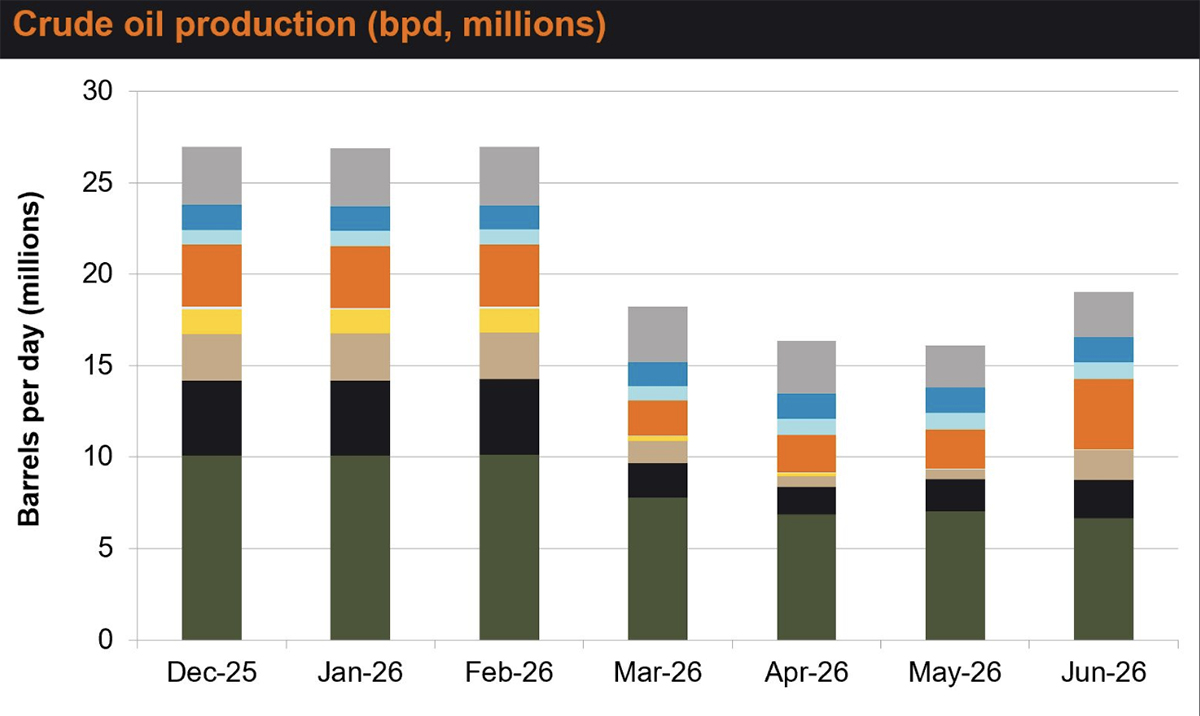
Overview of MENA crude oil production Dec-25 to Jun-26. (OPEC, EIA)2096315
Context
Continued disruption of the SoH
An interim ceasefire between the US and Iran ended on 7 July, after Iran fired missiles at ships in the SoH, damaging a Qatari liquefied natural gas (LNG) tanker and a Saudi crude tanker, and the US responded with strikes on Iran. On 12 July, the IRGC declared the waterway closed to shipping.
Kpler, a trade research firm, had reported a 16% increase in crude oil and condensate exports from Saudi Arabia, the UAE, Iraq, Kuwait, and Iran in the first half of July, up to 12 million bpd - approximately 30% below February's pre-war peak of 17.6 million bpd. While the ceasefire held, an average of 45 crossings occurred through the SoH per day. This was down from 138 crossings per day before the war began, according to the Joint Maritime Information Center (JMIC), a multinational maritime group.
However, after Iranian strikes resumed, the average daily crossings decreased to 13 per day. Kpler reports that remaining crossings are almost entirely undertaken via an Iranian-approved route.