Special Report: China advances UAV programmes
China is continuing to diversify its unmanned aerial vehicle (UAV) programmes, with state-owned companies unveiling new platforms in 2026 and reporting progress on previously disclosed systems.
In 2026, the Aviation Industry Corporation of China (AVIC) unveiled and flight-tested three new UAVs: a hybrid energy-powered platform, a cargo UAV, and a vertical take-off and landing (VTOL) surveillance system with a pusher-propulsion configuration.
AVIC has also outlined progress on its AR-500CJ and the new AR-600 shipborne rotary-wing UAVs. Separately, details have emerged of a fixed-wing VTOL reconnaissance UAV developed by China North Industries Group Corporation (Norinco) that is in service with the People’s Liberation Army (PLA).
Hybrid energy UAV
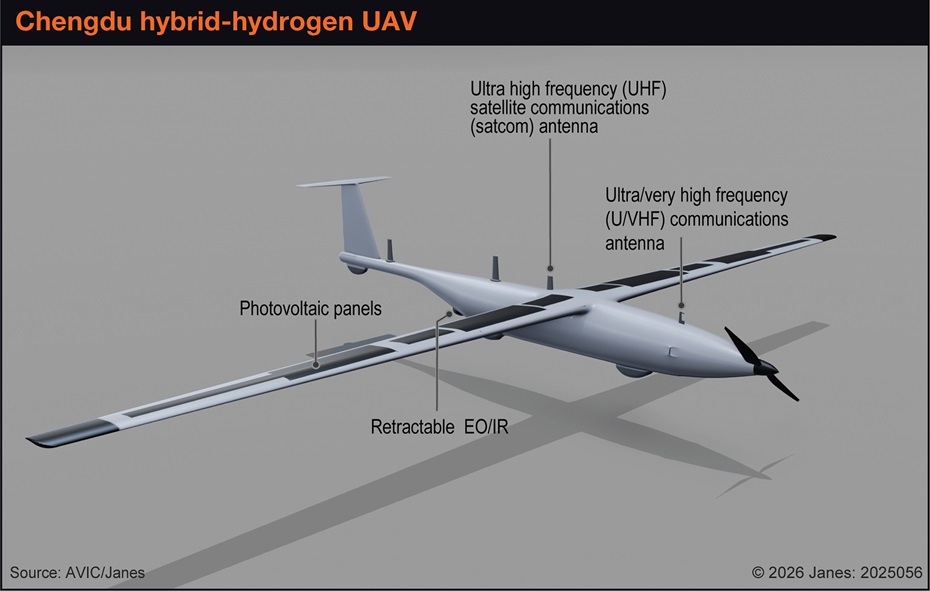
AVIC announced on its Weibo account that its subsidiary Chengdu conducted the first flight of a hybrid energy-powered UAV for low-altitude surveillance and reconnaissance in March.
The platform, tentatively known as the ‘long-endurance silent hybrid hydrogen energy UAV’, demonstrates the use of a ‘three-in-one’ power system in a small aircraft designed for low-altitude operations, the company said.
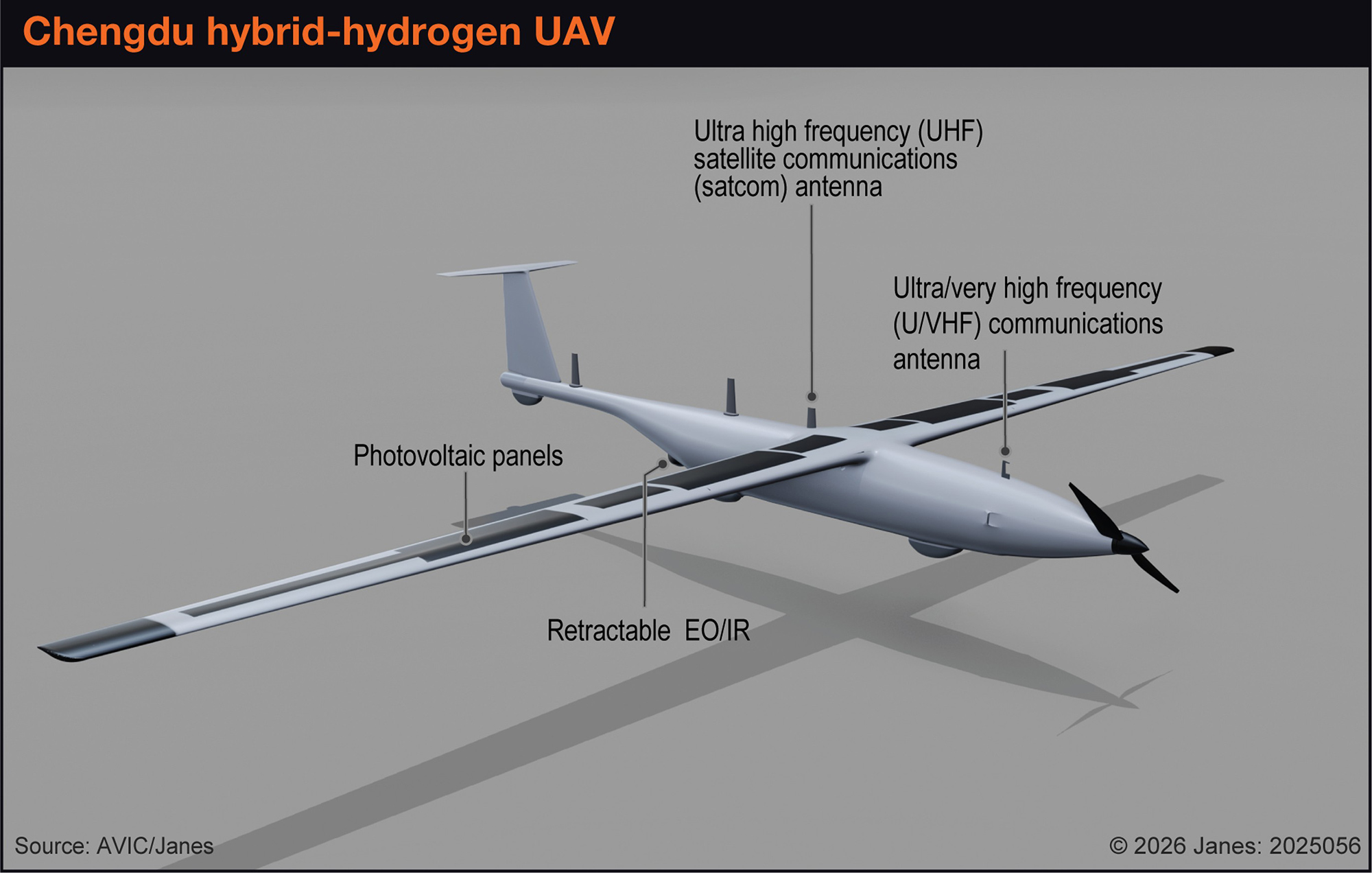 The Chengdu hybrid-hydrogen UAV incorporates a three-in-one power source, according to AVIC.
Image credit: AVIC/Janes
The UAV combines photovoltaic (solar) cells, hydrogen fuel cells, and lithium batteries to optimise energy management, providing an approximate 10% increase in endurance over battery-powered UAVs, AVIC said.
The UAV’s photovoltaic panels are fixed to the upper surfaces of its wings, according to AVIC footage released on its Weibo account. This indicates that the platform is capable of continuous power generation. In the video, the UAV was shown operating at altitudes below 2,000 m.
According to AVIC, the UAV is designed to incorporate modular payloads and features integrated hybrid energy management and an independent navigation architecture. Footage also shows a retractable electro-optic/infrared (EO/IR) sensor mounted at the rear of the fuselage.
AVIC did not release further specifications. However, the UAV likely builds on a 50 kg-class hydrogen-powered UAV jointly developed by Chengdu and Tsinghua University, which conducted its first flight in April 2025.
The platform is also likely to serve as a hybrid power testbed for larger UAVs.
Yunying-25
Chengdu has developed a VTOL surveillance UAV designated as Yunying-25 (Cloud Shadow-25), equipped with a ducted-fan pusher-propulsion system.
Externally similar to US firm Shield AI’s V-BAT intelligence, surveillance and reconnaissance (ISR) UAV, Yunying-25 has been developed in electric- and heavy fuel-powered variants.
According to AVIC, both variants measure 1.96 m in length and have a wingspan of 2.6 m. The electric variant has a maximum takeoff weight (MToW) of 25 kg, a payload capacity of 3 kg, an endurance of 1.5 hours, a range of 150 km, and a maximum speed of 190 km/h.
The heavy fuel variant has an MToW of 31 kg, a payload capacity of 4 kg, an endurance of 6 hours, a range of 600 km, and a maximum speed of 210 km/h.
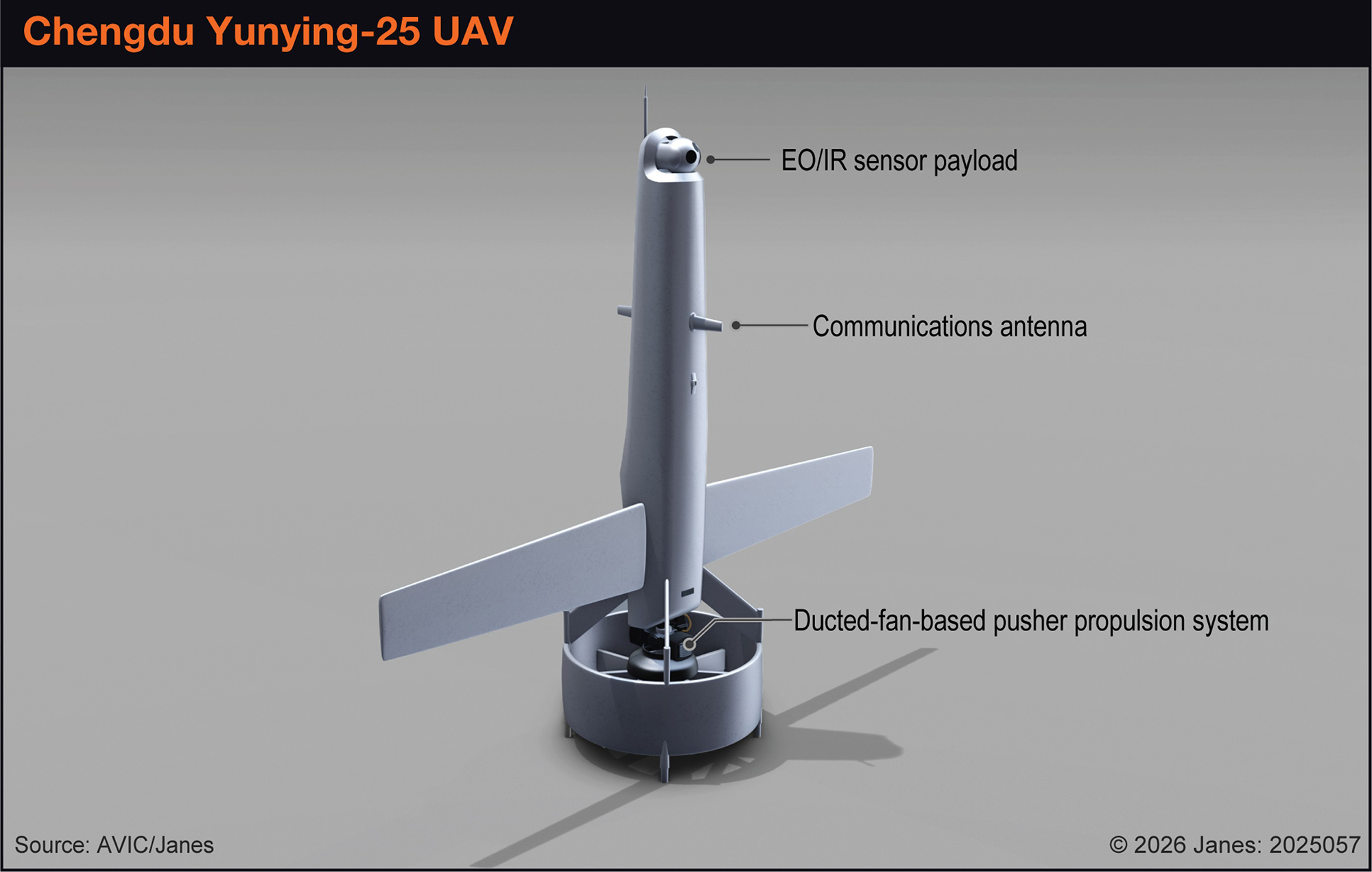
While AVIC has said the UAV will support civilian operations such as urban monitoring, industrial inspection, and emergency response, its similarity to V-BAT suggests potential military applications, including shipboard surveillance, anti-piracy patrols, and border patrol.
AVIC footage shows the UAV taking off and landing in confined areas such as a forest clearing and a static river barge. According to AVIC, the aircraft requires a three-by-three-meter area for launch and recovery, supporting operations from constrained terrain or naval vessels.
However, the footage does not show operations from a moving vessel, indicating further VTOL testing may be required.
According to AVIC, the UAV supports modular mission payloads and is equipped with an electro-optic/infrared (EO/IR) system for real-time video and imagery transmission. Its modular, disassemblable structure enables transport by light vehicles such as pickup trucks. The time from container opening to launch is less than five minutes, enabling rapid deployment, AVIC added.
The type is also capable of swarming operations. During the China Central Television (CCTV) Spring Festival Gala in Yibin in February 2026, a swarm of 10 Yunying-25s conducted a co-ordinated public flight demonstration, marking the type’s first large-scale public appearance.
Chengdu’s Wenyao intelligent control system was employed to manage the swarm, according to state media. AVIC has also released a computer-generated concept of operations showing 10 Yunying-25s operating together during an emergency response operation.
Yunying-25 is intended to be interoperable with the ‘long-endurance silent hybrid hydrogen energy UAV’ to provide command-and-control (C2) centres with multiple data sources, according to AVIC.
HH-200
Adding to its cargo UAV portfolio, AVIC unveiled the HH-200, which conducted its maiden flight at Pucheng in northwest China's Shaanxi Province in mid-April.
The HH-200 is likely intended as an evolution of AVIC’s earlier HH-100, which first flew in June 2024. Like the HH-100, it features a square, straight-through fuselage, a twin-engine high-wing configuration, and a twin-boom layout.
The HH-100 was designed with a MToW of two tonnes, a payload capacity of 700 kg, a cruise speed of 300 km/h, a service ceiling of 5,000 m, and a cargo hold measuring approximately 4 m3.
In contrast, the HH-200 has a standard cargo volume of 12 m3 (expandable to 18 m3), a maximum payload of 1.5 tonnes, a cruise speed of 310 km/h, and a range of 2,360 km, according to Chinese state media. AVIC has not disclosed the aircraft's length and wingspan.
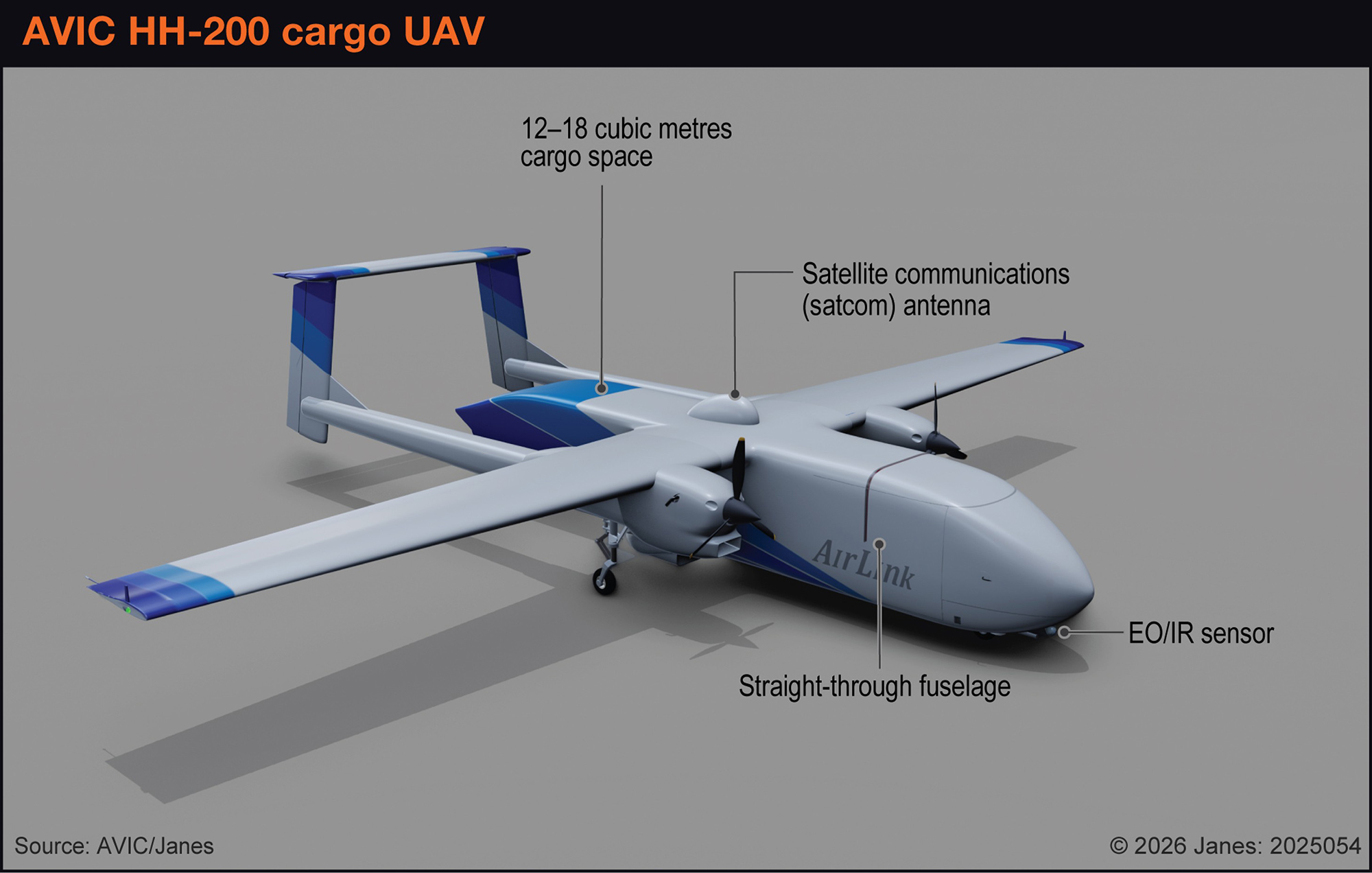 The AVIC HH-200 cargo UAV conducted its first flight in April 2026.
Image credit: AVIC/Janes
The aircraft has a service life of 50,000 flight hours or 15,000 take-off and landing cycles, AVIC said. It added that the HH-200 has a full life-cycle operating cost of CNY4.7 (USD0.69) per tonne-kilometre.
The HH-200 can take off and land on runways as short as 500 m and from high-altitude airports above 4,200 m. It is intended for point-to-point cargo logistics and cross-island transport, with potential for expanded multi-role operations, AVIC said.
Systems observed on the UAV include an EO/IR pod on the nose and a dorsal satellite communications (SATCOM) antenna between the wings. The UAV also carries a MA (Modern Ark) Aircraft logo, linking it to turboprop-powered platforms produced by the AVIC Xi’an Aircraft Industrial Corporation (XAC).
According to Fang Li, deputy chief engineer at XAC, two personnel can load the platform in under five minutes. He added that XAC has secured 21 orders for the HH-200, but did not provide details.
For more, please see Special Report: China advances UAV programmes