MENA Energy Activity Tracker: Ongoing crises in the Strait of Hormuz, Yemen, and disruptions in Libya pose a high threat to energy prices and supply in the medium-term
Events – 12 August to 15 September 2026
Iran
- 22 August: The Islamic Republic News Agency (IRNA) reported that Iran had granted permission for a limited number of Iraqi oil tankers to pass through the Strait of Hormuz (SoH), following repeated requests from the Federal Government in Baghdad (FGB).
- 24 August: According to a Reuters report, Patrick Pouyanné, Chairman and CEO of French oil major Total Energies, stated that the company was profitably moving crude oil through the SoH, as higher transport costs are being offset by steep discounts from producing Gulf countries.
- 5 September: US Central Command (CENTCOM) announced they had destroyed three Iranian crude oil carriers in the SoH in response to Islamic Revolutionary Guard Corps (IRGC) strikes on two US Navy warships.
- 8 September: US CENTCOM announced they had destroyed five Iranian crude oil carriers in the SoH in response to IRGC strikes on a US Navy warship.
Syria
- 17 August: According to Reuters, sources with knowledge of the project to develop a pipeline between Kirkuk, in Iraq, and Syria have warned that the development will require four years of construction and will cost at least USD15 billion.
- 13 September: The Syrian Observatory for Human Rights (SOHR) reported widespread protests against the government's decision to increase fuel prices.
Saudi Arabia
- 31 August: According to the Saudi national shipping company, Bahri, the IRGC hit one of its vessels while transiting the SoH, killing two sailors.
- 8 September: According to the Saudi Arabia Ministry of Energy, unmanned aerial vehicle (UAV) and missile attacks by Ansar Allah hit "several energy sector facilities and installations" in the Kingdom, which "caused fires at several locations, leading to a temporary halt in some operations".
- 9 September: According to Bloomberg News, sources close to Dow - a chemicals conglomerate - reported that the company is considering exiting its USD20 billion chemicals partnership with Saudi Aramco. No further open-source information on this has been released confirming any such decision to exit at the time of publication.
- 10 September: In the Organization of the Petroleum Exporting Countries (OPEC) monthly report for September, Saudi Arabia was recorded as having cut oil production by approximately a quarter - 8.135 million bpd to 6.238 million bpd - from July to August 2026.
- 10 September: Saudi Arabia closed its East-West pipeline following UAV attacks allegedly launched from Iraq. Vantor satellite imagery indicates that the eastern pumping station was destroyed in the attack.
- 15 September: According to a Reuters news wire, Saudi Arabia informed its European customers that some late-September 2026 crude oil cargoes will be cancelled amid strikes on the Kingdom's oil infrastructure.
Iraq
- 21 August: The Iraqi News Agency reported that Iraq's Prime Minister, Ali Faleh al-Zaidi, was aiming to increase Iraq's export quota through OPEC and to reach 8-10 million barrels of production per day (bpd) within six years.
- 24 August: According to a Reuters report, Iraq's State Oil Marketing Company (SOMO) and QatarEnergy opened tenders requiring buyers to load cargoes within the SoH.
- 27 August: Vetsa Ramakrishna Gupta, Head of Finance at India's Bharat Petroleum Corporation Ltd (BPCL), announced the company would shortly be receiving its first Iraqi oil cargo of the fiscal year and is seeking more oil from the Gulf if ships are available. Gupta also stated that BCPL typically needs 2 million barrels of Iraqi oil per month.
- 4 September: Iraq's Ministry of Oil acknowledged a "gap between production and consumption" for domestic fuel products, while urging citizens not to panic-buy gasoline or crowd petrol stations.
- 5 September: Iraq's Oil Ministry announced it had raised its oil export capacity to over 3 million bpd in September, up from 2.34 million in August.
United Arab Emirates (UAE)
- 14 August: The Emirati state news agency, WAM, reported that two Abu Dhabi National Oil Company (ADNOC) vessels had been attacked while transiting the SoH. The UAE's Ministry of Foreign Affairs condemned the strikes as a "hostile Iranian attack".
Qatar
- 28 August: According to a 28 August Reuters report, QatarEnergy notified Italian utility Edison - one of its largest customers in Europe - that it had extended force majeure on Liquefied Natural Gas (LNG) deliveries until early November 2026 due to the US-Iran conflict.
Libya
- 24 August: In a Facebook post, Libya's Ministry of Oil and Gas stated that the Libyan Minister of Oil and Gas, Khalifa Sadiq, had met with Patrick Pouyanné, Chairman and CEO of Total Energies, at the ONS 2026 conference in Norway. Sadiq and Pouyanné discussed Total's plans to increase investment and production in Libya - in particular at the Waha and Mabrouk fields - and to collaborate on natural gas and renewable energy opportunities in Libya.
- 29 August: The US Embassy to Libya welcomed Chevron's return to Libya and the resumption of its cooperation with the National Oil Corporation (NOC) in a post on X. Chevron and the NOC had signed a production-sharing agreement on 24 August 2026.
- 31 August: Georgia’s Kulevi refinery - the only refinery in the country - received its first cargo of Libyan crude oil as part of a supply agreement lasting until 2027, in a move to avoid EU sanctions on Russian imports.
- 6 September: Libya's NOC reported that Libya's oil production in August exceeded 43 million barrels - an increase of 1.55 million compared to July.
- 13 September: Egyptian engineering company Madkour signed a contract with Libya's state electricity company to build three power plants with a combined capacity of 660MW.
- 15 September: Libya's NOC announced that production had been halted at the Hamada and al-Tahara oil fields.
Egypt
- 25 August: The official presidency website reported on a meeting between Egyptian President Abdel Fattah El-Sisi, Prime Minister Moustafa Madbouly, and Minister of Petroleum and Mineral Resources Karim Badawi, in which Badawi presented a five-year plan to double Egypt's crude oil and condensate production and to invest over USD4 billion in six refinery projects.
Context
Continued disruption of the SoH and the Bab al-Mandab
Transits via the Strait of Hormuz continued to be restricted during the period 12 August to 15 September 2026, following the collapse of the US-Iran ceasefire on 7 July.
In a 28 August report, the United Kingdom Maritime Trade Operations (UKMTO) Centre, a UK government-affiliated maritime security coordination and reporting centre, stated that, since the collapse of the ceasefire, “no diplomatic resolution to the Strait of Hormuz conflict has been achieved” and highlighted that “commercial vessels continue to be targeted on the southern route, while regular kinetic activity against oil distribution infrastructure increases the risk of further disruption”.
Following Ansar Allah's (Yemen) imposition of a naval blockade on Saudi shipping via the Bab al-Mandab strait in July, UKMTO recorded six confirmed attacks on vessels linked to Saudi Arabia. Overall southbound transits from the Red Sea via the Bab al-Mandab, which had declined from 20 July onwards, remained below both pre-blockade and 2025 levels across the reporting period.
As a result, oil prices remained elevated throughout the period. According to the Financial Times, on 12 August 2026 Brent crude was priced at approximately USD89 per barrel on global markets and reached USD95 on 2 September following Iranian strikes on ships transiting the SoH, and reciprocal strikes on Iran by the US. By 10 September Brent had increased to USD110 per barrel.
For more on Ansar Allah’s naval blockade in the Red Sea and its implications for Saudi Arabia, please see:
Janes | Developments in Yemen indicate a high risk of escalation between Ansar Allah and Saudi-led Coalition forces
Janes | Ansar Allah’s attack against Saudi Arabia likely to increase the risk of renewed direct Saudi Arabian involvement in Yemen conflict
Janes | MENA Energy Activity Tracker – 01 July to 11 August 2026
Syria case study - overview
Since the collapse of the Assad government in December 2024, the Syrian armed opposition groups led by Hayat Tahrir al-Sham (HTS) have proclaimed themselves as the de facto government in Syria. The HTS-led government has centralised control over the executive, legislature, and judiciary, as well as the state’s armed and security forces.
On 29 March 2025, Syria’s de facto president Ahmad al-Sharaa announced the formation of a new cabinet. The cabinet created a Ministry of Energy by combining the former Ministry of Electricity, Ministry of Oil and Mineral Resources, and the Ministry of Water Resources. Integrated into the Ministry of Energy is the publicly owned Syrian Petroleum Company (SPC) which is responsible for regulating, managing, and developing the country’s oil and gas resources.
In January 2026, the HTS-led Syrian government extended its territorial control over the territory previously controlled by the Kurdish-led Qiwaat Suriyya al-Dimoqratiyya (QSD) in northeast Syria. This included taking control over the country’s main oil and gas fields and facilities in Raqqa, Deir al-Zour, and al-Hasaka governorates. However, as reported by Syria’s Ministry of Energy, the oil and gas facilities suffered significant physical damage from the conflict and unregulated extraction methods and will likely require an extensive rehabilitation process to restore production to pre-2011 rates.
Analysis – Syria
Syrian oil and natural gas reserves
Syria’s Ministry of Energy estimates on its official website that the country has 2.4 billion barrels of crude oil, 211 million cubic metres of natural gas, and 1.7-1.8 billion tonnes of phosphates.
Primary oil fields/areas include: Rumeilan and al-Suwaydiyah in northeast Hasakah governorate, which accounted for over half of Syria’s pre-2011 output; al-Omar in the eastern Deir al-Zor governorate, which is Syria’s largest field; and al-Tanak, also in Deir ez-Zor.
Syria also holds 8.5 trillion cubic feet (Tcf) of natural gas which is primarily located in central Syria and in Taibya in eastern Deir al-Zor.
Syria’s oil and gas sector
The Syrian civil war damaged oil and gas infrastructure across the country, led to the capture of oil fields by different non-state armed groups, and substantially degraded the domestic hydrocarbon industry. In February 2022, Syria’s Ministry of Petroleum, then under al-Assad’s government, reported that the country’s petroleum sector had incurred losses of more than USD100 billion since the beginning of the civil war in 2011.
In December 2024, the civil war ended with the collapse of al-Assad’s government and the establishment of a new administration under President Ahmad al-Sharaa.
Following the establishment of al-Sharaa’s government in December 2024, Syria has gradually begun to be reintegrated within the global economy. Syria’s access to SWIFT, a global messaging network used by financial institutions to transmit payment instructions and communication, was restored in June 2025, allowing staff and contractors to be paid.
On 1 July 2025, the US lifted sanctions on Syria’s oil ministry, maritime authority, and other energy entities and institutions. Widespread sanctions by the European Union (EU), United Kingdom (UK) and Switzerland were also lifted in July 2025.
Moreover, the Syrian government has sought to rehabilitate the hydrocarbon sector. On 29 September 2025, President al-Sharaa re-established the Syrian Petroleum Company (SPC) to consolidate the country’s oil and gas exploration, production and refining under a single state holding company, which reports in turn to the Syrian Ministry of Energy.
Several international oil companies have also signed agreements to return to Syria. According to Wood Mackenzie, a consultancy, the UAE’s Dana Gas, the US’ ConocoPhillips, and Syria’s Novaterra had signed memoranda of understanding (MoUs) to redevelop key Syrian oil and gas fields by January 2026.
On 17-18 January 2026, the Kurdish-led QSD agreed to a 14-point agreement with the government in Damascus, after which territories including the Omar oil field and Tabiyeh gas field were handed over to the al-Sharaa government. Following a separate handover on 5 February, the SPC also took control of the Rmeilan and al-Suwaydiyah oil fields. On 4 August 2026, the SPC stated that it had taken over all oil fields in the Jazira region and had begun rehabilitation work to boost production.
Crude oil production
According to the US Energy Information Administration (EIA), in 2010 Syria produced approximately 380,000 barrels of crude oil per day (bpd). By January 2018, this had declined to 24,000 bpd. Production increased gradually following the removal of President Bashar al-Assad in December 2024 and the establishment of a new government under President Ahmad al-Sharaa, rising to 101,000 bpd by April 2026.
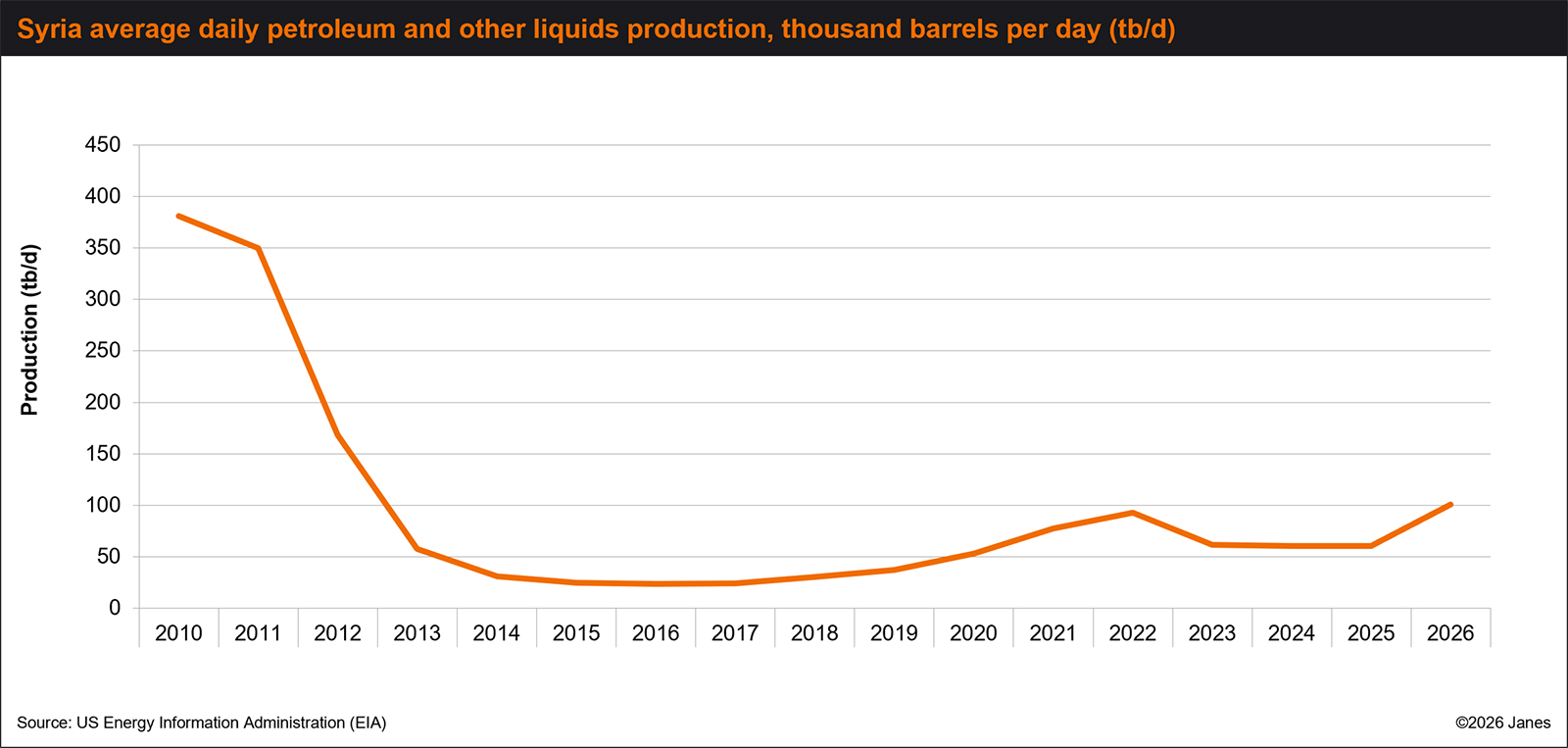 Graph depicting Syrian petroleum and other liquid production, 2010- 2026. Image credit: EIA
For more, please see, MENA Energy Activity Tracker: Ongoing crises in the Strait of Hormuz, Yemen, and disruptions in Libya pose a high threat to energy prices and supply in the medium-term