Special Report: Justice Mission 2025 sheds further light on China’s maritime playbook for a Taiwan contingency
 A file image of a China Coast Guard converted Jiangwei I-class offshore patrol vessel. This vessel class will likely be deployed in the event of a Taiwan contingency given how it has featured in past exercises.
Image credit: Japan Coast Guard
China’s recent military exercise, Justice Mission 2025, has revealed yet another evolution in Beijing’s maritime tactics. The drills featured an unprecedented integration of China Coast Guard (CCG) vessels with those of the People’s Liberation Army Navy (PLAN), and other units.
This integration underscores the layered approach that China will undertake to blockade Taiwan in the event of a contingency across the strait.
Conducted on 29 and 30 December 2025, Justice Mission 2025 was the largest and most complex military exercise China has staged around Taiwan since the drills that were launched in response to then US House Speaker Nancy Pelosi’s visit to Taiwan in 2022.
Justice Mission 2025 was executed amid heightened tensions following Washington’s approval of a USD11.1 billion arms package for Taiwan, and Taipei’s decision to boost defence spending to 3% of GDP in 2026.
Beijing framed the exercise as a “stern warning” to Taiwan’s so-called independence forces and external actors, while operationally rehearsing a blockade and multidomain strike campaign.
The exercise featured joint operations by the PLA’s air, land, naval, and rocket forces, and the CCG. It focused on combat readiness patrols, port blockades, and integrated sea-air manoeuvres, with live-fire drills in seven zones, some breaching Taiwan’s territorial waters for the first time since 2022.
This escalation was not only symbolic but operationally significant, as it demonstrated China’s ability to compress warning times and initiate large-scale drills with minimal notice.
Taiwan’s Ministry of National Defense reported 89 aircraft sorties and 28 vessels on the first day alone, and these comprised 15 PLAN warships and 13 CCG vessels. Over the 48-hour period, this surged to 130 aircraft, 14 PLAN ships, and eight CCG vessels.
Among the PLAN assets deployed was the Type 075 Yushen-class amphibious assault ship Hainan, marking its first appearance in Taiwan-focused drills. Other surface combatants included destroyers and frigates, supported by logistics and replenishment ships.
The CCG blockade contingent comprised at least 13 vessels positioned near Taiwan’s contiguous zone and outlying islands such as Matsu and Wuqiu.
The vessels were engaged in patrol and inspection operations simulating law enforcement under blockade conditions. This combination of military and paramilitary forces illustrates a deliberate strategy to blur the lines between peacetime enforcement and wartime operations.
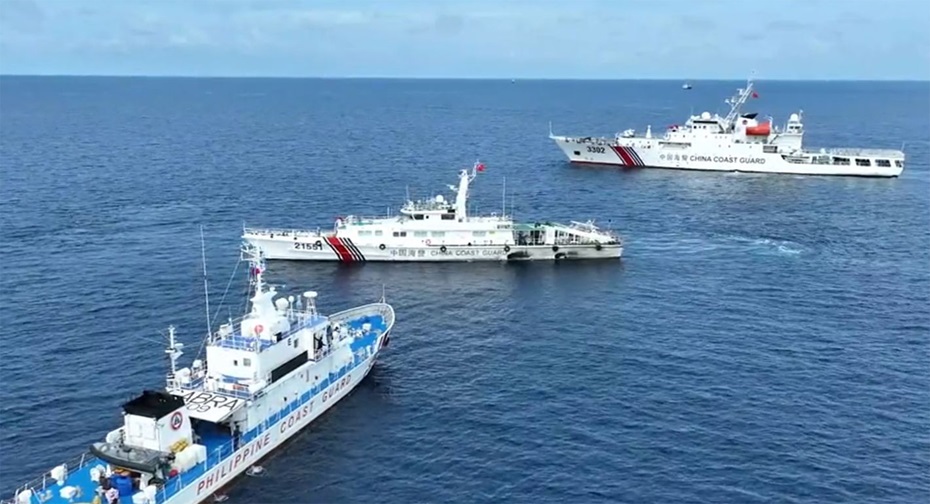
 CCG vessels seen here conducting a blockade operation in August 2023 to prevent the Philippines from sending provisions to its garrison on Second Thomas Shoal. Such tactics can be expected to feature prominently in the prelude to an invasion of Taiwan.
Image credit: Philippine Coast Guard
Escalated assertiveness
Unlike previous exercises, Justice Mission 2025 showcased a more assertive posture with regards to the CCG’s operations. This can be seen in how the vessels operated in close proximity to Taiwan’s maritime boundaries, and the distances observed during the drills are unprecedented.
Automatic Identification System (AIS) data and official statements also indicate that the CCG ships conducted verification and expulsion drills, shadowing Taiwanese vessels and reinforcing the blockade narrative.
This dual-use approach that combines military and paramilitary force offers Beijing a veneer of legitimacy under a ‘law enforcement’ pretext while enabling rapid escalation.
This signals a doctrinal shift. Future Taiwan contingencies will likely feature coastguard assets as front-line actors, interdicting commercial traffic and complicating foreign intervention under the guise of maritime policing. This is contrary to previous assumptions that regard the CCG’s role in a Taiwan contingency as largely auxiliary.
Such tactics of front-lining white hull vessels exploit legal ambiguity, making it harder for external naval services to justify intervention without appearing to escalate a situation that China will undoubtedly portray as a domestic law enforcement matter.