Warning intelligence report: China likely to continue to prioritise intimidation against Taiwan in the next six to 12 months despite PLA’s aggressive rhetoric, exercises - assessment
Key points
- This warning intelligence report uses 11 indicators to assess whether China will attempt to invade Taiwan in the next six to 12 months and to identify the most likely alternative futures to this scenario
- The Communist Party of China's stated objective of achieving unification with Taiwan and the Chinese People's Liberation Army's (PLA's) ongoing modernisation and strengthening of capabilities across all domains continue to increase the threat of a major military conflict in the Taiwan Strait. The PLA's increasingly dehumanising rhetoric towards the Taiwanese leadership and increasingly aggressive exercises around Taiwan have prompted Janes to raise the likelihood of an invasion from 5% to 7% for the next six to 12 months
- Janes assesses that in the most likely scenario (70% likelihood; a decrease from 75% in the December 2024 report), China would continue to focus on intimidation and coercion tactics against Taiwan in the next six to 12 months, but refrain from launching a military operation
Significant changes
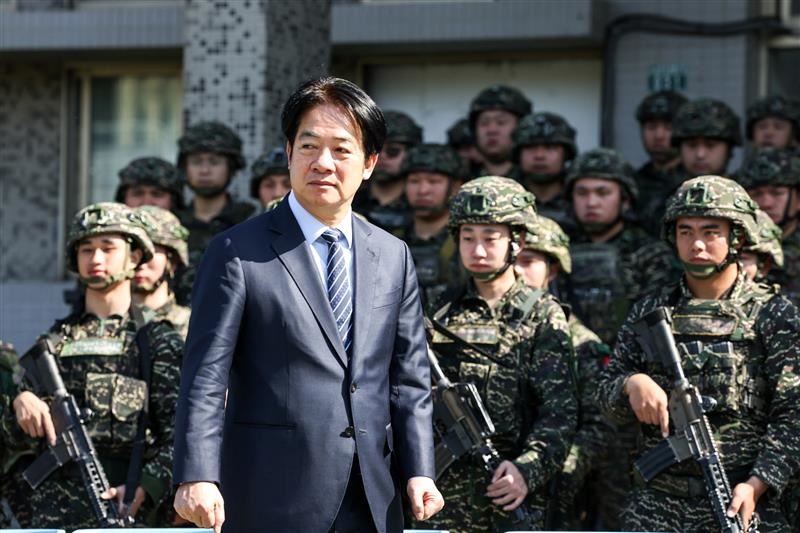
China's hostile rhetoric increased during the People's Liberation Army's (PLA's) ‘Strait Thunder 2025A' exercises near Taiwan on 1 and 2 April 2025, with PLA Eastern Theater Command (ETC) publishing a video referring to Taiwanese President William Lai as a “parasite poisoning Taiwan island” and depicted him as a caterpillar spreading smaller parasites in Taiwan. In comparison, the previous report noted that China's rhetoric towards Taiwan was limited to accusing ruling Democratic Progressive Party (DPP) of harming Taiwan's interests and contributing to crossstrait tensions.
The PLA continues joint training with the China Coast Guard (CCG) and the People's Armed Forces Maritime Militia (PAFMM) in the ETC, with these auxiliary forces adopting a more active role in coercing Taiwan. Manoeuvres have included practising blockades of key sea routes near Taiwan and participating in larger numbers in PLA exercises compared with the previous reporting period. The PLA Navy (PLAN) also deployed the Type 002 Shandong (CV 17) aircraft carrier – with its home port in Southern Theater Command (STC) – in the April 2025 ‘Strait Thunder 2025A' exercises near Taiwan. The previous reporting period saw the deployment of the Type 001 Liaoning (CV 16) aircraft carrier – with its home port in Northern Theater Command (NTC) – which in October 2024 participated in the ‘Joint Sword2024B' exercise near Taiwan.
Satellite imagery analysis of ETC and Taiwan Strait military bases indicates that at least eight bases are undergoing significant changes with infrastructure changes mainly aimed at supporting existing units and assets. Meanwhile, the PLA tested landing barges at Donghai Island in Guangdong province in southeastern China in March 2025 marking a notable development in the PLA's amphibious operations capabilities. In the previous reporting period PLA amphibious exercises were small in scale and typically involved single combined arms brigades in each instance. PLA exercises during the reporting period became more provocative with the ‘Strait Thunder 2025A' exercise in April 2025 targeting mock structures of Taiwanese critical national infrastructure (CNI), such as the main liquified natural gas (LNG) storage facility in Kaohsiung. This was the first time that the PLA published footage depicting specific CNI, with mock targets representing real Taiwanese infrastructure. There were also PLA propaganda images that displayed six missiles imposed over locations matching with Taiwan's coastal LNG facilities.
IQ scenario: China launches a large-scale invasion of Taiwan (7% likelihood)
Scenario description
In this scenario, China conducts a seaborne invasion of Taiwan, with accompanying aerial (aircraft and missile) attacks targeting key Taiwanese command-and-control, communication, and political nodes, before launching an amphibious assault on several beaches located on Taiwan's northern and western coasts.
China would seek to achieve air superiority in the first phase, before attempting to secure beachheads to land troops on Taiwan's main island. China would also use civilian vessels to augment its troop and equipment transport capability across the Taiwan Strait. The PLAN would take up blocking positions around the Taiwan Strait and encircle Taiwan to prevent external support from reaching the island, as well as to prevent breakout attempts by Taiwanese forces. The PLA Air Force (PLAAF) would also support the navy in blockading the island and preventing aerial reinforcement and resupply of Taiwan by external actors. Other services such as the CCG and maritime militia are very likely to support the PLAN in its naval operations by acting as auxiliary units that can fulfil reconnaissance and other support roles such as resupply or raiding.
Likelihood justification
Janes assesses that a Chinese invasion of Taiwan is very unlikely to happen in the next six to 12 months (7% likelihood). This percentage has increased since the last report (5%) because of the PLA's increasingly belligerent rhetoric and growing participation of assets and deployments relevant to a blockade scenario in PLA exercises around Taiwan.
There has been no significant hostile rhetoric from the Chinese leadership towards Taiwan calling for war or armed action against Taiwan in the past 12 months. China has also not issued mobilisation orders for its troops that would be indicative of imminent military action against Taiwan. There have not been any extra recruitment campaigns by the PLA to bolster its ranks, and recruitment drives at the provincial and local levels have proceeded according to the annual schedule as of June 2025.
Janes conducted satellite imagery analysis of multiple military bases and facilities in the ETC. Out of the 63 facilities reviewed, significant expansion activities were observed at eight facilities between November 2024 and May 2025. Janes has identified the most significant changes in dual-use facilities, where provincial governments are expanding civilian-use infrastructure. Janes did not identify any significant changes in military logistics facilities, military healthcare facilities, or key ports in the ETC.
However, the expansion activities by themselves are not indicative of China preparing for an invasion within the coming six to 12 months. A related indicator of China massing troops in the ETC and an expansion of the bases to accommodate troops is also absent. A massing of troops and assets in the ETC along with expanded bases would be a positive indicator for an invasion scenario.
Separately, China has not conducted an intensive number of amphibious, combined arms, or joint exercises between December 2024 and May 2025 that would indicate preparations for an imminent invasion. However, the March 2025 testing of landing barges at Donghai Island increases overall invasion risk due to the specific focus on amphibious operations. Any invasion of Taiwan would almost certainly involve amphibious operations, and the refinement of China's amphibious assault capabilities through training exercises such as these very likely indicates a long-term focus on military action against Taiwan. Chinese military exercises around Taiwan between December 2024 and May 2025 also indicate a strengthening of invasionrelated capabilities. The ‘Strait Thunder 2025A' exercise held in April 2025 simulated attacks on Taiwan's CNI and involved greater numbers of CCG units than were present during the previous iteration of the exercise in October 2024.
However, a preparation for invasion would almost certainly be indicated by China conducting large-scale and frequent drills including involving the use of civilian assets like civilian roll-on/roll-off (ro-ro) cargo ships. The drills observed by Janes do not fit these parameters.
In addition, there have been no indicators to show that Taiwan is preparing for an invasion by China within the next six to 12 months. Taiwan has not conducted civil defence or air raid drills beyond annually scheduled drills. Taiwan has also not released new or updated war guidelines for its civilians beyond an English-language version of the existing guidebook – All-Out Defense Contingency Handbook – in March 2025, after issuing a civil defence contingency handbook in June 2023, indicating that the government does not consider an invasion imminent.
The likelihood of this scenario would increase if:
- China increases hostile rhetoric against Taiwan including calling for the forceful removal of the elected government
- China embarks on a simultaneous expansion of its military bases located in the ETC and on the transport infrastructure leading up to such bases
- China increases the frequency and scale of its military drills around Taiwan that include allied services such as the CCG beyond the bi-annual exercises
- Economic and social cross-strait integration stagnates or decreases
Scenario key assumptions
- China will prioritise a military capability build up before launching an invasion of Taiwan
- The military activities carried out by China are part of its regular force improvement posture
- Taiwanese intelligence will have sufficient warning of an impending Chinese invasion, which will influence the government's decision to prepare its citizens for war