First Estonian minehunter upgrade completes
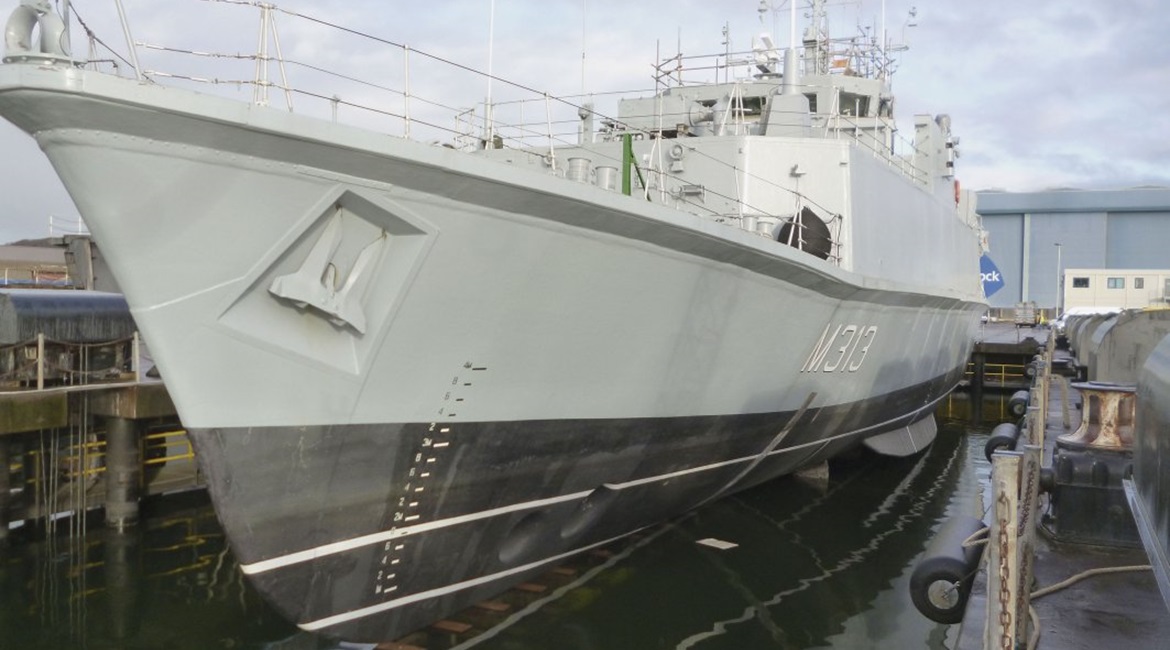
The first of three Estonian Navy Sandown-class minehunters to be fitted with new mine countermeasures (MCM) sonar and tactical data-handling systems has completed its capability upgrade at Babcock’s Rosyth dockyard in Fife, Scotland.
EML Admiral Cowan – the flagship of the Estonian Navy – underwent a five-month docking period at Rosyth between July and December 2018. The ship will now return to Estonia prior to undergoing trials in the North Sea in May 2019 to demonstrate full operational capability.
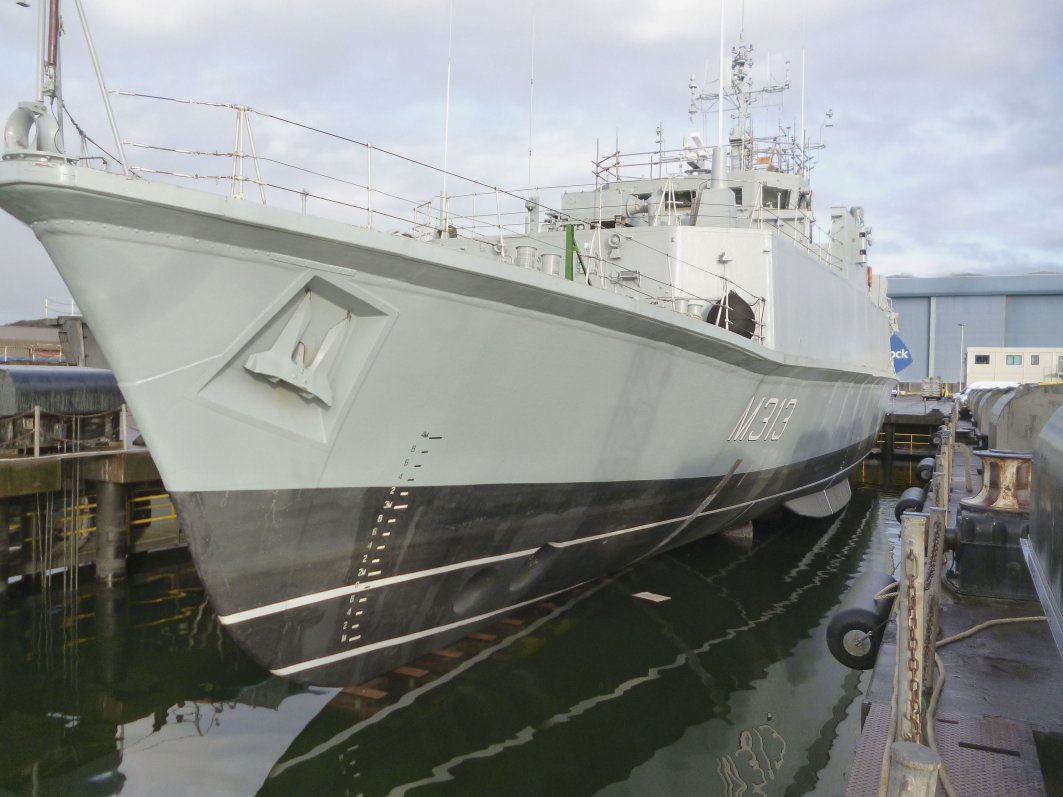
Having completed its upgrade, EML Admiral Cowan will start trials in the North Sea in May 2019 to demonstrate full operational capability. (Babcock)
The Estonian Ministry of Defence in early 2016 selected Thales UK as prime contractor for the minehunter capability upgrade. Under the terms of contract, the company is taking responsibility for platform additions and alterations, and equipment/system specification, procurement, platform, and system integration. Thales is overseeing Babcock, which is embodying the upgrade, and managing all test, trial, and acceptance events.
The capability upgrade package includes fitting the Thales Sonar 2193 hull-mounted wideband minehunting sonar (replacing the Sonar 2093 variable depth sonar), the Thales M-CUBE command-and-control system (replacing the BAE Systems NAUTIS 3), an upgraded navigation system, and a number of other discrete upgrades and defect rectifications. Thales is also delivering a new fleet mine warfare data centre to the Estonian Navy.
Sonar 2193, already in service on the Royal Navy’s (RN's) Hunt-class MCMVs and two ex-RN Hunt class vessels transferred to Lithuania, is optimised for shallow waters (down to 80 m), and uses wideband pulse compression techniques to improve the detection and classification of low echo strength targets at longer ranges. In particular, the echo structure derived from wideband processing techniques significantly improves target classification.
Go beyond the headlines - with direct links to interconnected entities
Get full access to validated equipment, military capabilities, and market insights.


