Kymeta unveils new multi-band, multi-orbit satcom capabilities
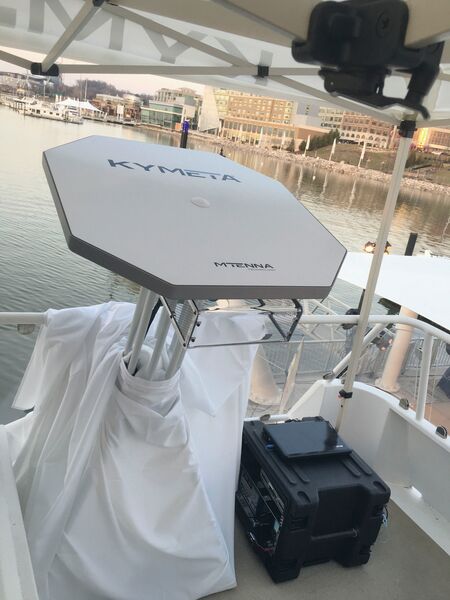

Kymeta's commercial maritime system on display. The company's Kestrel u5 terminal is a scaled-down version of the legacy commercial model developed for maritime operations. (Anika Torruella)
Satellite communications (satcom) company Kymeta has rolled out a pair of new satcom terminal technologies designed to provide advanced multi-band and multi-orbit capabilities to end-users.
The new KuKa 8 series of flat-panel satellite terminal systems is the company's first multi-band, multi-orbit single aperture antenna offering, providing “simultaneous operation across both Ku and Ka frequency bands … [and] seamless switching across satellite networks spanning multiple orbits and frequency bands”, as well as multiple satcom constellations simultaneously, according to a March company statement.
As designed, the multi-band and multi-orbit capability in the KuKa 8 series of terminals will “enable pathway diversity across proliferated [low Earth orbit] and hybrid architectures” by integrating alternative satcom connectivity via networks operating at geostationary orbit (GEO), medium Earth orbit (MEO), and highly elliptical orbit (HEO), programme officials said in the statement.
Those alternative satcom network pathways will provide KuKa 8 terminal users more resilient connectivity when operating in contested or denied environments “where electronic warfare, jamming, and new threats can disrupt any single-network or single-band terminal”, the officials noted. The integration of alternate satcom pathways, paired with the system's software-defined antenna platform and open standards architecture, allows for “rapid [connectivity] reconfiguration… And capability evolution as missions and networks change”, programme officials said.
Go beyond the headlines - with direct links to interconnected entities
Get full access to validated equipment, military capabilities, and market insights.