Feature: NATO looks to enable an ‘Internet of Things' for unmanned ASW
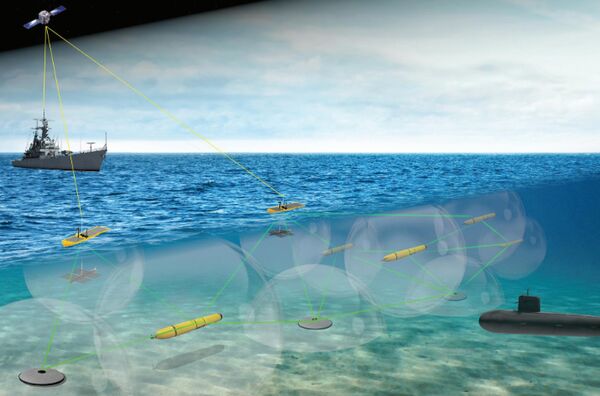

NATO's ASW Barrier Smart Defence Initiative has been the catalyst for the development of the AUWB-MN. (NATO)
A Saab-led consortium of industry, small and medium-sized enterprises (SMEs) and academia aims to demonstrate an “internet” for the undersea battlespace at the Robotic Experimentation and Prototyping using Maritime Unmanned Systems (REPMUS) 2026 exercise in September 2026.
Known as Mangrove, the multinational consortium was tasked last year to design a reference architecture and a test and reference environment for the Allied Underwater Battlespace Mission Network (AUWB-MN). The project seeks to establish a communications net to support the secure transfer of data between multiple nodes operating across a wide area of ocean. The objective is to use a common digital backbone to facilitate interoperability in command and control (C2) and data exchange between various vehicles and sensors.
The NATO Anti-Submarine Warfare (ASW) Barrier Smart Defence Initiative (SDI) has driven the development of the AUWB-MN. This UK-led initiative, established in 2018, responded to the perceived growing ASW threat. The ASW Barrier SDI programme acknowledged that a lack of conventional manned ASW assets — such as frigates, destroyers, and submarines — required a new approach to wide-area ocean surveillance to maintain an operational advantage.
“People woke up to the idea that uncrewed systems - maritime robots - offered the potential to close capability gaps,” David Burton, a retired UK Royal Navy (RN) commodore who now serves as NATO ASW Barrier SDI project director, told Janes. “And the biggest gap was in the area of ASW in the underwater battlespace.
Go beyond the headlines - with direct links to interconnected entities
Get full access to validated equipment, military capabilities, and market insights.