Euronaval 2026: MBDA broadens Stratus RS use cases, plans LO flight tests before 2030
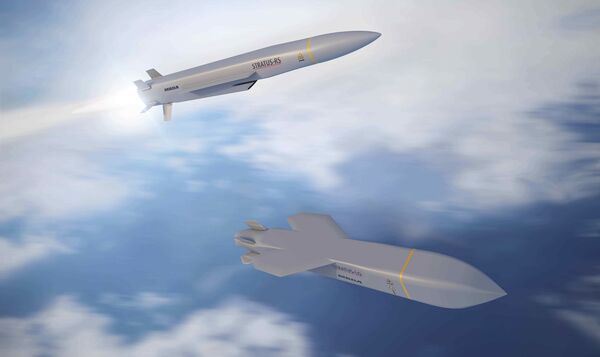

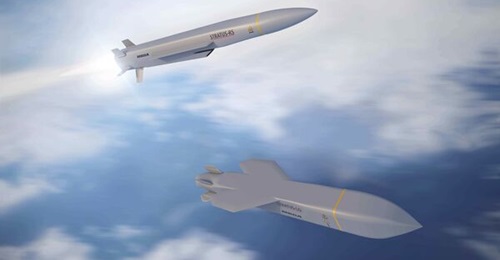
MBDA's Stratus has two effectors: the subsonic, long range, very low observable Stratus LO cruise missile (pictured bottom); and the high-supersonic/high-agility ramjet-powered Stratus RS. (MBDA)
MBDA revealed new details about its development of Stratus missiles at a briefing at the Euronaval 2026 exhibition, held in Paris from 3-6 November.
In addition to Stratus RS' (Rapid Strike) application for suppression of enemy air defences/destruction of enemy air defences (SEAD/DEAD) missions, MBDA said it has optimised the system for anti-ship and deep strike roles. The company has developed a multipurpose warhead to support each of these mission profiles, allowing operators to use armour-piercing/tandem-charge warheads for anti-ship/deep-strike roles, or airburst for SEAD/DEAD operations.
Stratus RS now features a wider range of attack profiles, including sea-skimming and top attack trajectories, which can be further programmed and mixed to enable more complex attack vectors, according to the company. To achieve this, the Stratus RS has liquid-fuelled ramjet propulsion developed in-house by MBDA. The propulsion allows for more precise thrust control, active fuel management, and command-prompted ignition-shutdown-reignition capabilities, it said. Stratus RS can thus employ novel flight trajectories (for example loiter-and-dash) and make terminal guidance adjustments which are challenging for solid-fuel ramjet systems.
The missile incorporates an active RF (radio frequency) seeker using an AESA (active electronically scanned array) manufactured by Thales for all-weather identification and target discrimination, with synthetic aperture radar (SAR) providing increased accuracy for top-attack flight trajectories.
Go beyond the headlines - with direct links to interconnected entities
Get full access to validated equipment, military capabilities, and market insights.