DSEI 2021: TDW's PARM 1 seeks comeback
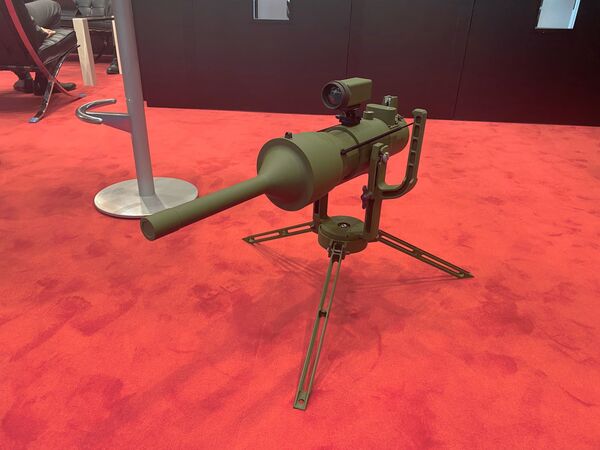

The mock-up of the PARM 1 with an IR sensor displayed at DSEI. (Janes/Riccardo Cociani)
TDW GmbH, a subsidiary of MBDA Germany, publicly displayed its Automated Anti-Tank Weapon (PARM) for the first time at the DSEI show in London on 14–17 September, marking a de facto relaunch for a system that was developed in the 1980s.
The company displayed a PARM 1 with a mock-up infrared (IR) sensor fitted to a new accessory rail to show an alternative way of triggering the off-route mine, which is normally initiated when a vehicle crushes a fibre-optic cable strung out across its path or manually using a command wire. The IR sensor would enable it to be programmed so that it allows a pre-set number to pass by before it fires.
Christoph Schwarz, TDW Business Development Marketing & Contract representative, told Janes only prototypes of the IR sensor have been developed so far. Concepts for radar, magnetic, and seismic sensors are also being worked on, he added. TDW developed similar concepts in the 1990s, such as replacing the fibre-optic cable with a combination of an acoustic and a passive/active IR sensors.
According to Janes Mines & EOD Operational Guide, the PARM 1 is effective at ranges of 2–40 m and is claimed to be able to penetrate more than 600 mm of conventional armour. The TDW brochure does not include performance figures but says it can penetrate explosive reactive armour (ERA) to a “considerable extent”. Schwarz said he could not provide further details.
Go beyond the headlines - with direct links to interconnected entities
Get full access to validated equipment, military capabilities, and market insights.