Thales reveals new ISR concepts
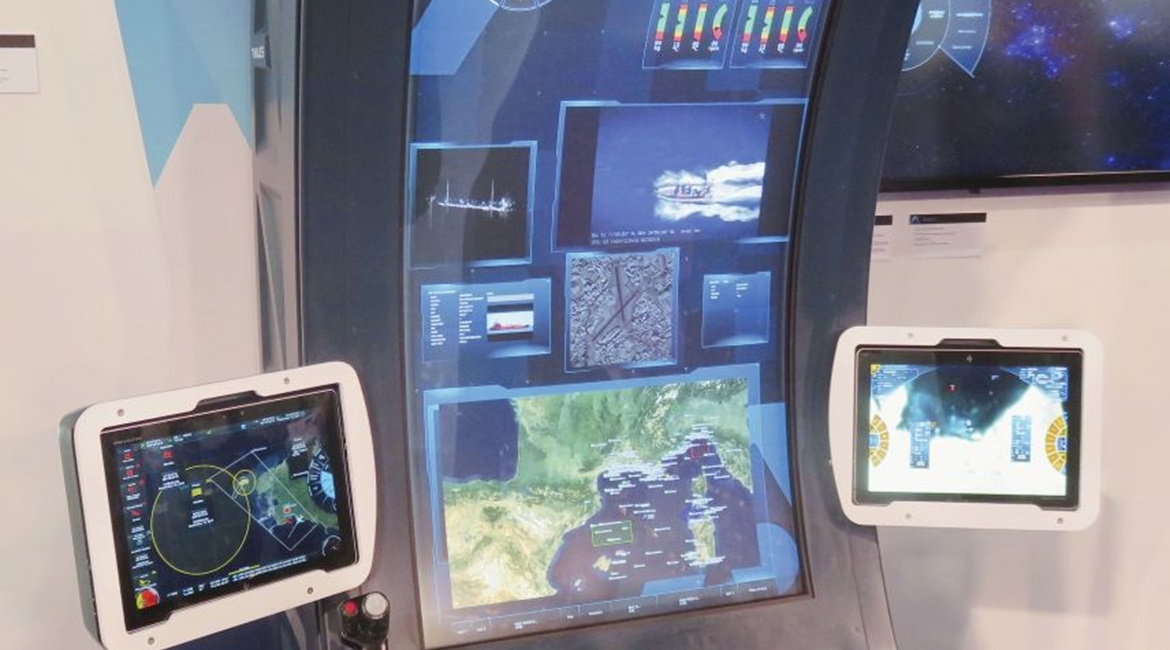
Thales has developed new intelligence, surveillance, and reconnaissance (ISR) concepts in both the land and air domains and demonstrated these at DSEI 2019 in London in September.
Digital Crew is a real-time self-learning artificial intelligence (AI) algorithm applied to digital electro-optical (EO) imagery for recognition of people, platforms, and objects. It is designed to reduce the cognitive load of sensor operators and is effective in day and night conditions.
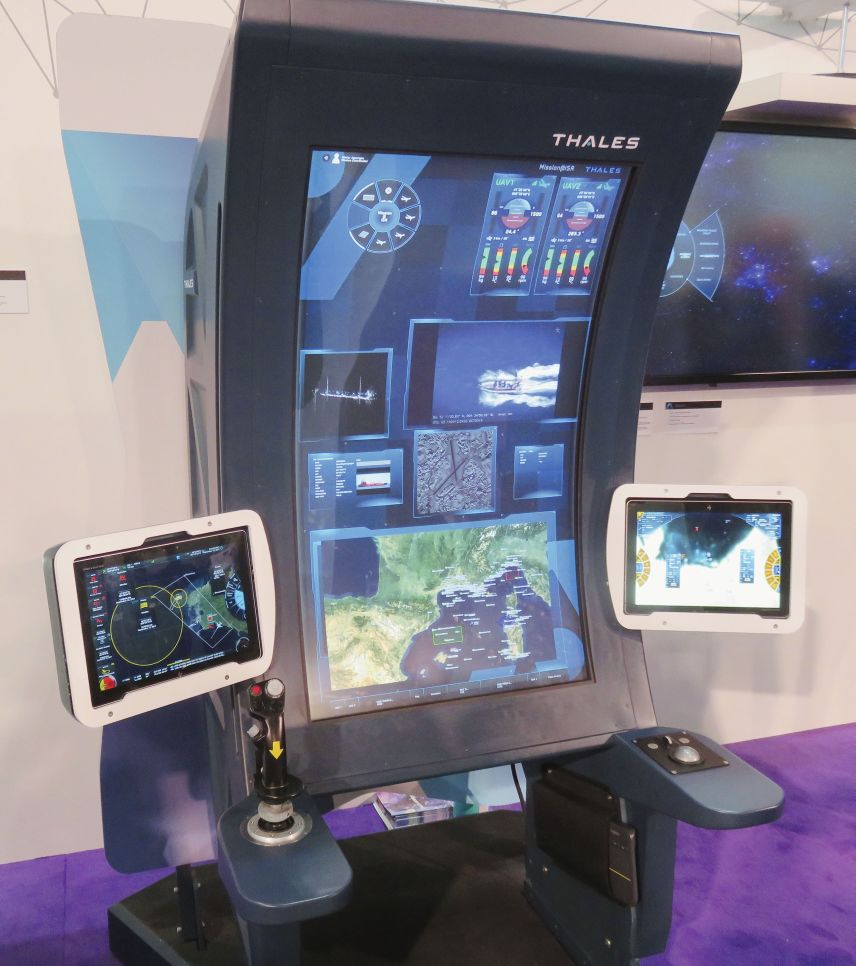
Pictured here is the Thales Mission@ISR concept demonstrator displayed at DSEI 2019. On the single curved screen from the top are: circular menu; mission data for two UAVs; two electro-optical sensor feeds; AIS track data; overhead imagery; and overall tactical picture. (Giles Ebbutt)
The system incorporates facial recognition algorithms for identification of individuals using database comparison. It can recognise an individual in a crowd and identify possible threats such as an armed person through comparison with the entities in the database, with up to 1,000 objects stored within the latter. Vehicle types can be automatically identified in overhead imagery.
Digital Crew can also plot the location of a detected target using the bearing of the object and its apparent relative size to calculate the range. A Thales representative told Jane’s that location was accurate to within 2.5 m, and that the effect of camera zoom is automatically considered in the sizing calculation.
It can prioritise identified targets according to pre-set criteria and can be installed on a vehicle platform with a 360° EO system for local situational awareness. The representative said it was important that a human was retained in the decision-making response loop to potential identified threats as the system was not completely infallible when identifying objects as weapons.
Go beyond the headlines - with direct links to interconnected entities
Get full access to validated equipment, military capabilities, and market insights.