US CNO cites potential diminished role for carrier strike groups in future naval force
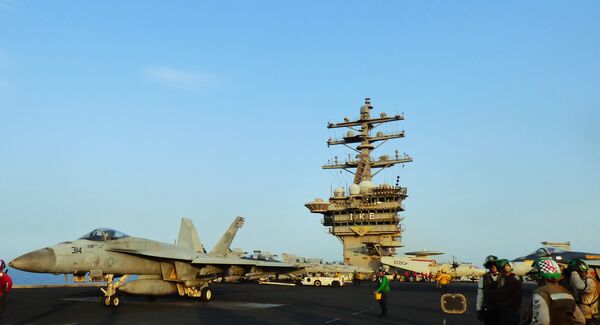

The US Navy may move away from reliance on carrier strike group operations, like those shown here aboard USS Dwight D Eisenhower. (Michael Fabey)
The US Navy (USN) may be less reliant on carrier strike groups (CSGs) for future naval operations, according to Admiral Daryl Caudle, chief of Naval Operations (CNO).
“For decades, our normal force generation model has been centered around strike groups,” Adm Caudle said on 26 October during a question-and-answer period of the Navy Memorial's SITREP Speakers Series session, the USN noted in a statement about the CNO's comments.
“You lived in a have-and-have-not, a poor-man-rich-man problem, a one or a zero,” Adm Caudle said. “Could the navy do more than a one or a zero? And of course it can. This idea of packaging our navy in a way to solve combatant commander key operational problems in a unique way by listening to what they really need, that may not be tied to the strike group.”
In the US Southern Command (SOUTHCOM) area of responsibility (AOR), for example, Adm Caudle noted that an effective, tailored force package for maritime domain awareness might combine uncrewed systems, littoral combat ships (LCSs), afloat forward staging bases, and US Coast Guard (USCG) integration rather than a traditional carrier strike group, the USN noted.
The CNO had introduced and touted his concept of tailored or “hedge” forces in the beginning of 2026.
The USN can no longer automatically count on overwhelming adversary forces and must use newly designed forces and command-and-control (C2) systems to win new naval fights, Adm Caudle noted on 10 February during his keynote address at the WEST 2026 conference in San Diego, California.
Go beyond the headlines - with direct links to interconnected entities
Get full access to validated equipment, military capabilities, and market insights.