UK DIP 2026: RN abandons Type 83 destroyer plan in favour of Hybrid Navy pivot
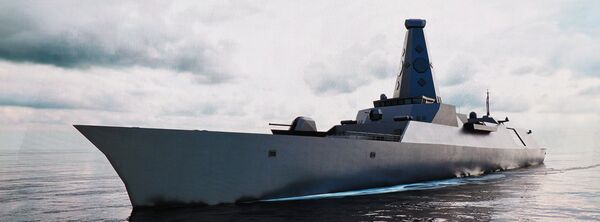

Type 83 was viewed as an air warfare variant of a potential family of minimally crewed escorts, but was cancelled on 29 June 2026. (Royal Navy/Crown Copyright)
The UK Ministry of Defence (MoD) has confirmed plans to axe the Royal Navy's (RN's) projected Type 83 destroyer programme and instead deliver a new maritime integrated air and missile defence (M-IAMD) capability though a ‘system of systems' combining a crewed Common Combat Vessel (CCV) working in conjunction with large unmanned surface vehicle (USVs).
The move, announced on 29 June 2026 in advance of the government's long-awaited Defence Investment Plan (DIP), signals a decisive shift towards a Hybrid Navy model mixing interconnected manned, unmanned, and increasingly autonomous host platforms. The move to abandon Type 83 – previously seen as the core host platform for the Future Air Dominance System (FADS) – reflects a decision to disaggregate ‘decide', ‘sense' and ‘effect' functions that have historically been consolidated on a single complex warship platform.
FADS is intended to deliver M-IAMD and long-range precision strike capabilities into the RN fleet from the mid-2030s. The programme - characterised as an interoperable, multi-domain ‘system of systems' underpinned by themes of sense, decide, effect, connect and enable - entered the concept phase in 2025 following approval of its strategic outline case.
A class of between six and eight Type 83s had been envisaged. Early concept development studies had framed a complex warship of between 145 m and 165 m in length, and displacing between 6,000 tonnes and 10,000 tonnes. However, cost modelling deemed this option unaffordable, with unit cost estimated at above GBP2.5 billion (USD3.3 billion) per ship.
Go beyond the headlines - with direct links to interconnected entities
Get full access to validated equipment, military capabilities, and market insights.