Special Report: Portugal builds new unmanned systems ship
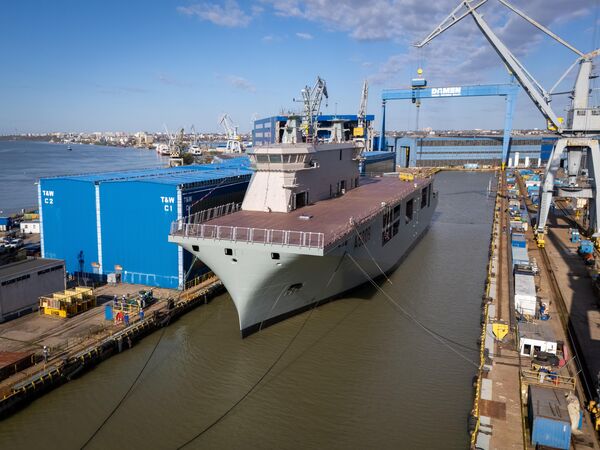

The Portugese Navy's future multi-domain maritime unmanned systems ship D. João II , seen on launch at Damen's yard in Romania on 7 April 2026. (Portugese Navy)
The Portuguese Navy is building maritime unmanned systems (MUS)-focused vessels for manned-unmanned teaming (MUM-T) and testing at events like Robotic Experimentation and Prototyping with Maritime Unmanned Systems (REPMUS), which it holds each September in conjunction with NATO.
First among them, and of any NATO navy at this scale, is its Damen-built, MPSS-7000 (multi-purpose support ship) auxiliary vessel D. João II (A5209). Referred to by the navy as a multifunctional naval platform (Plataforma Naval Multifuncional), the ship is a dedicated MUS operations platform.
Laid down at Damen's Galati shipyard in Romania on 3 October 2024 and floated out on 7 April 2026, the ship is set for harbour acceptance trials in late 2026, sea trials in very early in 2027, and the passing of separate delivery and initial operational capability (IOC) milestones in the second quarter of 2027. Beyond that, the ambition – not yet confirmed, due to the detailed work still ahead – is to pass the full operational capability (FOC) milestone in 2028.
Concept
Often called ‘the drone carrier', D. João II was conceived, designed, and built to carry MUS from all domains. According to a Navy briefing document from April 2026, as well as scientific and humanitarian work, the ship is intended to conduct sovereignty and surveillance missions in Portuguese waters and enable the navy's activities, including operational experimentation (OPEX).
These include protecting critical underwater infrastructure (CUI); and intelligence, surveillance, and reconnaissance (ISR).
D. João II's
Go beyond the headlines - with direct links to interconnected entities
Get full access to validated equipment, military capabilities, and market insights.