Analysis indicates US Navy should shift from teaming manned and unmanned force components
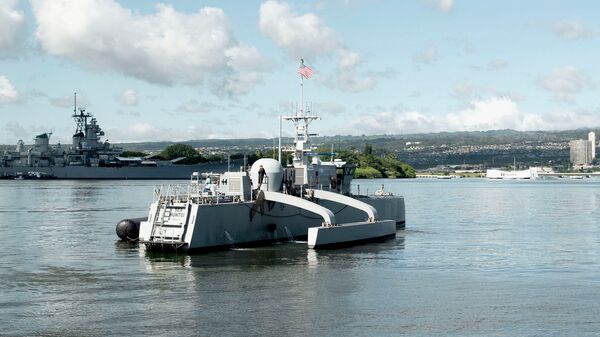

The US Navy is integrating medium unmanned surface vessels like the Sea Hunter shown here into fleet operations. (US Navy)
The US Navy (USN) should focus on developing operational concepts that rely more on only using unmanned or related remote autonomous systems (RAS) instead of teaming those systems with traditional manned forces, according to wargaming results and analysis of USN forces recently completed by the Hudson Institute.
“Manned-unmanned teaming concepts suboptimise both the manned and unmanned components of the team and fail to exploit the advantages of each,” Hudson Institute Senior Fellow Bryan Clark told Janes on 23 July during a briefing about the think tank's recent wargames analysis.
Analysis results and a pending report based on the wargames conducted for the USN are expected to be released in the third quarter, Clark said.
The navy has experimented with RAS for more than a decade, according to Clark.
“However, these initiatives—including Task Force 59 in the Middle East, 4th Fleet in Central and South America, and the integrated battle problems in the Indo-Pacific—mostly focused on how RAS could complement crewed units as remote sensors, decoys, or adjunct magazines,” he said.
A stealthy platform like a F-35 Joint Strike Fighter or attack submarine (SSN) can only remain undetectable when teamed with RAS if the unmanned element can maintain the same stealth signature as its manned counterparts, Clark observed.
“But a stealthy RAS with sufficient range to deploy from far enough away to avoid drawing attention will be expensive and complex, reducing its scale and expendability,” he said.
A medium unmanned surface vehicle (MUSV) could carry additional missiles to support a carrier strike group (CSG) or surface action group (SAG), Clark acknowledged.
Go beyond the headlines - with direct links to interconnected entities
Get full access to validated equipment, military capabilities, and market insights.