US funding Jordanian armoured vehicles for Palestinian forces
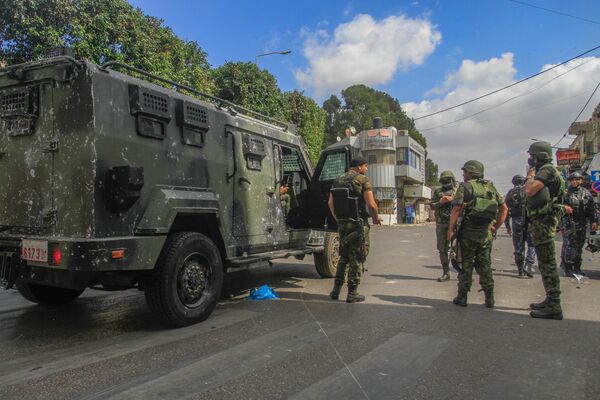

Palestinian National Security Forces personnel stand next to an Al-Jawad during protests in the West Bank city of Nablus on 20 September. (Getty Images)
The US embassy in Israel has ordered armoured vehicles from Jordan Light Vehicle Manufacturing (JLVM) on behalf of the Palestinian Authority (PA) security forces, according to a notice published on the US System of Award Management website on 21 September.
The order is for six Al-Jawad MK IV and nine Al-Maha light armoured vehicles (LAVs) at an estimated total cost of USD2.3 million.
The Al-Jawad uses the Ford F-550 chassis and has a gross vehicle weight (GVW) of 8.6 tonne, while the Al-Maha uses the Toyota Land Cruiser chassis and has a GVW of 5.5 tonne.
The notice, which was posted to justify placing an order without a full and open competition, said similar vehicles were procured for the Palestinian National Security Forces in 2016 from a partnership involving JLVM and the US company Jankel Tactical Services. “That partnership has dissolved and JLVM is able to offer nearly identical LAVs with significant cost reductions,” it said, adding that import/export challenges “plagued” the delivery of the previous vehicles from the US.
Janes has earlier reported that six US-funded Al-Jawads were delivered to the Palestinian National Security Forces in December 2016. A second batch of five Al-Jawads, which was funded by the European Union, was delivered in May 2019.
Go beyond the headlines - with direct links to interconnected entities
Get full access to validated equipment, military capabilities, and market insights.