Land Forces 2026: Shield AI positions Australia as regional autonomy hub
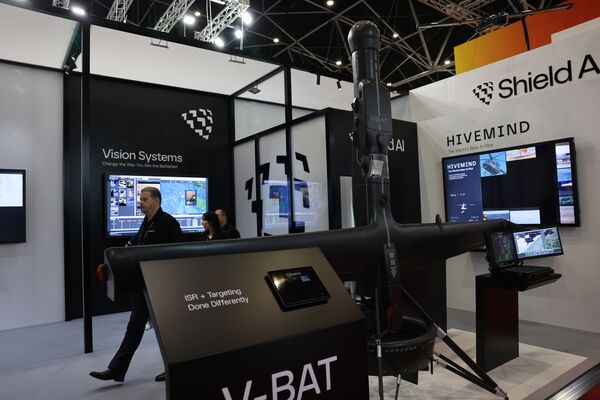

Shield AI exhibited its V-BAT unmanned aerial system at Land Forces 2026. (Gordon Arthur)
Shield AI is expanding its Asia-Pacific activities from Australia, which the company describes as its largest footprint outside the US. Company officials say the focus is driven by opportunities associated with AUKUS Pillar II and related frontier technologies.
Adam Hogan, Shield AI's Vice President Australia, Asia & Middle East, told Janes at Land Forces 2026 in Perth, Western Australia, that the company's focus on Australia is driven principally by the AUKUS Pillar II pathway and its associated “frontier tech”.
He said, “It allows us to apply our key design authorities and chief engineers here, build capability here and then return it back to the central repositories, so that we can learn from the learnings in the US and the learnings in Australia. They're also doing the same in the UK.”
Australian capability
One Australian line of effort stems from Shield AI's acquisition of Sentient Vision Systems in 2024. Its flagship Visual Detection and Ranging (ViDAR) product has been used on platforms such as the ScanEagle unmanned aerial system (UAS).
Hogan said, “We're applying much more horsepower to it now by investment, which is then folding that vision technology back into what we call mission autonomy, which is a perception stack that's then used on various platforms like V-BAT, X-BAT and other programmes.” Shield AI plans to continue developing the ViDAR product.
The company also hopes to use its vision analytics expertise to track drones from both land- and air-based platforms, identify them, and hand targets off to an effector.
Go beyond the headlines - with direct links to interconnected entities
Get full access to validated equipment, military capabilities, and market insights.