Hub change: US reforms its Asian alliance system
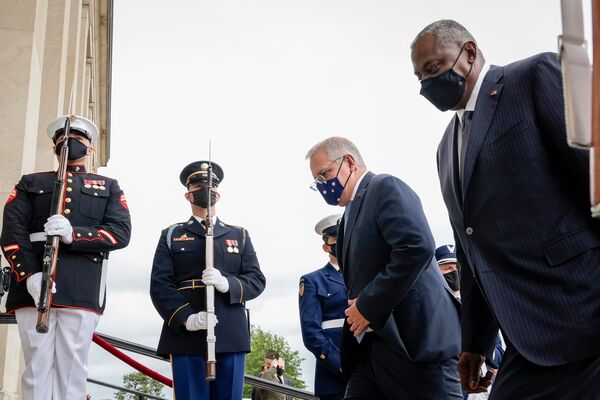

Australian Prime Minister Scott Morrison and US Secretary of Defense Lloyd Austin pass a military honour guard as they walk inside for a meeting at the Pentagon on 22 September 2021. A week earlier, Australia, the US, and the United Kingdom announced their AUKUS security pact to help Australia develop and deploy nuclear-powered submarines. (Drew Angerer/Getty Images)
For 75 years after the end of the Second World War, the US maintained an alliance system in Asia focused on a handful of key bilateral relationships and mutual defence treaties. The plan was to act as a bulwark against Soviet expansionism and enable US operations in a region with diverse strategic goals and historical animosities. In essence, the US acted as a ‘hub' with numerous bilateral ‘spokes' to countries in the region.
That ‘hub-and-spokes' alliance system is now in flux, as the US adapts to the rise of another near-peer competitor in East Asia and regional states see their strategic interests align. The release of the Indo-Pacific Strategy on 11 February gave the clearest indication yet that reforming this alliance system is at the heart of the US' overall strategy in the region. The second of five objectives in the strategy focused on ‘building connections within and beyond the region', while six of the 10 lines of effort identified were about building closer relationships.
Go beyond the headlines - with direct links to interconnected entities
Get full access to validated equipment, military capabilities, and market insights.