Hanwha Systems launches 30-tonne USV
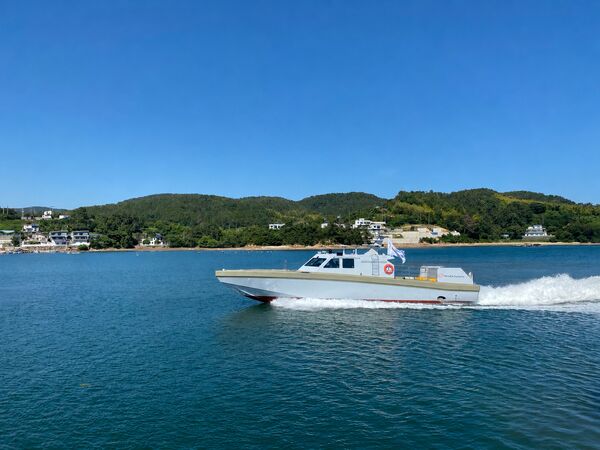

Hanwha Systems' 30-tonne unmanned surface vessel, launched in June 2026, is being used to trial autonomous-navigation and mission-management technologies. (Hanwha Systems)
South Korea's Hanwha Systems announced on 9 July that it has launched a 30-tonne unmanned surface vessel (USV).
The vessel was launched in June 2026 in Busan and has since entered a programme of sea trials between Busan and Jangmok Port on Geoje Island.
The company said the programme forms part of a broader effort to support the Republic of Korea Navy's transition towards a force that incorporates manned-unmanned concepts.
In support of this objective, the company said it is also developing a larger combat-capable 140-tonne USV alongside the 30-tonne vessel, with total investment amounting to around KRW70 billion (USD46 million).
According to Hanwha Systems, the newly launched 30-tonne USV will serve as a testbed for advanced artificial intelligence (AI)-enabled autonomous navigation technologies through the end of 2027.
The vessel will also be used to test mission-management systems and integrated machinery-control technologies required to support future unmanned naval operations.
The company said the USV's software architecture has been designed to conform to the US Navy's Unmanned Maritime Autonomy Architecture (UMAA) standard, describing this as an important precursor to entering international markets.
Hanwha Systems said UMAA is a framework that enables unmanned systems to assess situations and execute missions independently while facilitating swarm operations and interoperability with other weapon systems.
The company added that it has already demonstrated autonomous-navigation capabilities under domestic standards using its Haeryeong reconnaissance USV and is now moving towards validation against the US Navy's UMAA standard.
For more, please see: MADEX 2025: Hanwha debuts Combat Unmanned Surface Vessel
Go beyond the headlines - with direct links to interconnected entities
Get full access to validated equipment, military capabilities, and market insights.