USAF seeks new wide-range IR surveillance capability
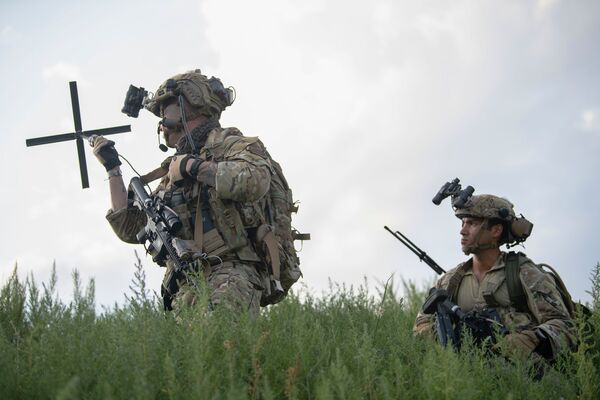

Tactical Air Control Party (TACP) specialists at the 13th Air Support Operations Squadron conduct reconnaissance training, Aug. 03, 2021, at Fort Carson Army Base, CO. (US Air Force)
US Air Force (USAF) leaders are exploring options on the development of a new wide-area infrared (IR) aerial surveillance capability, specifically designed to support expeditionary operations, such as the air service's Tactical Air Control Party (TACP) units, according to a recent USAF solicitation.
The September request for information (RFI) issued by the Air Force Life Cycle Management Center's Intelligence, Surveillance and Reconnaissance & Special Operations Forces Directorate is calling for industry proposals for the Wide Area Infrared Surveillance (WAIS) System. Led by the directorate's Special Warfare Program Office, the WAIS initiative is designed to close a series of operational gaps in the air service's ISR capabilities, according to the RFI.
Under current IR-based ISR capabilities, USAF personnel are “unable to conduct target development with organically sensed intelligence and targeting information from the land and sea domain” or carry out mission analysis or actual targeting missions based on that same based on that same multi-domain data set, programme officials wrote in the solicitation.
Further, airmen utilising current IR-based ISR systems cannot conduct “machine to machine data exchange across joint and coalition networks” or fully integrate USAF-operated ISR networks in each area of responsibility (AOR), the RFI notice said. Along with being unable to fully integrate service networks within an AOR, air service personnel are also “unable to establish resilient redundant and survivable communications pathways with [the] required or appropriate echelon” when fielding current IR ISR capabilities, it added.
Go beyond the headlines - with direct links to interconnected entities
Get full access to validated equipment, military capabilities, and market insights.