REPMUS 2026: Marble demonstrates Arctic-capable “ISR Bubble” system
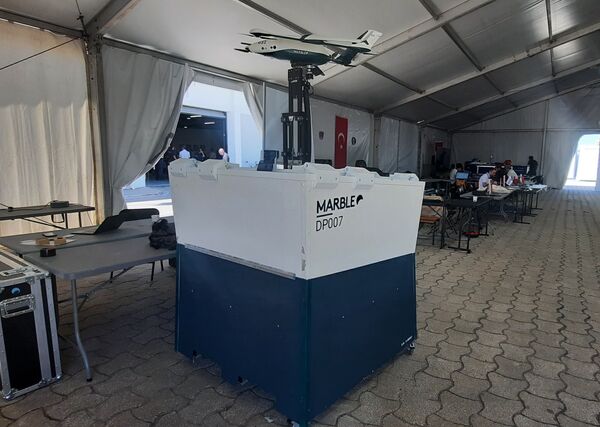

Marble UAV hangar at Exercise REPMUS 26 in Portugal on 22 September 2026. (Janes/Neil Dee)
UK company Marble demonstrated its “ISR Bubble” system at NATO Exercise ‘REPMUS 26' (Robotic Experimentation and Prototyping with Maritime Unmanned Systems) which took place from 31 August to 25 September 2026 in Portugal.
Speaking to Janes at REPMUS on 22 September 2026, Matheu Parr, chief commercial officer at Marble, said that the ISR Bubble includes a hangar and unmanned aerial vehicles (UAVs), and can be operated remotely. The ISR Bubble can be used to monitor critical national infrastructure (CNI), including in the Arctic, he added.
The hangar can hold four UAVs, and can launch, recharge, and recover the aircraft. Each UAV can operate over a 250 km radius around the hangar. Marble has designed the system with Arctic conditions in mind from the outset, Parr said. Marble has also developed a software layer that allows the hangar to be remotely controlled, to remove the need for additional personnel to be present in such harsh environments.
Parr identified three deployment methods for the system. The first is to place the hangars near towns close to chokepoints. The hangar could be connected to the power grid at such locations. Parr provided the example of Cambridge Bay in Nunavut, Canada, a natural chokepoint with a large amount of shipping passing through. The second deployment method is remote operation, where the hangar is placed in a location and deployments are conducted remotely.
The third method is from a ship. Parr said that Marble test-launched a UAV from the Uruguayan Navy's Modernised Lüneburg-class support ship General Artigas during trials from 14 to 15 November 2024. Research is underway at Marble to enable landing of the UAV on ships in higher sea states, Parr added.
Go beyond the headlines - with direct links to interconnected entities
Get full access to validated equipment, military capabilities, and market insights.