Navy League 2025: Barracuda UUV testing remains on track
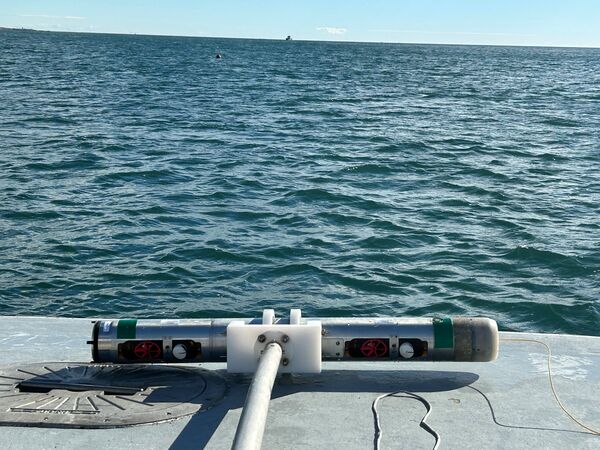

Testing is being done on the Barracuda UUV shown here. (Raytheon)
Raytheon recently conducted tethered autonomous tests on its Barracuda unmanned underwater vehicle (UUV) as the company prepares for US Navy (USN) developmental testing within about a year, Bill Guarini, company director, Naval Systems & Sustainment, confirmed to Janes on 1 April during a briefing in advance of the Navy League Sea-Air-Space 2025 annual conference and exposition, which started on 7 April.
“The tether is just an umbilical cord for data recording and analysis,” Guarini told Janes. “It's not a command signal, just a data-collection signal. The rest of the test is all autonomous.”
The UUV is on course for operational testing and initial operational capability (IOC) in 2027, he said.
A Barracuda is designed to find undersea mine-like shapes, and send data and images back to ships for sailors to analyse. If a shape is determined to be a mine, it is neutralised with a shaped charge from the UUV.
The USN has been pushing for unmanned and autonomous technology that will help remove sailors from more dangerous missions such as clearing mines.
For more information about USN demand for unmanned underwater systems, please see Navy League 2025: Demand signal continues to grow UUVs .
The UUV's sensor suite includes a wideband sonar to help find the mine and an electro-optical camera to capture imagery of the suspected object.
“We're using the contractor testing to capture different mine shapes,” Guarini said, adding that during different test phases the mines will be at different distances and depths.
“Contract testing is a very deliberate process,” he said. “Most of it is serial. So far we've not met any speed bumps.”
Go beyond the headlines - with direct links to interconnected entities
Get full access to validated equipment, military capabilities, and market insights.