China tests new HQ-16-derived air-defence system
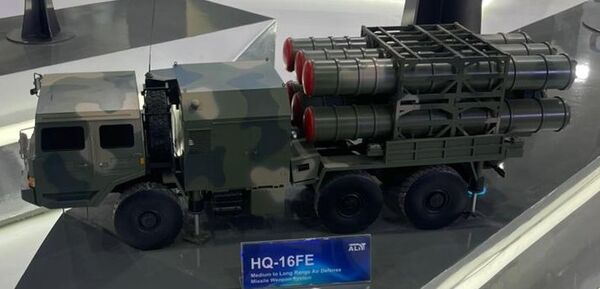

A scale model of the HQ-16FE, the export variant of the HQ-16 surface-to-air missile system, is displayed at Egypt Defence Expo 2025. (Janes/Ganimat Kaur Sidhu)
China's People's Liberation Army (PLA) has conducted the first live-fire drills of a new missile-based air-defence system, state-owned China Central Television (CCTV) reported on 5 June.
Footage published by CCTV shows the system being fired in the Gobi Desert in northwestern China by an unnamed brigade of the PLA's 73rd Group Army under the Eastern Theatre Command, which is headquartered in Nanjing, Jiangsu.
According to CCTV, troops operated in challenging terrain and under electromagnetic interference conditions to test the system's effectiveness and capabilities. CCTV added that the new system demonstrated the ability to intercept multiple target types at a range of 50 km.
CCTV did not disclose the system's designation, specifications, or deployment status.
Janes analysis of the footage suggests the system is an upgraded variant of the in-service Hong Qi (HQ)-16 family of surface-to-air missiles (SAMs).
The system comprises a launcher vehicle with six missile pods mounted on a 6x6 truck, supported by command-and-control and multi-function radar units.
Footage shows the missile being launched from fully vertical cells, suggesting compatibility with naval vertical launch systems (VLSs). This implies a cold- or hot-launch VLS configuration, where missiles are housed in sealed canisters and fired straight up using gas pressure or rocket ignition before manoeuvring toward the target. The design enables 360-degree engagement without needing to reorient the launcher, improves response time, and allows integration with standard naval VLS architectures.
Go beyond the headlines - with direct links to interconnected entities
Get full access to validated equipment, military capabilities, and market insights.